x402 Protocol Introduces Pay-Per-Use Model for AI Agent Compute
Coinbase has rolled out the Upto mechanism for the x402 protocol, replacing fixed fees with usage-based pricing for AI agents consuming computational resources.
Coinbase Brings Flexible Pricing to x402
Coinbase has announced a major upgrade to the x402 protocol, introducing a usage-based payment model that replaces the previous fixed-fee structure for AI agent compute. The new mechanism, called Upto, is already available through the x402 SDK and CDP Facilitator tool.
«Usage-based pricing is now live on x402! The new "Upto" scheme lets agents pay only for what they consume, unlocking variable-cost services like LLM inference, compute, and data queries on x402. Available now on the x402 SDK + CDP Facilitator.» — Coinbase Developer Platform🛡️ (@CoinbaseDev), original post
The Upto mechanism grants autonomous AI systems access to variable-cost services, including large language model (LLM) inference, general compute tasks, and database queries.
Why This Matters
Before this update, x402 only supported fixed payments — a model suitable for deterministic APIs but fundamentally incompatible with services where costs depend on token volume, compute duration, or query complexity. In practice, lightweight and resource-intensive tasks cost users the same amount.
Shifting to a consumption-based model is a crucial step toward full autonomous commerce for AI agents. As these agents become more active participants in on-chain economies, the need for instant, fair micropayments grows critical. Upto directly addresses this by letting agents spend in proportion to actual resource consumption.
How the Upto Scheme Works
Service providers set a maximum rate for task execution. Users (or AI agents) approve spending within that defined limit. The system then charges exclusively for the actual computational resources consumed — if a request turns out to be simple, the final amount is significantly lower than the ceiling.
This approach eliminates overpayment and allows users to allocate a precise budget to an AI agent without guessing potential costs. Upto operates across EVM-compatible networks and supports all ERC-20 tokens. The CDP Facilitator tool handles transactions without gas fees.
Governance and Major Participants
The x402 protocol was originally built by Coinbase, but governance transitioned to the nonprofit Linux Foundation in early April. Through the x402 Foundation, technology giants including Google, Microsoft, and Amazon Web Services are contributing to the project's development.
On-Chain Activity Shows Declining Trend
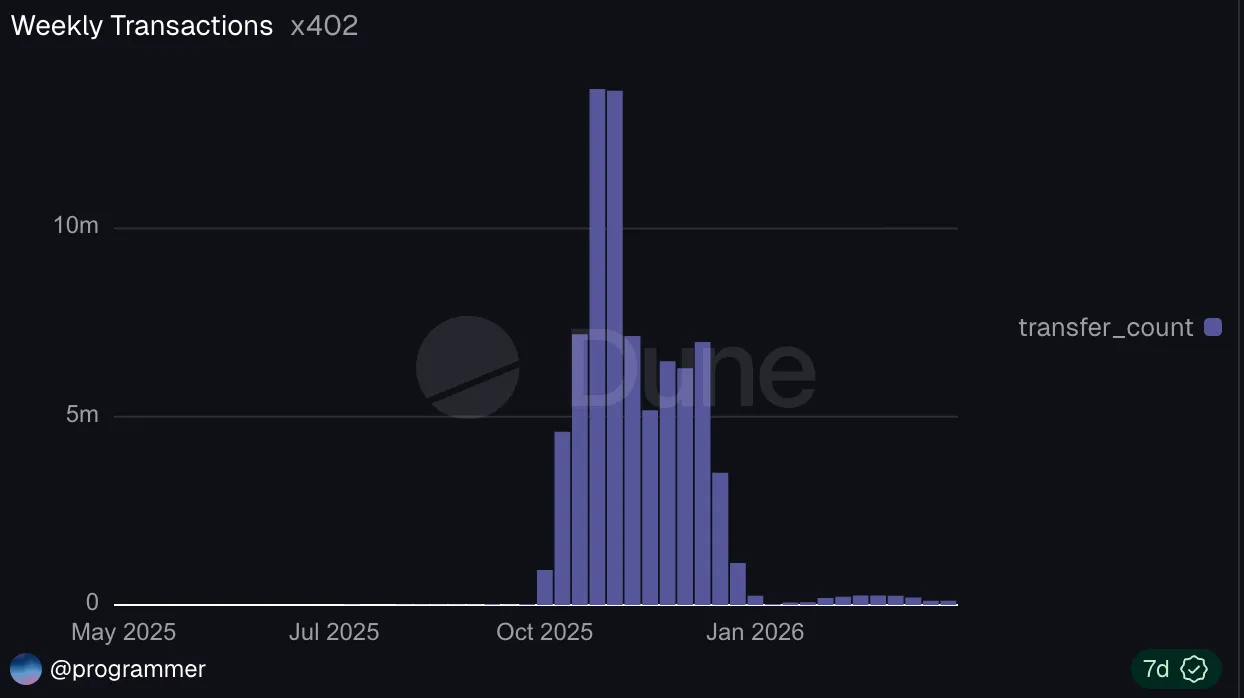
Despite strong institutional interest, Dune Analytics data reveals a notable decline in on-chain activity throughout 2026. Peak usage occurred during the week of November 4–10 last year, when weekly volume hit a record 13.7 million transactions.
From there, numbers dropped sharply. By early January 2026, weekly transactions had fallen below 1 million and continued declining through the first quarter. During the last week of March, just 112,708 transfers were processed via x402.
The second version of the x402 protocol launched in December last year. The Upto update aims to reinvigorate the platform by offering a more attractive and equitable economic model for the expanding AI agent ecosystem.
Frequently Asked Questions
What is the x402 Upto payment mechanism?
Upto is a new usage-based pricing scheme for the x402 protocol that lets AI agents pay only for the compute resources they actually consume. Providers set a maximum price, and the system charges based on actual computational costs rather than a flat fee.
Which blockchains does x402 Upto support?
Upto operates across all EVM-compatible networks and supports any ERC-20 token. The CDP Facilitator tool enables gasless transactions for seamless micropayments.
Who governs the x402 protocol now?
Originally created by Coinbase, the x402 protocol transitioned to the nonprofit Linux Foundation in early April 2026. Google, Microsoft, and Amazon Web Services are also contributing to its development through the x402 Foundation.
How much on-chain activity does x402 currently have?
According to Dune Analytics, x402 transaction volume has dropped significantly from a peak of 13.7 million weekly transactions in November 2025 to just 112,708 transfers in the last week of March 2026.
Why do AI agents need usage-based pricing?
Fixed fees don't work well for services where costs vary based on query complexity, token count, or compute time. Usage-based pricing eliminates overpayment and allows precise budget allocation for autonomous AI agents.
Read also
How ERC-8004 and x402 Standards Are Turning AI Agents Into Market Participants
Blockchain standards ERC-8004 and x402 are building the infrastructure for autonomous machine payments, challenging Big Tech's closed ecosystems and the attention economy model.
AI Agent Transaction Volume Is 15x Lower Than Bloomberg's Estimates, Says a16z Partner
a16z partner Noah Levine challenged Bloomberg's AI agent payment data, showing actual on-chain volume at $1.6–3M versus the reported $24M.
Bernstein: AI Agents Could Become the Key Growth Driver for Stablecoins
Bernstein analysts argue that AI-powered payments could significantly boost stablecoin adoption, even though current machine-to-machine transaction volumes remain modest.
Coinbase Warns of Potential Bitcoin Cascade Crash Risk
Coinbase Institutional researchers identified critical Bitcoin price levels and cascade crash risks if support at $60,000 breaks. Gamma exposure analysis reveals different market scenarios.
Google Enhances Opal AI Platform with New Autonomous Agents
Google has upgraded its visual AI workflow builder Opal with agent functionality that automatically analyzes tasks and selects appropriate tools for completion.
Bitcoin Buyers Return to Binance and Coinbase After Two-Month Selling Streak
CryptoQuant data shows trading volume delta flipping positive on major exchanges for the first time since mid-February. BTC tests $75,000 amid multiple bullish on-chain signals.