
AI Agent Transaction Volume Is 15x Lower Than Bloomberg's Estimates, Says a16z Partner
a16z partner Noah Levine challenged Bloomberg's AI agent payment data, showing actual on-chain volume at $1.6–3M versus the reported $24M.
Noah Levine, a partner at venture capital firm a16z, has disputed Bloomberg's reporting on AI agent payment volumes, presenting evidence that the real figures are dramatically lower than published estimates.
«Original post» — Noah Levine (@nlevine19), March 11, 2026
The Numbers Don't Add Up: $24M vs. $1.6M
Bloomberg reported that automated AI systems processed $24 million in transactions between February 5 and March 7, 2026, citing data from the x402.org platform.
Levine countered with alternative figures from Allium Labs, which tracked approximately $3 million in on-chain volume over the same period — roughly eight times less than Bloomberg's number.
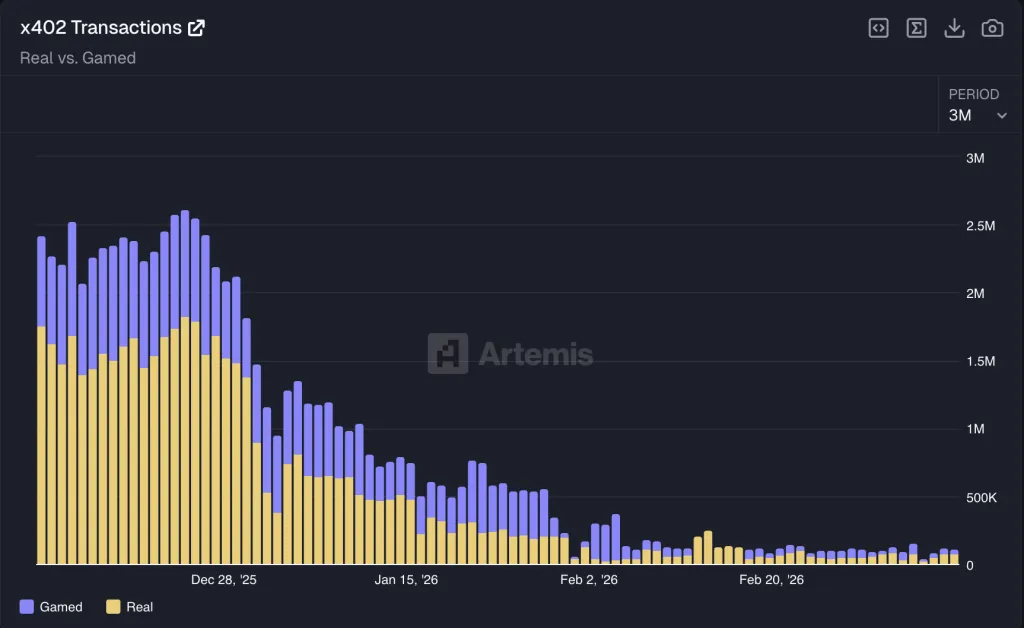
Source: X/Artemis
Even that reduced figure may be inflated. An analyst at Artemis, operating under the pseudonym OnchainLu, developed a filter to identify wash trading — instances where wallets transact with themselves or shuffle funds between linked addresses. After applying this filter, the total dropped to just $1.6 million, a full 15x below Bloomberg's estimate. Original Artemis post.
Levine noted that the gap starkly illustrates how early-stage even the measurement infrastructure itself remains.
Why This Matters
Inflated metrics can distort perception of an entire industry. When a major financial outlet publishes figures that overstate reality by a factor of 15, investors and companies risk making decisions based on false assumptions. Correcting the data to actual values is essential for accurately gauging the pace of development in the AI payments sector and avoiding a hype-driven bubble.
That said, modest current volumes don't necessarily signal a lack of potential — rather, they point to a nascent market still finding its footing.
Big Tech Is Betting on Future Scale
Despite the underwhelming real figures, Levine views the infrastructure being built around AI agent payments as highly promising. He highlighted that Coinbase developed the x402 standard, while Stripe, Cloudflare, and Vercel have all shipped their own integrations. Google has also launched its own payment protocol for agents.
According to Levine, none of these major players are building for the current $1.6 million per month. Their bet is on what that number will look like when AI agents become default buyers across the economy.
What Are AI Agents Actually Buying?
Levine detailed the primary spending categories for automated systems. Current activity centers on developer tooling:
- Firecrawl — web scraping at $0.01 per operation;
- Browserbase — browser sessions;
- Freepik — image generation.
All of these services accept regular payment cards, but through the x402 standard, a user or agent can pay for individual requests directly from a crypto wallet — no subscription or registration required.
The pay-per-request model is gradually expanding beyond developer tools. Levine cited StableEnrich as an example — a product that aggregates data from Google Maps and other sources via a unified x402 interface. Sales teams are already using it to gather intelligence on potential clients.
Context: AI Agent Infrastructure Keeps Expanding
In February 2026, Coinbase launched Agentic Wallets, a tool enabling AI assistants to autonomously hold funds, process payments, trade tokens, and interact with DeFi protocols.
That same month, the founder of Binance predicted the dawn of the AI agent era, suggesting that every individual could eventually have hundreds, thousands, or even millions of digital assistants making payments in cryptocurrency.
The current data makes one thing clear: the market is at its earliest stage, and reliable methods for measuring its true scale are still being developed.
Frequently Asked Questions
How much do AI agents actually transact on-chain?
According to Allium Labs data, AI agents processed roughly $3 million in on-chain transactions between February 5 and March 7, 2026. After filtering out wash trades, Artemis analyst OnchainLu estimated the true figure at just $1.6 million.
Why was Bloomberg's AI agent payment data inaccurate?
Bloomberg reported $24 million in AI agent transactions based on x402.org statistics. a16z partner Noah Levine presented alternative calculations showing the figure was overstated by 8-15x, partly due to wash trading and immature measurement methodologies.
What is the x402 payment standard?
x402 is a payment standard developed by Coinbase that enables pay-per-request transactions directly from a crypto wallet. It eliminates the need for subscriptions or account registration. Stripe, Cloudflare, and Vercel have already built integrations with it.
What are AI agents spending money on?
Most AI agent spending currently goes toward developer tools: web scraping via Firecrawl at $0.01 per operation, browser sessions through Browserbase, and image generation from Freepik. The model is expanding into sales intelligence with products like StableEnrich.
Which companies are building AI agent payment infrastructure?
Coinbase developed the x402 standard and launched Agentic Wallets. Stripe, Cloudflare, and Vercel have shipped their own integrations. Google has also launched a dedicated payment protocol for AI agents.
Read also
How ERC-8004 and x402 Standards Are Turning AI Agents Into Market Participants
Blockchain standards ERC-8004 and x402 are building the infrastructure for autonomous machine payments, challenging Big Tech's closed ecosystems and the attention economy model.
Bernstein: AI Agents Could Become the Key Growth Driver for Stablecoins
Bernstein analysts argue that AI-powered payments could significantly boost stablecoin adoption, even though current machine-to-machine transaction volumes remain modest.
Bloomberg and Kaiko Partner to Bring Financial Data On-Chain via Canton Network
Bloomberg and Kaiko have partnered to bring institutional-grade financial data on-chain through Canton Network, starting with tokenized US Treasuries and repo operations.
Coinbase Warns of Potential Bitcoin Cascade Crash Risk
Coinbase Institutional researchers identified critical Bitcoin price levels and cascade crash risks if support at $60,000 breaks. Gamma exposure analysis reveals different market scenarios.
Google Enhances Opal AI Platform with New Autonomous Agents
Google has upgraded its visual AI workflow builder Opal with agent functionality that automatically analyzes tasks and selects appropriate tools for completion.
Bloomberg Strategist Warns Bitcoin Could Crash to $10,000 If $75,000 Level Breaks
Bloomberg Intelligence senior strategist Mike McGlone warned that Bitcoin faces a potential crash to $10,000 if buyers fail to hold the $75,000 level. BTC currently trades near $68,900.