
Bernstein: AI Agents Could Become the Key Growth Driver for Stablecoins
Bernstein analysts argue that AI-powered payments could significantly boost stablecoin adoption, even though current machine-to-machine transaction volumes remain modest.
Investment firm Bernstein has identified autonomous AI agents as a potentially transformative force for the stablecoin market. While machine-to-machine payment volumes remain limited for now, the long-term outlook appears compelling, according to a report covered by The Block.
Why Stablecoins Are a Natural Fit for AI Payments
Bernstein analysts believe that fiat-pegged digital assets could serve as the foundation for a new category of transactions — operations entirely initiated, authorized, and executed by software agents or autonomous systems without human involvement.
Stablecoins possess several characteristics that make them ideally suited for these use cases:
- Programmability — payment logic such as escrow arrangements, revenue sharing, or staged fund releases can be embedded directly into the token;
- Micropayment capability — high-throughput blockchains and state channels make massive volumes of small transactions economically viable;
- Global accessibility — AI assistants can pay for compute resources or data in real time, bypassing banks and approval workflows entirely.
Major Players Building Machine Payment Infrastructure
Several prominent companies are already laying the groundwork for agent-to-agent payments. Coinbase is developing the x402 protocol, which integrates payment functionality into the HTTP layer of the internet. Circle has launched a nanopayment system designed for AI agent interactions. Stripe, through its investments in Bridge and Privy, has introduced a machine payment protocol built on the Tempo blockchain.
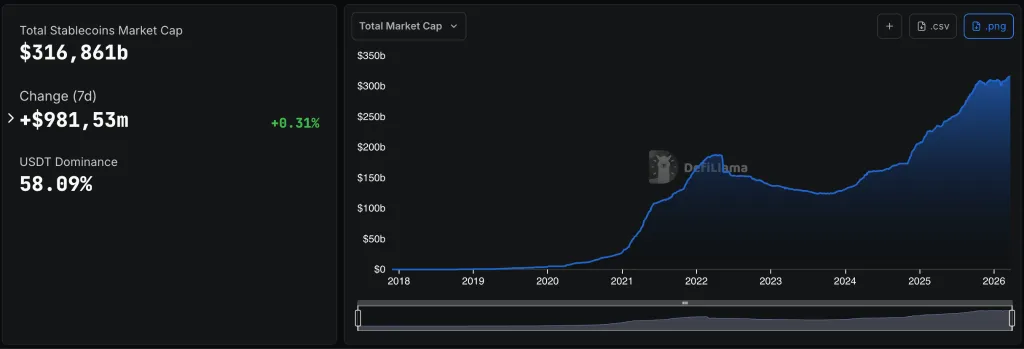
Stablecoin market capitalization over time. Source: DefiLlama
Current Volumes Remain Modest
Adoption of machine payment protocols is progressing slowly. Stripe's MPP protocol processed just $5,000 in its first week after launch. Coinbase's x402 has performed better, handling approximately $25 million over the past 30 days, but the scale still falls far short of mainstream adoption.
Why This Matters
Bernstein analysts are careful to note that their investment thesis on stablecoins does not hinge solely on AI payments. The sector already exhibits strong demand from consumer and enterprise applications. Growth areas include cross-border business settlements, remittances, and stablecoin-based neobanking with card integrations.
According to the analysts, Circle and Coinbase products remain the most direct vehicles for gaining exposure to the sector's growth. AI-driven payments represent upside optionality, but the core thesis rests on USDC's expanding adoption and deepening liquidity.
Notably, in 2026, Circle's USDC surpassed Tether's USDT in adjusted volume for the first time in seven years — a signal that competitive dynamics within the stablecoin sector are shifting meaningfully.
Frequently Asked Questions
Why could AI agents drive stablecoin adoption?
AI agents execute transactions autonomously without human intervention. Stablecoins are well-suited for this because they are programmable, support micropayments, and are globally accessible — agents don't need banks or manual approvals.
Which companies are building machine payment infrastructure?
Coinbase is developing the x402 protocol that integrates payments into the HTTP layer. Circle has launched nanopayments for AI agents. Stripe, through investments in Bridge and Privy, introduced a machine payment protocol on the Tempo blockchain.
What volumes have machine payment protocols processed so far?
Stripe's MPP protocol handled just $5,000 in its first week. Coinbase's x402 processed approximately $25 million over 30 days. Both figures indicate that adoption is still in its early stages.
How does Bernstein's stablecoin investment thesis relate to AI?
Bernstein emphasizes that their stablecoin thesis does not depend on AI payments alone. The core case rests on USDC's growing adoption and liquidity across consumer and enterprise use cases. AI payments represent additional upside potential.
Has USDC overtaken USDT in trading volume?
In 2026, Circle's USDC surpassed Tether's USDT in adjusted volume for the first time in seven years. This milestone signals a significant shift in competitive dynamics within the stablecoin market.
Read also
How ERC-8004 and x402 Standards Are Turning AI Agents Into Market Participants
Blockchain standards ERC-8004 and x402 are building the infrastructure for autonomous machine payments, challenging Big Tech's closed ecosystems and the attention economy model.
Stablecoin Transfer Volume Hits $10.5 Trillion in January — Highest Since April 2022
January stablecoin transaction volume surpassed $10.5 trillion, marking the highest monthly figure since April 2022. USDC led transfers while USDT maintained market cap dominance.
Bernstein Calls $60,000 a 'Clear Bottom' for Bitcoin, Expects Extended Bull Cycle
Analysts at Bernstein have identified $60,000 as a firm floor for Bitcoin, projecting a structurally longer bull cycle. On-chain data from Glassnode confirms a resurgence of buying activity.
AI Agent Transaction Volume Is 15x Lower Than Bloomberg's Estimates, Says a16z Partner
a16z partner Noah Levine challenged Bloomberg's AI agent payment data, showing actual on-chain volume at $1.6–3M versus the reported $24M.
Top 10 Dollar Stablecoins in 2026: From Dominant Players to Exit Candidates
The stablecoin market has surpassed $311 billion in total capitalization. Here's a breakdown of the ten largest USD-pegged stablecoins — from undisputed leaders Tether and Circle to ambitious newcomers.
TRON Energy Rental: How to Cut USDT Transfer Fees by Up to 60%
USDT issuance on TRON surpassed $85 billion in February 2026, but transfer fees remain steep at $1.83–$3.83 per transaction. Energy rental services like TronZap offer a way to cut costs by 50–60%.