
Top 10 Dollar Stablecoins in 2026: From Dominant Players to Exit Candidates
The stablecoin market has surpassed $311 billion in total capitalization. Here's a breakdown of the ten largest USD-pegged stablecoins — from undisputed leaders Tether and Circle to ambitious newcomers.
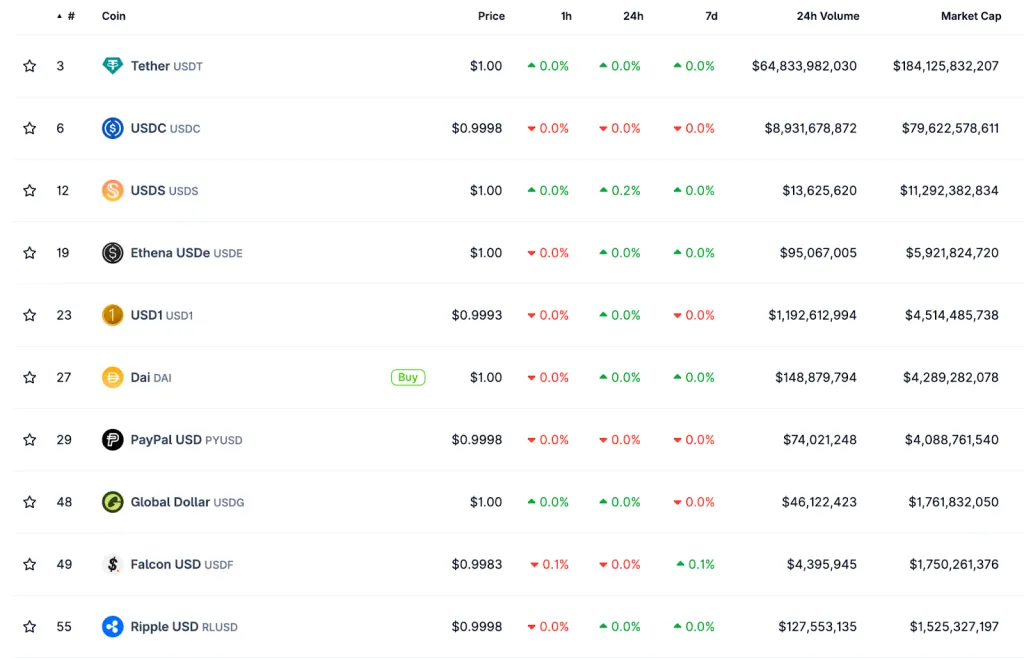
By March 2026, the combined market capitalization of stablecoins has exceeded $311 billion. The landscape has grown increasingly complex as institutional investors, tech giants, and politically connected figures compete for market share. Below is a detailed breakdown of the ten largest dollar-pegged stablecoins based on CoinGecko data as of March 18, 2026.
Market Leaders: Tether and Circle
1. Tether (USDT) — ~$184.1B
Launched in 2014, USDT remains the undisputed king of stablecoins. A pivotal moment came with the conclusion of Tether's protracted legal battle with the New York Attorney General's office in 2021. The company faced accusations of opaque accounting practices and concealing financial information related to its affiliated exchange Bitfinex. The settlement required Tether to regularly publish independent audit reports.
This forced a fundamental restructuring of reserves: Tether eliminated commercial paper holdings and shifted heavily into short-term U.S. Treasury bonds. The company also diversified into gold — as of February 2026, Tether held approximately 148 metric tons of the precious metal, making it one of the world's largest non-sovereign gold holders. Additional investments in mining royalty companies further bolster the reserves backing both USDT and Tether Gold (XAUT).
2. USDC — ~$79.6B
The stablecoin issued by Circle and Coinbase since 2018 targets institutional investors who prioritize full regulatory compliance. In March 2023, USDC briefly lost its dollar peg following the collapse of Silicon Valley Bank, where Circle held a portion of its reserves. The company quickly raised capital and restored the 1:1 ratio within days.
In 2025, the total value transferred via USDC surpassed that of USDT. By March 2026, Circle's product also overtook its main rival in adjusted transaction volume. BlackRock manages a significant portion of USDC's reserves, which consist of government bonds and bank deposits.
The New Wave: Sky, Ethena, and World Liberty Financial
3. USDS — ~$11.3B
USDS emerged from MakerDAO's transformation into Sky Protocol as part of the Endgame strategy. The upgrade enabled conversion of the MKR governance token into 24,000 SKY and migration of the original DAI stablecoin into USDS. The project has successfully attracted liquidity from aging pools and is actively integrating into lending protocols. Its core proposition balances decentralized governance with traditional financial yield through a mix of RWA instruments and DeFi lending.
4. Ethena USDe — ~$5.9B
Launched in 2024 by Ethena Labs, USDe operates as a "synthetic dollar" using a delta-neutral trading strategy. Users lock BTC, ETH, stETH, or USDT in a smart contract and receive sUSDe tokens that generate yield from staking rewards and funding rate collection on futures exchanges. However, the model hit turbulence in November 2025 when falling yields caused USDe's market cap to plunge 50% in a single month. By March 2026, capital deployed in Ethena's market-neutral strategies dropped from $2 billion to $800 million. USDe functions primarily as an investment instrument for institutional and experienced DeFi participants.
5. USD1 — ~$4.5B
World Liberty Financial, a DeFi platform directly linked to the family of U.S. President Donald Trump, issues USD1 on Ethereum and BNB Chain. The stablecoin is backed by short-term U.S. Treasuries, deposits, and cash equivalents, with BitGo serving as custodian. In January 2025, an investment fund linked to UAE's Sheikh Tahnoun bin Zayed Al Nahyan acquired 49% of World Liberty Financial in a previously undisclosed deal, amplifying concerns about potential conflicts of interest.
Veterans and B2B Challengers
6. Dai (DAI) — ~$4.2B
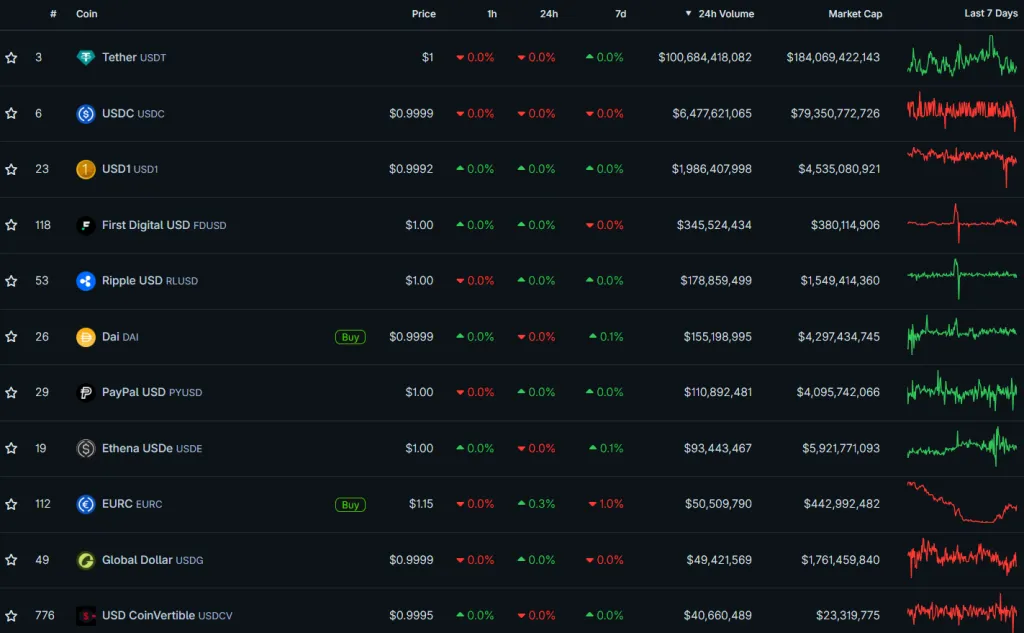
Since its 2017 launch, DAI has embodied the decentralization ethos — minted exclusively through overcollateralized smart contracts. The protocol survived its biggest stress test during the March 2020 market crash when Ethereum lost nearly half its value in 24 hours. A cascade of liquidations and network congestion caused a brief depeg, but MakerDAO successfully recapitalized through MKR token auctions. Daily trading volume exceeded $155 million at the time of writing. DAI remains the choice for users who consider the absence of asset-freezing capabilities more valuable than the yield or marketing advantages of newer projects.
7. PayPal USD (PYUSD) — ~$4.1B
Launched in 2023 in partnership with Paxos, PayPal's stablecoin is the only top-10 entry that leverages an existing Web2 user base. Within two months of launch, PYUSD was integrated into Venmo. In April 2024, PayPal introduced cross-border payments via Xoom supporting over 100 crypto assets. By late 2025, YouTube enabled U.S.-based content creators to receive payouts in PYUSD.
8–9. Global Dollar (USDG) — ~$1.8B & Falcon USD (USDf) — ~$1.7B
USDG, issued by a consortium of Paxos, Robinhood, and Kraken under the Monetary Authority of Singapore's regulatory framework, employs a B2B revenue-sharing model. Network participants earn income proportional to their contribution to the token's growth. Zero-fee stablecoin transactions in apps like Robinhood create a compelling incentive to switch away from Tether and Circle.
Falcon USD (USDf) from Falcon Finance competes with USDe through a dual-minting mechanism: Classic Mint (collateralized 1:1 with USDT or USDC) and Innovative Mint (using volatile assets like BTC or ETH with 30–40% overcollateralization). Yield is generated by staking USDf into the sUSDf derivative, which accrues returns from delta-neutral strategies and arbitrage.
10. Ripple USD (RLUSD) — ~$1.5B
Ripple Labs' stablecoin is fully backed by dollar assets and U.S. Treasury bonds. Market makers B2C2 and Keyrock provide liquidity. In January 2025, Ripple partnered with Chainlink's decentralized oracle network to accelerate RLUSD's DeFi integration. Daily trading volume stood at approximately $178 million at the time of writing.
Why This Matters
The stablecoin market is no longer a Tether-Circle duopoly. Payment giants (PayPal), fintech platforms (Robinhood, Kraken), politically affiliated entities (World Liberty Financial), and DeFi innovators (Ethena, Falcon Finance) have all entered the arena. For users, this translates to greater choice and reduced dependency on any single issuer. For regulators, it presents a growing challenge: overseeing a $311 billion-plus market whose participants operate across multiple jurisdictions with fundamentally different collateral models.
Frequently Asked Questions
What is the largest stablecoin by market cap in 2026?
As of March 18, 2026, Tether (USDT) remains the largest dollar stablecoin with approximately $184.1 billion in market capitalization. USDC holds the second position at ~$79.6 billion.
How does USDC compare to USDT in transaction volume?
In 2025, the total value transferred via USDC surpassed that of USDT. By March 2026, Circle's stablecoin also overtook Tether in adjusted transaction volume. BlackRock manages a significant portion of USDC's reserves.
What is Ethena USDe and how does it generate yield?
USDe is a synthetic dollar stablecoin that uses a delta-neutral trading strategy. Users lock crypto assets in a smart contract and receive sUSDe tokens that generate yield from staking rewards and funding rates on futures exchanges. It functions primarily as an investment instrument rather than a payment tool.
Who is behind the USD1 stablecoin?
USD1 is issued by World Liberty Financial, a DeFi platform directly linked to the family of U.S. President Donald Trump. In January 2025, an investment fund tied to UAE's Sheikh Tahnoun bin Zayed Al Nahyan acquired 49% of the company.
What is the total stablecoin market size in 2026?
The total stablecoin market capitalization exceeded $311 billion by 2026. The sector has grown significantly more complex with the entry of institutional investors, payment giants like PayPal, and politically affiliated entities.
Read also
Stablecoin Transfer Volume Hits $10.5 Trillion in January — Highest Since April 2022
January stablecoin transaction volume surpassed $10.5 trillion, marking the highest monthly figure since April 2022. USDC led transfers while USDT maintained market cap dominance.
TRON Energy Rental: How to Cut USDT Transfer Fees by Up to 60%
USDT issuance on TRON surpassed $85 billion in February 2026, but transfer fees remain steep at $1.83–$3.83 per transaction. Energy rental services like TronZap offer a way to cut costs by 50–60%.
TON Wallet Introduces Yield Vaults for BTC, ETH, and USDT Directly in Telegram
TON Wallet has launched yield vaults for BTC, ETH, and USDT directly within Telegram, offering up to 18% APY on stablecoins through partnerships with Morpho, TAC, and Re7.
Weekly Recap: Bitcoin Tests $74K, Miners Dump Holdings, ChatGPT Boycott Grows
Bitcoin briefly touched $74,000 before retreating to $67,500. Public miners sold over 15,000 BTC in five months, traders flocked to Hyperliquid for oil and gold futures, and a ChatGPT boycott gained major traction.
Bitcoin Down 2.5% Weekly: Jane Street Accusations & 7 Ethereum Forks
Bitcoin lost ~2.5% over the week amid macro shocks and geopolitical tensions. Jane Street faced market manipulation allegations while Ethereum unveiled an ambitious seven hard fork roadmap through 2029.
Weekly Recap: Aave Ecosystem Rescue Mobilizes 100,000 ETH and Quantum Computer Cracks 15-Bit ECC Key
Bitcoin held near $78,000, the DeFi community rallied over 100,000 ETH to help Aave recover from the Kelp hack, and a researcher cracked a 15-bit ECC key on a quantum computer.