
How ERC-8004 and x402 Standards Are Turning AI Agents Into Market Participants
Blockchain standards ERC-8004 and x402 are building the infrastructure for autonomous machine payments, challenging Big Tech's closed ecosystems and the attention economy model.
Today's neural networks can analyze financial reports and generate complex code in seconds, yet even OpenAI's most advanced models cannot independently execute a simple payment. Two emerging blockchain standards — ERC-8004 and x402 — aim to dismantle this barrier by giving algorithms their own identity and payment infrastructure.
Why This Matters
As long as an AI assistant remains a mere "advisor" that recommends products while a human completes the purchase, the full potential of automation stays unrealized. The shift to machine-to-machine (M2M) payments — without biometrics or manual confirmations — paves the way for a fully autonomous agent economy. This represents a paradigm shift from the "internet of information" to the "internet of actions," where algorithms independently manage capital, identify counterparties, and close deals in milliseconds.
ERC-8004: A Digital Passport for Algorithms
According to Tiger Research, the ERC-8004 standard introduces a "passport" in NFT format. Rather than a collectible token, it functions as a dynamic container for structured data built around three core components:
- Identity — a unique address and technical profile tied to a specific owner or developer;
- Reputation — a cumulative reliability score. Each successful transaction and absence of failures raises the score recorded in the NFT's metadata;
- Validation — a ruleset defining spending limits, permitted product categories, and conditions for autonomous purchases.

Key components of the ERC-8004 standard. Source: Tiger Research, ForkLog
On-chain reputation is critical: while a human can simply switch banks, an algorithm that loses its rating in an open protocol faces instant loss of access to reliable counterparties.
x402: Payment Infrastructure for Bots
The x402 standard, championed by Coinbase, revives HTTP status code 402 (Payment Required), originally proposed in 1997. The mechanism is straightforward: when an agent requests data via API, the server responds with code 402 alongside payment details. The bot completes the transaction and attaches the payment hash to a follow-up request. No subscriptions, accounts, or registration needed.
Tiger Research illustrated the process through an AI assistant named Ekko tasked with purchasing a laptop for $800. The workflow proceeds in three stages: mutual verification through ERC-8004 (the buyer confirms its spending limit and 72-point reputation score; the seller verifies product availability and a 70-point rating), funds are locked in an escrow smart contract via x402, and upon delivery confirmation the payment releases automatically with both parties' ratings updated. Ekko earns 8 additional reputation points, securing future discounts as a trusted client.
Big Tech vs. Crypto: Competing Architectures
A fundamental divide has emerged in the agent payments space. Tech giants are building closed ecosystems while the crypto industry pushes a permissionless approach.
Google AP2
In September 2025, Google unveiled Agent Payment Protocol 2.0, operating on a three-tier model: intent → cart → payment mandate via Google Pay. The protocol supports only verified merchants, delivering security at the cost of limiting an agent's market freedom.
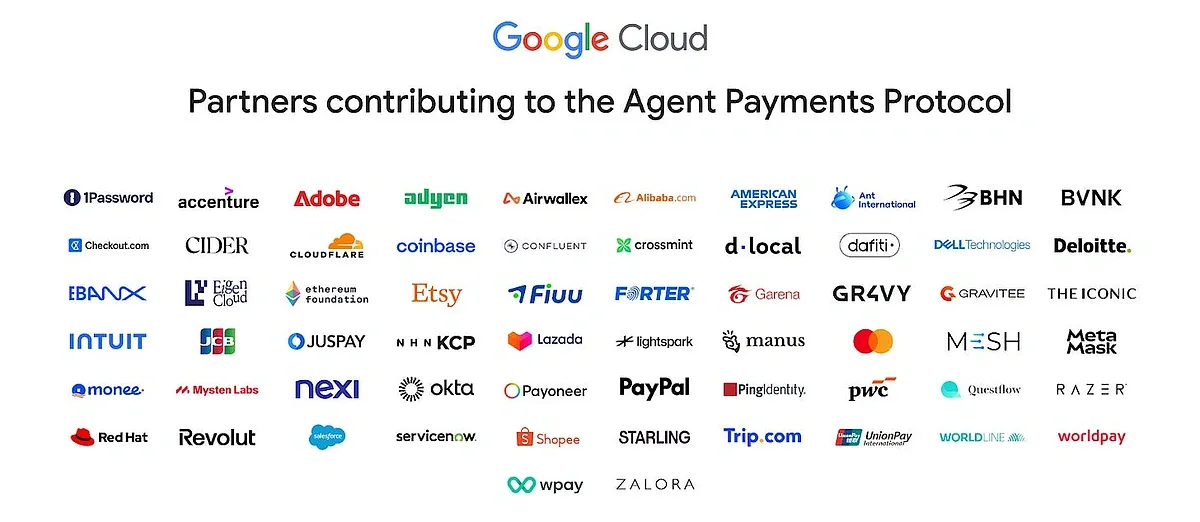
Google AP2 partner participants. Source: Google Cloud
Stripe and the Tempo Blockchain
Stripe, together with Paradigm, launched the mainnet of the Tempo L1 blockchain and introduced MPP — a product already being tested by Anthropic, OpenAI, Mastercard, and Visa. Agents can reserve, say, $100 and spend it on micropayments as they consume compute or databases. Thousands of micro-transactions are batched into a single final on-chain settlement — essential for high-frequency services like DoorDash or Shopify.
Valued at $107 billion, Stripe processes $1.4 trillion in annual transactions across 195 countries. Its net revenue grew 28% year-over-year to $5.1 billion. JPMorgan analysts believe the company could lead a "twin revolution in AI and money movement," with the addressable market potentially exceeding $350 billion by decade's end.
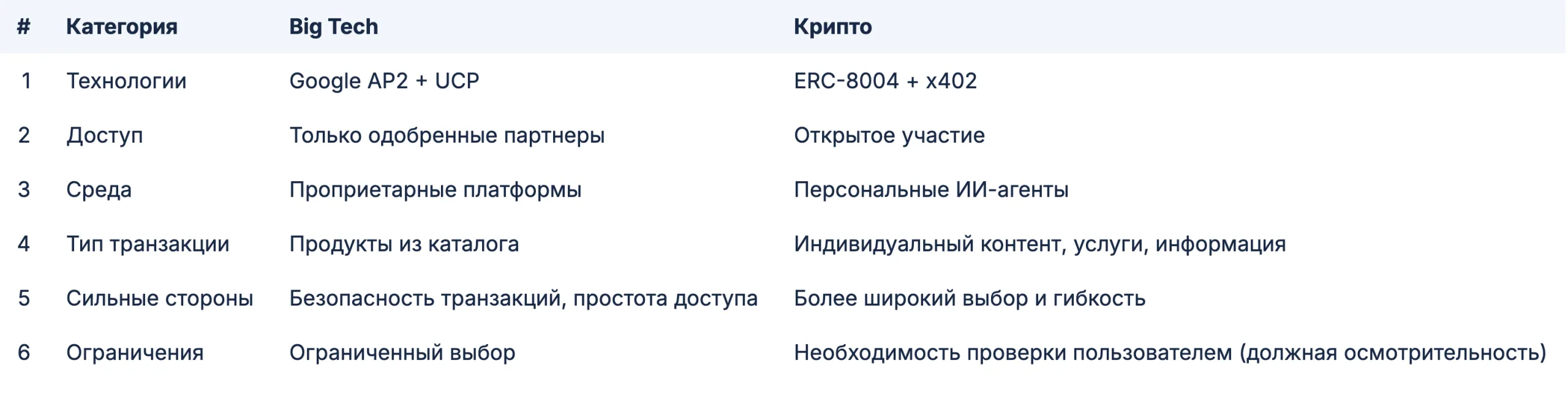
Comparison of Big Tech and crypto approaches to agent payments. Source: Tiger Research, ForkLog
CoinGecko: Pay-Per-Query Instead of Subscriptions
Aggregator CoinGecko is already applying x402 in production. The platform has opened endpoints where autonomous bots retrieve data at $0.01 per request, paying directly in USDC stablecoins. No API keys, account registration, or card linking required — a pure pay-per-use model.
Stablecoins as the Foundation of the Agent Economy
Volatile assets like BTC or ETH are ill-suited for machine transactions — agents need budget predictability. Bernstein analysts describe stablecoins as the ideal medium for programmable logic, enabling protocol-level automatic revenue splitting, staged payouts, and escrow conditions.
"The next wave of blockchains is built to settle payments instead of tokens. General purpose chains weren't designed for institutional payment flows. A new wave of chains built for stablecoin payments is filling that gap, and none of them are going after the same market." — Delphi Digital (@Delphi_Digital), original post
In 2026, USDC's adjusted transaction volume surpassed USDT for the first time in seven years — a result of Circle's institutional focus and deep integration with L2 networks like Base.
Current volumes remain modest: Coinbase's x402 protocol processes roughly $25 million per month, while Stripe's MPP recorded just $5,000 in its first week. Most AI agents supporting ERC-8004 operate on BNB Chain (over 45,000), followed by Base (>23,000), Ethereum (>14,000), and Monad (>8,000).
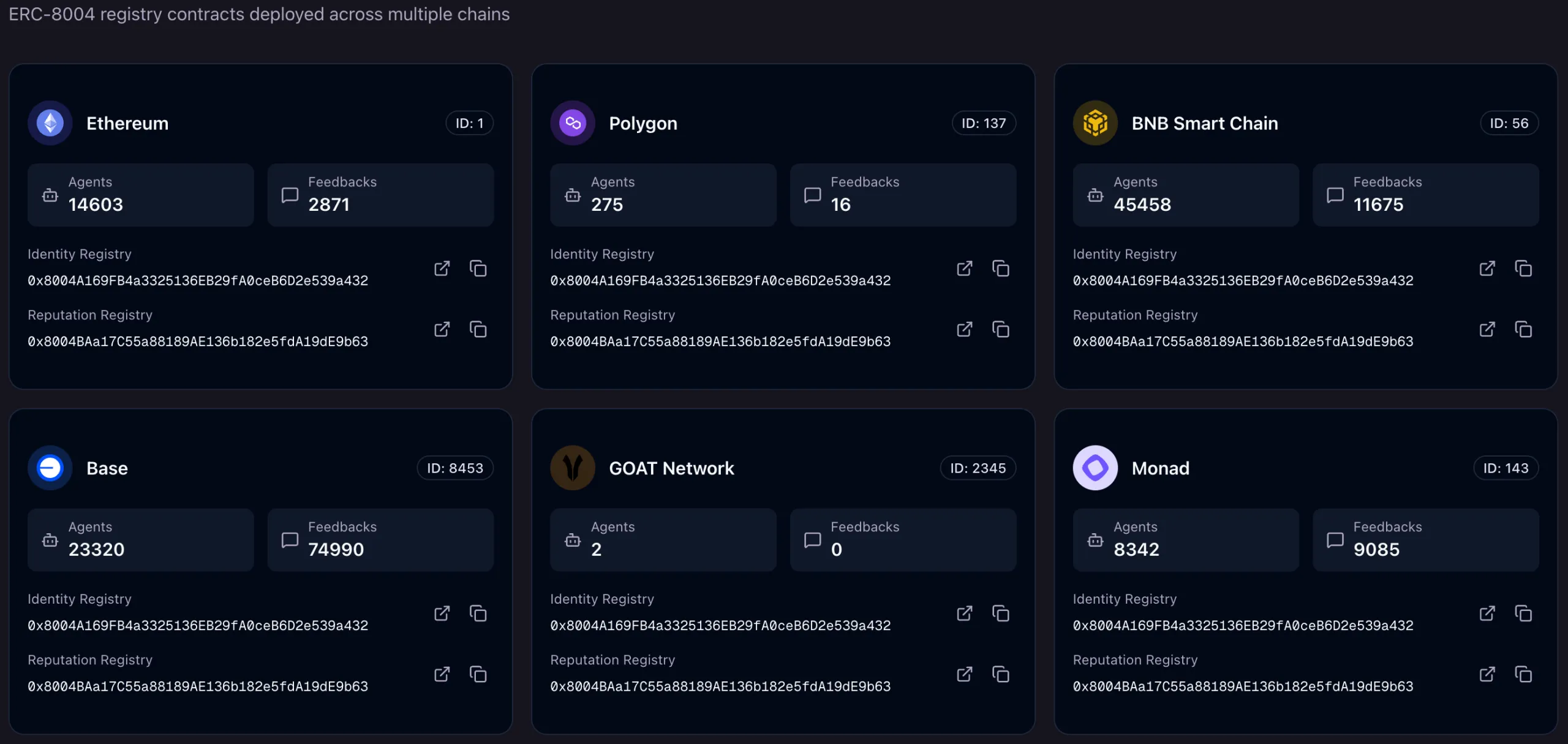
Distribution of ERC-8004 AI agents across blockchains. Source: 8004scan
The Advertising Model Under Threat
Shifting the primary "user" from human to algorithm strikes at the foundation of internet monetization. Experts at a16z have highlighted the core issue: AI agents don't click banners, watch video ads, or respond to emotional marketing triggers. A bot makes decisions strictly by parameters — price, supplier reputation, delivery speed.
If programs generate the majority of web traffic, advertising budgets at companies like Google and Meta could lose their effectiveness. Merit Systems' Sam Ragsdale noted the historical irony: the advertising industry funded the open internet whose data trained the very neural networks now dismantling the ad-based monetization model.
For media, this signals a potential pivot toward selling structured data to algorithms via microtransactions. An "outcome economy" is taking shape, where the value lies not in capturing audience attention but in the accuracy of information. Companies will allocate dedicated budgets to algorithms, and digital assistants will independently hire bot subcontractors for rendering, analytics, and other tasks. Humans will retain the role of setting strategic goals and overseeing the reputation of their algorithm fleet.
Early Stage, Real Architecture
The ratification of ERC-8004 and x402, the Tempo mainnet launch, and CoinGecko's micropayment integration all signal that the infrastructure for an autonomous algorithmic economy is being built now. Financial metrics are still modest, but the architectural foundations are in place. The outcome of the standoff between open crypto protocols and Big Tech's closed ecosystems will determine who controls digital commerce over the next decade.
Frequently Asked Questions
What is ERC-8004 and how does it work for AI agents?
ERC-8004 is a blockchain standard that creates an NFT-based 'digital passport' for AI agents, containing identity, reputation score, and validation rules. It allows algorithms to prove their reliability in autonomous transactions without exposing their owner's private data.
How does the x402 payment protocol enable machine-to-machine payments?
The x402 protocol repurposes the HTTP 402 (Payment Required) status code. When a bot requests data, the server responds with payment details; the bot pays in stablecoins and attaches the transaction hash to a follow-up request. No subscriptions or account registration required.
Which blockchains support ERC-8004 AI agents?
The majority of ERC-8004 AI agents operate on BNB Chain (over 45,000). Base follows with more than 23,000, Ethereum with over 14,000, and Monad with more than 8,000 agents.
How does Google AP2 differ from crypto-based agent payment protocols?
Google AP2 restricts agents to verified merchants only and routes payments through Google Pay, prioritizing safety over freedom. Crypto protocols like ERC-8004 and x402 offer permissionless architecture, enabling bots to transact with any counterparty without centralized approval.
Why are stablecoins central to the AI agent economy?
AI agents require budget predictability that volatile assets like BTC or ETH cannot provide. Stablecoins enable programmable logic at the protocol level, including automatic revenue distribution, staged payouts, and escrow conditions — making them the ideal settlement layer for autonomous machine payments.
Read also
AI Agent Transaction Volume Is 15x Lower Than Bloomberg's Estimates, Says a16z Partner
a16z partner Noah Levine challenged Bloomberg's AI agent payment data, showing actual on-chain volume at $1.6–3M versus the reported $24M.
Stripe Launches Tempo Blockchain for Sub-Second Payments
Stripe co-founders Patrick and John Collison declared that most blockchains are unfit for payments and unveiled Tempo, a proprietary blockchain designed for sub-second corporate transactions.
Stablecoin Transfer Volume Hits $10.5 Trillion in January — Highest Since April 2022
January stablecoin transaction volume surpassed $10.5 trillion, marking the highest monthly figure since April 2022. USDC led transfers while USDT maintained market cap dominance.
TRON Energy Rental: How to Cut USDT Transfer Fees by Up to 60%
USDT issuance on TRON surpassed $85 billion in February 2026, but transfer fees remain steep at $1.83–$3.83 per transaction. Energy rental services like TronZap offer a way to cut costs by 50–60%.
Bernstein Calls $60,000 a 'Clear Bottom' for Bitcoin, Expects Extended Bull Cycle
Analysts at Bernstein have identified $60,000 as a firm floor for Bitcoin, projecting a structurally longer bull cycle. On-chain data from Glassnode confirms a resurgence of buying activity.
Top 10 Dollar Stablecoins in 2026: From Dominant Players to Exit Candidates
The stablecoin market has surpassed $311 billion in total capitalization. Here's a breakdown of the ten largest USD-pegged stablecoins — from undisputed leaders Tether and Circle to ambitious newcomers.