
Bitcoin Buyers Return to Binance and Coinbase After Two-Month Selling Streak
CryptoQuant data shows trading volume delta flipping positive on major exchanges for the first time since mid-February. BTC tests $75,000 amid multiple bullish on-chain signals.
Volume delta turns positive on major exchanges
Bitcoin buyers are flowing back to Binance and Coinbase for the first time following two months of relentless selling pressure. CryptoQuant analyst Darkfost flagged the shift in market dynamics on March 17.
"🗞️ Buyer activity returns to bitcoin after heavy February selling. Despite escalating tensions in Iran, Bitcoin continues to show a degree of resilience, particularly compared to equities and commodities, which are increasingly displaying toppish market structures…" — Darkfost (@Darkfost_Coc), original post
According to the analyst, Bitcoin is showing unexpected resilience despite geopolitical tensions around Iran and a potentially hawkish Federal Reserve stance. On March 17, BTC touched $75,000 — its highest level in six weeks.
The primary indicator of the sentiment reversal is a shift in trading volumes favoring buyers on leading platforms. On February 16, the 30-day moving average of volume delta on Binance stood at negative $145 million, while Coinbase recorded negative $88 million. Both retail and institutional participants were firmly on the sell side.
By mid-March, the picture had reversed: Binance's average delta turned positive at $21 million, and Coinbase's at $14 million. Darkfost described the move as modest but representing a clear improvement over February conditions. He cautioned, however, that the trend needs further confirmation, noting the market still lacks sufficient liquidity. If the current trajectory holds, it could gradually support prices and help Bitcoin break out of its tight trading range.
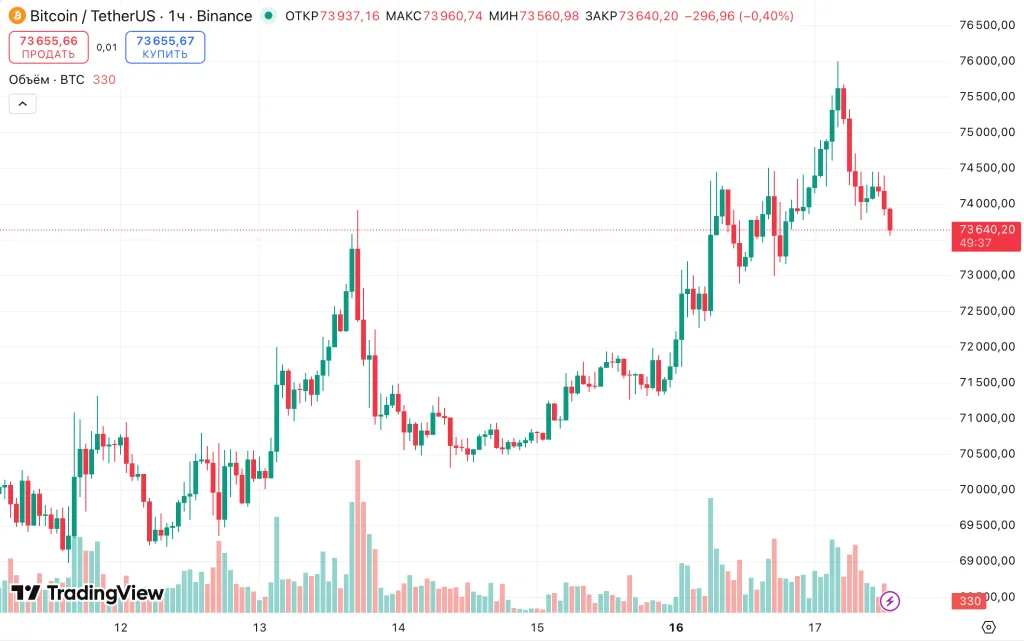
Hourly BTC/USDT chart on Binance. Source: TradingView
Why this matters
Binance and Coinbase collectively serve the largest pool of retail and institutional crypto traders globally. A shift from net selling to net buying on these platforms can be an early signal that the two-month distribution phase is ending. Historically, volume delta reversals on major exchanges have preceded broader price recoveries. If sustained, this could set the stage for a more significant move higher.
Long-term holders remain unfazed
Matthew Sigel, head of digital assets, cited Bernstein research showing that retail panic selling has failed to shake the conviction of long-term Bitcoin holders.
"Bitcoin retail holders have panic sold in recent months. However, long term holders remain resilient. Bitcoin holders inactive for more than 1 year stands at 60% of total supply. This ownership structure is unique to Bitcoin signifying long term 'believers' who remain…" — matthew sigel, recovering CFA (@matthew_sigel), original post
The data reveals that 60% of all existing Bitcoin has not moved in over a year. Bernstein analysts called this ownership structure unique to Bitcoin, demonstrating that the majority of investors treat it as a store of value — even after it underperformed gold last year. Additionally, roughly 14% of BTC supply is now held by ETFs, corporate treasuries (including Strategy), and government entities. Bitcoin's stable capital base continues to expand.
A cascade of bullish on-chain signals
Investor Sweep highlighted that Bitcoin perpetual funding rates turned positive after 14 consecutive days in negative territory — meaning the entire market had been positioned short.
"Bitcoin perpetual funding rates have been negative for 14 consecutive days. The entire market was short. Today, funding just flipped green. The last time this happened, Bitcoin 4x'd." — Sweep (@0xSweep), original post
CryptoQuant analyst Ignacio Moreno de Vicente identified another structural signal. Bitcoin's Inter-Exchange Flow Pulse (IFP) crossed above its 90-day moving average for the first time in an extended period, entering bullish territory.
"A Structural Liquidity Signal Just Turned Positive for Bitcoin. Bitcoin's Inter-Exchange Flow Pulse (IFP) has recently flipped back into bullish territory as the indicator crosses above its 90-day moving average." — CryptoQuant.com (@cryptoquant_com), original post
Historically, similar IFP crossovers preceded sustained bullish phases in 2016, 2019, and 2022.
Near-term price targets
At the time of writing, Bitcoin was trading around $73,600. MN Trading founder Michaël van de Poppe sees the $76,000–$80,000 range as the next key resistance zone.
"Bitcoin starts to trend upwards and is on its way towards the next resistance around $76–80K. I don't think we'll pass that in one-go, but at least we're building a monthly engulfing and, slowly, but surely, the sentiment switches." — Michaël van de Poppe (@CryptoMichNL), original post
Earlier in March, Santiment analysts also reported that large holders had been accumulating Bitcoin — adding another piece of evidence pointing to a potential shift in market sentiment.
Frequently Asked Questions
Why are Bitcoin buyers returning to Binance and Coinbase?
After two months of heavy selling, the 30-day moving average of volume delta turned positive on both major exchanges. Binance shifted from -$145M to +$21M and Coinbase from -$88M to +$14M, signaling renewed buyer interest from both retail and institutional participants.
What percentage of Bitcoin supply is held by long-term holders?
According to Bernstein data cited by Matthew Sigel, 60% of all Bitcoin has remained inactive for more than one year. This ownership structure indicates that the majority of holders view BTC as a store of value rather than a short-term trading instrument.
What is the Bitcoin Inter-Exchange Flow Pulse (IFP) signal?
The IFP tracks Bitcoin flows between exchanges and recently crossed above its 90-day moving average, entering bullish territory. CryptoQuant analyst Ignacio Moreno de Vicente noted that similar crossovers historically preceded sustained rallies in 2016, 2019, and 2022.
What is the Bitcoin price target for March 2026?
Bitcoin tested $75,000 on March 17, its highest in six weeks. MN Trading founder Michaël van de Poppe identified the $76,000–$80,000 zone as the next major resistance, though he doesn't expect it to be cleared on the first attempt.
How much Bitcoin is held by ETFs and corporate treasuries?
Bernstein estimates that nearly 14% of total BTC supply is now owned by ETFs, corporate treasuries including Strategy, and government entities. This growing institutional base adds structural support to Bitcoin's price.
Read also
Bitcoin Hits $70,000 as Iran Ceasefire Talks Boost Risk Appetite
Bitcoin surged 4% to test the $70,000 level on April 6 amid reports of ceasefire negotiations between the US, Israel, and Iran. The derivatives market, however, sends mixed signals.
Options Traders Bet on Bitcoin Rally to $80,000 by Summer
Bitcoin consolidates near $70,000 after a volatility spike. Options market participants are increasingly positioning for a rally to $80,000 by early summer, despite macroeconomic headwinds.
Bitcoin Down 2.5% Weekly: Jane Street Accusations & 7 Ethereum Forks
Bitcoin lost ~2.5% over the week amid macro shocks and geopolitical tensions. Jane Street faced market manipulation allegations while Ethereum unveiled an ambitious seven hard fork roadmap through 2029.
TON Wallet Introduces Yield Vaults for BTC, ETH, and USDT Directly in Telegram
TON Wallet has launched yield vaults for BTC, ETH, and USDT directly within Telegram, offering up to 18% APY on stablecoins through partnerships with Morpho, TAC, and Re7.
Weekly Recap: Aave Ecosystem Rescue Mobilizes 100,000 ETH and Quantum Computer Cracks 15-Bit ECC Key
Bitcoin held near $78,000, the DeFi community rallied over 100,000 ETH to help Aave recover from the Kelp hack, and a researcher cracked a 15-bit ECC key on a quantum computer.
Strategy Becomes Most-Shorted US Stock With $6B in Bets
Strategy tops the list of most-shorted large-cap US stocks with $6 billion in short positions, representing 14% of its market cap, as Bitcoin's decline erodes confidence in the company's debt-fueled BTC accumulation model.