
Alchemy Launches AgentPay: A Universal Gateway for AI Agent Payments
 CircleINFRASTRUCTURE
Web3 infrastructure provider Alchemy has unveiled AgentPay, a unified integration layer that connects fragmented AI agent payment protocols from Coinbase, Stripe, Visa, Mastercard, and Circle under a single endpoint.
One Endpoint to Rule Them All
Alchemy, one of the leading Web3 infrastructure providers, has introduced AgentPay — a product designed to unify fragmented AI agent payment systems. The tool allows merchants to accept payments from AI agents through a single integration point, aggregating protocols from Coinbase, Stripe, Visa, Mastercard, and Circle.
«🚨 NEW: Introducing Alchemy AgentPay: Your business, now accepting agent payments. ✔️ One integration, every agentic payment protocol ✔️ Zero code changes to your existing API ✔️ New protocols added automatically. Simple. Universal. Future-proof.» — Alchemy (@Alchemy), original post
The core problem AgentPay addresses is protocol incompatibility. Previously, merchants had to configure separate gateways for each standard in order to receive transfers from AI agents. Alchemy CTO Guillaume Poncen stated that this approach is unsustainable, and that fragmentation will only intensify as new systems emerge. AgentPay is built to solve this.
How AgentPay Works
The onboarding process is straightforward: a merchant registers their existing API on the Alchemy platform and receives a new endpoint. Through this endpoint, any AI agent can execute a payment using one of the supported protocols — x402, MPP, A2P, or L402.
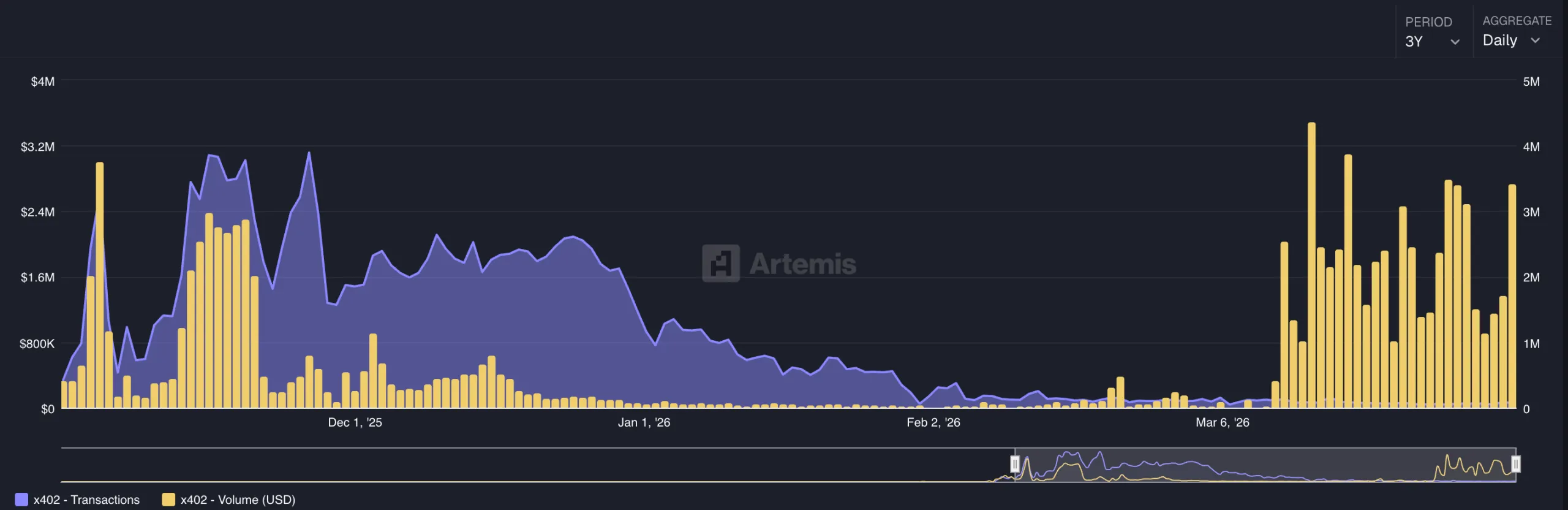
Poncen emphasized that AgentPay operates purely as a transit layer for routing commands. Alchemy itself never touches user funds — the product simply routes requests between agents and merchants.
AgentPay is currently undergoing closed beta testing, with a public release expected in the coming weeks.
Why This Matters
Alchemy is often described as the "AWS of Web3," providing developers with foundational infrastructure and node services for building blockchain applications. Its move into the agentic payments space signals growing demand for infrastructure to support autonomous financial operations.
The autonomous finance model relies on micro- and nano-transactions. Some of these operations occur directly between AI agents with no human involvement whatsoever. This segment is expected to eventually become the backbone of payment activity on the internet.

McKinsey analysts project that by 2030, retail payments made through AI agents will reach $3–5 trillion. Universal gateways like AgentPay could become essential infrastructure for servicing this market.
Competition in the Agentic Payments Space
Alchemy is not the only player building infrastructure for AI agents. The Solana Foundation previously announced Solana Agent Skills — a set of capabilities that can be embedded into AI agents for blockchain interaction. AgentPay's arrival further confirms the broader trend toward standardized tooling for the emerging agent economy.
Frequently Asked Questions
What is Alchemy AgentPay?
AgentPay is a universal payment gateway by Alchemy that lets merchants accept AI agent payments through a single endpoint. It supports multiple protocols including x402, MPP, A2P, and L402, aggregating solutions from Coinbase, Stripe, Visa, Mastercard, and Circle.
When will AgentPay be publicly available?
AgentPay is currently in closed beta testing. A public release is expected in the coming weeks, though no specific date has been announced.
Does Alchemy handle user funds through AgentPay?
No. According to Alchemy CTO Guillaume Poncen, AgentPay functions solely as a transit layer for routing payment commands. Alchemy never touches user funds directly.
How big will AI agent payments be by 2030?
McKinsey analysts forecast that retail payments made through AI agents will reach $3–5 trillion by 2030. This projection highlights the massive potential for agentic payment infrastructure.
What payment protocols does AgentPay support?
AgentPay currently supports x402, MPP, A2P, and L402 protocols. New protocols are added automatically as they emerge, ensuring forward compatibility for merchants.
Read also
How ERC-8004 and x402 Standards Are Turning AI Agents Into Market Participants
Blockchain standards ERC-8004 and x402 are building the infrastructure for autonomous machine payments, challenging Big Tech's closed ecosystems and the attention economy model.
AI Agent Transaction Volume Is 15x Lower Than Bloomberg's Estimates, Says a16z Partner
a16z partner Noah Levine challenged Bloomberg's AI agent payment data, showing actual on-chain volume at $1.6–3M versus the reported $24M.
Google Enhances Opal AI Platform with New Autonomous Agents
Google has upgraded its visual AI workflow builder Opal with agent functionality that automatically analyzes tasks and selects appropriate tools for completion.
Bernstein: AI Agents Could Become the Key Growth Driver for Stablecoins
Bernstein analysts argue that AI-powered payments could significantly boost stablecoin adoption, even though current machine-to-machine transaction volumes remain modest.
Anthropic Tests AI Agent Marketplace Where Claude Buys and Sells on Behalf of Humans
Anthropic ran Project Deal, a Slack-based marketplace where Claude AI agents autonomously traded real goods on behalf of 69 employees. The experiment revealed that model quality significantly impacts deal outcomes, while negotiation style instructions had little effect.
Ledger Unveils AI Security Roadmap to Protect Users in the Age of Autonomous Agents
Ledger has published its AI Security Roadmap 2026, outlining how the hardware wallet maker plans to secure digital assets as AI agents gain autonomous access to wallets and transactions.