
Wintermute: Stocks and Crypto Are Becoming 'Fungible Assets' as Retail Capital Shifts
Wintermute analysts have identified a major shift in retail investor behavior, with capital flowing from crypto into equities as the two asset classes increasingly function as interchangeable risk instruments.
Market maker Wintermute's research team has concluded that stocks and cryptocurrencies are increasingly functioning as "risk-reducing fungible assets." Retail capital flows show that investors are now allocating between these segments rather than investing in both simultaneously.
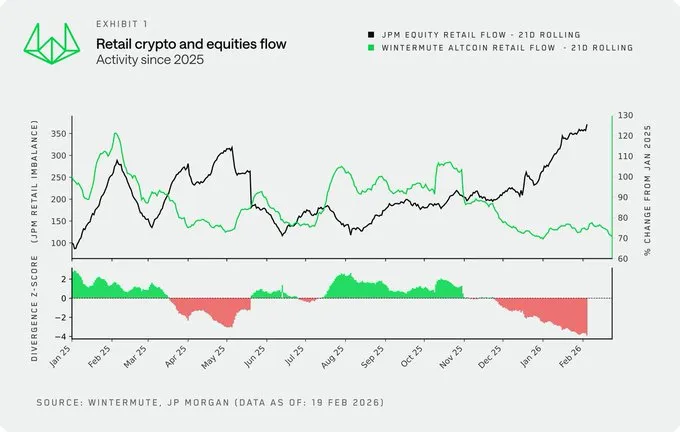
«By cross-referencing our own crypto investor data with JPMorgan's retail equity inflow data, we gain a new lens for studying the relationship between participant activity in equity and crypto markets» — Wintermute, original post
Why This Matters
Until late 2024, equity and crypto markets moved in lockstep — bullish sentiment among traditional investors translated directly into digital asset purchases. That synchronization broke down in 2025. Retail investors are now pouring money into stocks at record pace while largely sidelining crypto. The fluctuating correlation between retail activity and altcoin market capitalization confirms this structural shift.
Key Drivers Behind the Rotation
Wintermute identified several catalysts for the current dynamic:
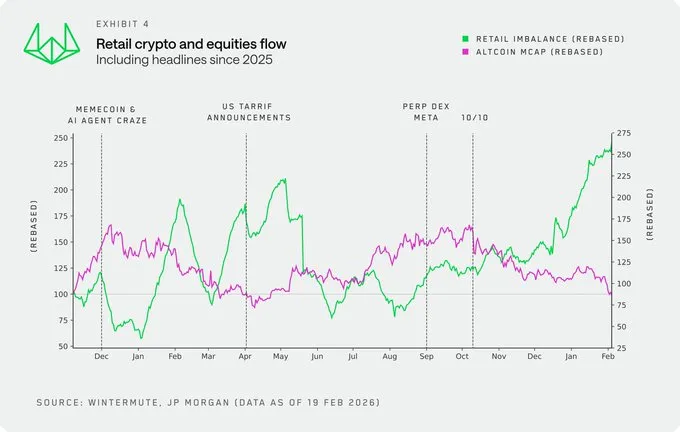
- Memecoins and AI agents "had their moment in the spotlight" — when equity market activity stalled, investors rotated into these crypto niches;
- Retail participants aggressively bought the dip in equities, including during the U.S. tariff announcements in April 2025 and more recently;
- After October 10, a near-complete rotation into equities occurred, and this trend persists.
The analysts stressed that they don't view retail crypto activity as significant enough to divert attention from stocks. Rather, the elevated engagement in equity markets is what's crowding out demand for digital assets.
Crypto Matures — and Loses Its Volatility Edge
The growing presence of sophisticated investors alongside new liquidity instruments like ETFs and DATs has dampened the "reflexive volatility spikes" that characterized previous cycles. With total crypto market capitalization at $2.3 trillion, meaningful price appreciation now requires substantially more capital inflow than it did five years ago, according to Wintermute.
The firm argues that declining volatility weakens crypto's core appeal for investors. The extreme price swings of the 2021–2022 cycle, which attracted an entire generation of new participants, have essentially disappeared in their familiar form. For volatility-seeking retail traders, equities are becoming an increasingly attractive alternative.
Cryptocurrencies still hold a place in portfolios, but digital assets have become just one of many instruments rather than the primary vehicle for speculation, the analysts concluded. Monitoring retail activity in equities is emerging as a new indicator for identifying windows of more sustainable crypto demand.
Frequently Asked Questions
What does Wintermute mean by stocks and crypto becoming 'fungible assets'?
Wintermute's research team concluded that stocks and cryptocurrencies are increasingly functioning as "risk-reducing fungible assets," meaning retail investors now allocate capital between the two segments rather than investing in both simultaneously.
Why is retail capital shifting from crypto to stocks in 2025?
Until late 2024, equity and crypto markets moved in lockstep, but that synchronization broke down in 2025. Retail investors are now pouring money into stocks at record pace while largely sidelining crypto, driven by aggressive dip-buying in equities (including during U.S. tariff announcements in April 2025) and a near-complete rotation into equities after October 10.
Why is crypto losing its appeal for retail traders according to Wintermute?
The growing presence of sophisticated investors and new liquidity instruments like ETFs and DATs has dampened the reflexive volatility spikes that characterized previous cycles. With total crypto market cap at $2.3 trillion, meaningful price appreciation now requires substantially more capital inflow, and declining volatility weakens crypto's core appeal for speculation-driven retail traders.
What drove retail investors into crypto niches like memecoins and AI agents?
According to Wintermute, memecoins and AI agents "had their moment in the spotlight" when equity market activity stalled, prompting investors to rotate into these crypto niches. However, once equity markets became active again, retail participants shifted back aggressively into stocks.
How can retail equity activity be used as a crypto market indicator?
Wintermute suggests that monitoring retail activity in equities is emerging as a new indicator for identifying windows of more sustainable crypto demand, since elevated engagement in equity markets crowds out demand for digital assets.
Read also
Bitcoin Rebounds to $70,000 as Leverage Drops and ETF Inflows Continue
BTC recovered above $70,000 on March 10, erasing weekend losses. Spot ETFs attracted $568M in weekly inflows while the estimated leverage ratio on Binance fell sharply from 0.198 to 0.152.
Wintermute Links Bitcoin Stagnation to Macroeconomic Regime Shift
The market maker explains crypto weakness through structural economic changes: AI sector reassessment and deglobalization. Bitcoin behaves as a high-risk asset alongside tech stocks.
Bitcoin Down 2.5% Weekly: Jane Street Accusations & 7 Ethereum Forks
Bitcoin lost ~2.5% over the week amid macro shocks and geopolitical tensions. Jane Street faced market manipulation allegations while Ethereum unveiled an ambitious seven hard fork roadmap through 2029.
Options Traders Bet on Bitcoin Rally to $80,000 by Summer
Bitcoin consolidates near $70,000 after a volatility spike. Options market participants are increasingly positioning for a rally to $80,000 by early summer, despite macroeconomic headwinds.
Bitcoin-Stock Market Correlation Hits 2022 Lows
Bitcoin's independence from traditional markets reaches two-year highs as analysts view decoupling as key condition for future crypto growth.
Top 10 Dollar Stablecoins in 2026: From Dominant Players to Exit Candidates
The stablecoin market has surpassed $311 billion in total capitalization. Here's a breakdown of the ten largest USD-pegged stablecoins — from undisputed leaders Tether and Circle to ambitious newcomers.