Tether Taps KPMG for Its First Full Audit as Financial Times Reveals the Name
Financial Times has identified KPMG as the Big Four firm hired by Tether for its first comprehensive audit, with PwC preparing the stablecoin issuer's internal systems for the review.
Tether, the issuer of the world's largest stablecoin USDT, has hired KPMG to conduct a full audit of its financial statements, according to the Financial Times, which cited people familiar with the matter. Another Big Four firm, PwC, will handle preparation of Tether's internal systems ahead of the independent review.
Tether enlists a Big Four auditor for the first time
What Tether Announced
On March 24, Tether publicly disclosed that it had signed a competitive agreement with a Big Four auditor but did not reveal the firm's identity. The Financial Times has now confirmed it is KPMG.
"Tether Signs Big Four Firm to Complete First Full Audit, Setting a New Quality Standard for the Digital Asset Economy" — Tether (@tether), original post
According to Tether's press release, the move is designed to underscore three key points:
- USDT is fully backed by collateral;
- Its reserves maintain high liquidity;
- Asset management follows world-class risk management practices.
Tether also stated that the institutional-grade audit should serve as a signal for the entire industry, claiming that other stablecoin issuers "settle for a minimum level of transparency."
Why This Matters
Securing a Big Four auditor is a landmark moment for Tether, a company that has faced persistent scrutiny over the transparency of its reserves. A comprehensive audit by KPMG could significantly bolster institutional and regulatory confidence in the largest stablecoin by market cap.
The FT reports that the full financial review is intended to support Tether's planned business expansion in the United States and its fundraising efforts. In February, the company attempted to raise $15–$20 billion at a $500 billion valuation but encountered investor hesitancy. Potential backers deemed the investment risky given Tether's past regulatory issues.
Tether's Trust-Building Measures
The company emphasized that it has taken several steps in recent years to strengthen credibility:
- Reinforced its reserve base with a focus on liquidity and conservative asset management;
- Established regular disclosure of updated reserve composition data to improve transparency;
- Actively cooperated with law enforcement agencies worldwide to identify illicit activity, freeze illegally obtained funds, and protect users;
- Implemented robust compliance and risk management systems to maintain USDT's status as a secure and reliable digital dollar.
USDT's Market Position
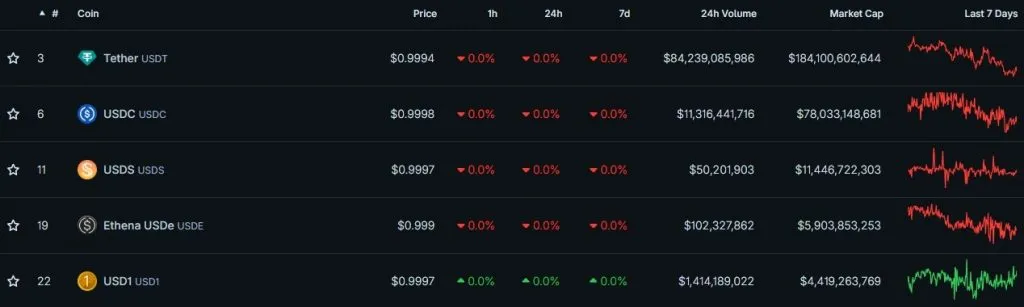
Tether's flagship token continues to dominate the stablecoin segment, which has a combined market capitalization of approximately $310 billion. USDT's own market cap exceeds $184 billion.
Competition is intensifying, however. Data from analytics platform Artemis shows that in 2025, Circle's USDC surpassed Tether's token in total value transferred — $17.3 trillion versus $12.9 trillion. In 2026, Circle's stablecoin has continued to lead in adjusted transaction volume.
Obtaining a clean audit opinion from KPMG could give Tether a powerful edge in the battle for institutional capital and a stronger foothold in the US market.
Frequently Asked Questions
Who is auditing Tether?
According to the Financial Times, Tether has hired KPMG, one of the Big Four accounting firms, to conduct its first comprehensive financial audit. PwC, another Big Four firm, will prepare Tether's internal systems for the review.
Why does Tether need a Big Four audit?
The audit is intended to strengthen institutional and regulatory confidence in USDT. Tether is planning to expand its business in the US and previously attempted to raise $15–$20 billion at a $500 billion valuation, but investors raised concerns about risk.
What is USDT's current market cap?
USDT's market capitalization exceeds $184 billion. The total stablecoin market stands at approximately $310 billion, with Tether's token remaining the dominant player in the segment.
Has USDC overtaken USDT in transaction volume?
According to Artemis data, USDC surpassed USDT in total value transferred in 2025 — $17.3 trillion versus $12.9 trillion. In 2026, Circle's stablecoin has continued to lead in adjusted transaction volume.
When did Tether announce the Big Four deal?
Tether published a press release on March 24, 2026, announcing a competitive agreement with a Big Four auditor but did not disclose the firm's name. The Financial Times subsequently identified it as KPMG.
Read also
Stablecoin Transfer Volume Hits $10.5 Trillion in January — Highest Since April 2022
January stablecoin transaction volume surpassed $10.5 trillion, marking the highest monthly figure since April 2022. USDC led transfers while USDT maintained market cap dominance.
TRON Energy Rental: How to Cut USDT Transfer Fees by Up to 60%
USDT issuance on TRON surpassed $85 billion in February 2026, but transfer fees remain steep at $1.83–$3.83 per transaction. Energy rental services like TronZap offer a way to cut costs by 50–60%.
Top 10 Dollar Stablecoins in 2026: From Dominant Players to Exit Candidates
The stablecoin market has surpassed $311 billion in total capitalization. Here's a breakdown of the ten largest USD-pegged stablecoins — from undisputed leaders Tether and Circle to ambitious newcomers.
Tether Has Frozen $4.2 Billion in Illicit Funds Through Law Enforcement Cooperation
The issuer of the world's largest stablecoin USDT revealed it has cumulatively blocked $4.2 billion in assets tied to criminal activity, working alongside agencies from over 60 countries.
TON Wallet Introduces Yield Vaults for BTC, ETH, and USDT Directly in Telegram
TON Wallet has launched yield vaults for BTC, ETH, and USDT directly within Telegram, offering up to 18% APY on stablecoins through partnerships with Morpho, TAC, and Re7.
How ERC-8004 and x402 Standards Are Turning AI Agents Into Market Participants
Blockchain standards ERC-8004 and x402 are building the infrastructure for autonomous machine payments, challenging Big Tech's closed ecosystems and the attention economy model.