Tether Has Frozen $4.2 Billion in Illicit Funds Through Law Enforcement Cooperation
The issuer of the world's largest stablecoin USDT revealed it has cumulatively blocked $4.2 billion in assets tied to criminal activity, working alongside agencies from over 60 countries.
Tether, the company behind the USDT stablecoin, has disclosed that its cumulative total of frozen assets linked to illicit activity has reached approximately $4.2 billion. These actions were carried out in collaboration with law enforcement agencies worldwide.
Tether ramps up cooperation with law enforcement to combat crypto-related crime
US DOJ Recognition and the North Carolina Operation
The disclosure came as Tether received a formal acknowledgment from the United States Department of Justice for its role in disrupting a "pig butchering" fraud scheme. The operation, conducted in North Carolina, led to the seizure of nearly $61 million in criminal proceeds.
Tether stated that the action underscores its commitment to leading the digital asset industry by complying with regulatory requirements and maintaining transparency to assist global law enforcement in combating crypto-related crime.
Why This Matters
The sheer scale of frozen funds — $4.2 billion — highlights the degree of control centralized stablecoin issuers can exercise over token flows. For the broader crypto market, this carries dual implications: regulators may grow more comfortable with stablecoins as supervisable instruments, while debates around censorship risks and centralized asset control intensify.
According to blockchain analytics firm Elliptic, by the end of 2025 stablecoin issuers — primarily Tether and Circle — had blacklisted roughly 5,700 wallets holding approximately $2.5 billion. Around three-quarters of those addresses contained USDT at the time of freezing.
Major Enforcement Actions in 2025
In February, Tether assisted in seizing $544 million in digital assets at the request of US authorities. In total, the company has directly cooperated with more than 310 agencies across 64 countries.
Key enforcement cases highlighted by Tether for 2025 include:
- Freezing and reissuing 1.6 million USDT linked to terrorism financing in Gaza, at the request of the US DOJ;
- Blocking $6.2 million in a cross-border money laundering scheme involving Klever Wallet, in partnership with Brazilian authorities;
- Seizure of approximately $225 million from pig butchering operators by government agents in Oklahoma City;
- Confiscation of $23 million from sanctioned exchange Garantex by the US Secret Service (USSS);
- Arrest of approximately $12 million by Thai police and the USSS from a transnational fraud network.
USDT vs. USDC: Stablecoin Market Dynamics
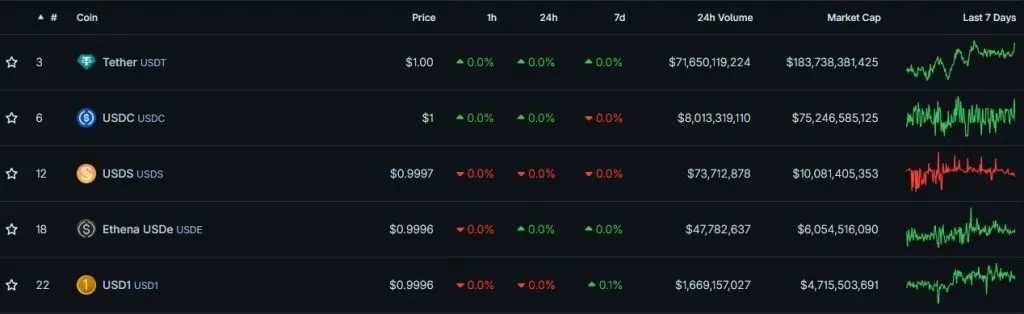
USDT's market capitalization stands at approximately $183.7 billion, making it the dominant force in the $311.5 billion stablecoin sector. Its closest rival, Circle's USDC, holds a market cap just above $75.2 billion.
However, USDC surpassed USDT in transferred value during 2025 — $17.3 trillion compared to $12.9 trillion. In January 2026, total stablecoin transaction volume surged to a record $10.5 trillion, with USDC accounting for $8.3 trillion and USDT for $1.7 trillion.
Tether's net profit exceeded $10 billion for the previous year. The company has also accumulated reserves of 148 metric tons of physical gold, according to estimates by Jefferies.
Frequently Asked Questions
How much illicit funds has Tether frozen in total?
Tether has frozen approximately $4.2 billion in assets linked to illicit activity, carried out in collaboration with law enforcement agencies worldwide.
Why did the US Department of Justice acknowledge Tether?
The US DOJ formally acknowledged Tether for its role in disrupting a "pig butchering" fraud scheme in North Carolina, which led to the seizure of nearly $61 million in criminal proceeds.
How many law enforcement agencies has Tether cooperated with?
Tether has directly cooperated with more than 310 agencies across 64 countries.
How many wallets have stablecoin issuers blacklisted by the end of 2025?
According to blockchain analytics firm Elliptic, stablecoin issuers — primarily Tether and Circle — had blacklisted roughly 5,700 wallets holding approximately $2.5 billion by the end of 2025. Around three-quarters of those addresses contained USDT at the time of freezing.
What major Tether enforcement actions occurred in 2025?
In February 2025, Tether assisted in seizing $544 million in digital assets at the request of US authorities. Key cases also included freezing and reissuing 1.6 million USDT linked to terrorism financing in Gaza at the request of the US DOJ.
Read also
Stablecoin Transfer Volume Hits $10.5 Trillion in January — Highest Since April 2022
January stablecoin transaction volume surpassed $10.5 trillion, marking the highest monthly figure since April 2022. USDC led transfers while USDT maintained market cap dominance.
Top 10 Dollar Stablecoins in 2026: From Dominant Players to Exit Candidates
The stablecoin market has surpassed $311 billion in total capitalization. Here's a breakdown of the ten largest USD-pegged stablecoins — from undisputed leaders Tether and Circle to ambitious newcomers.
TRON Energy Rental: How to Cut USDT Transfer Fees by Up to 60%
USDT issuance on TRON surpassed $85 billion in February 2026, but transfer fees remain steep at $1.83–$3.83 per transaction. Energy rental services like TronZap offer a way to cut costs by 50–60%.
TON Wallet Introduces Yield Vaults for BTC, ETH, and USDT Directly in Telegram
TON Wallet has launched yield vaults for BTC, ETH, and USDT directly within Telegram, offering up to 18% APY on stablecoins through partnerships with Morpho, TAC, and Re7.
How ERC-8004 and x402 Standards Are Turning AI Agents Into Market Participants
Blockchain standards ERC-8004 and x402 are building the infrastructure for autonomous machine payments, challenging Big Tech's closed ecosystems and the attention economy model.
Bernstein Calls $60,000 a 'Clear Bottom' for Bitcoin, Expects Extended Bull Cycle
Analysts at Bernstein have identified $60,000 as a firm floor for Bitcoin, projecting a structurally longer bull cycle. On-chain data from Glassnode confirms a resurgence of buying activity.