SEC Greenlights Tokenized Securities Trading on Nasdaq
The SEC has approved Nasdaq's proposal to trade tokenized stocks from the Russell 1000 index and select ETFs, while maintaining traditional clearing and settlement infrastructure.
Nasdaq Gets SEC Approval for Tokenized Stock Trading
The U.S. Securities and Exchange Commission (SEC) has approved Nasdaq's proposal to enable trading of tokenized securities. The initiative covers stocks listed in the Russell 1000 index along with select ETFs. Clearing and settlement will continue to operate through existing market infrastructure.
Tokenized real-world assets (RWA) will retain all properties of their traditional counterparts, including ownership rights, ticker symbols, and trading priorities. In its approval letter, the SEC emphasized that placing a security on a blockchain does not alter its legal status — the asset remains a stock, not merely a technological instrument.
Why This Matters
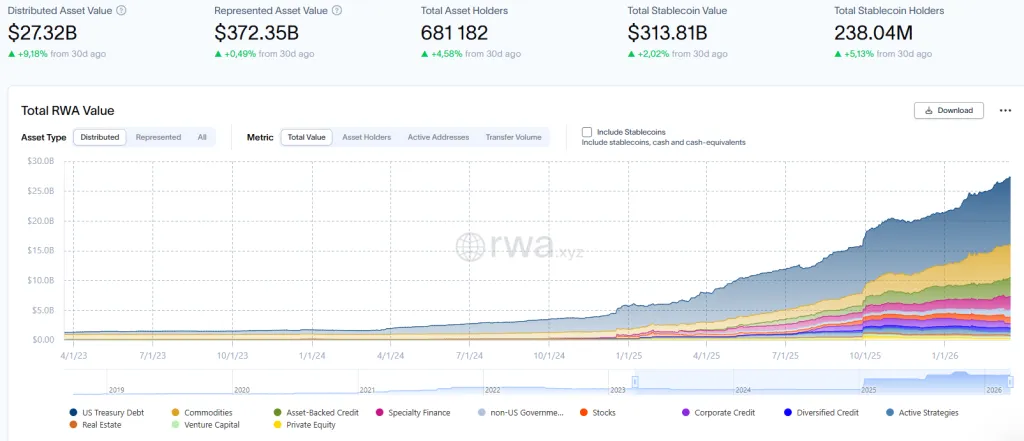
The SEC's decision effectively legitimizes tokenization of traditional financial instruments on one of the world's largest exchanges. Nasdaq's adoption of blockchain-based trading could set a precedent for the entire industry. At the time of publication, the total market capitalization of the real-world asset tokenization sector stands at $27.32 billion, according to RWA.xyz.
Nasdaq filed its application in September of last year, drawing a comparison between tokenization and the historic shift from floor trading to electronic markets. In November, the head of the exchange's digital asset division, Matt Savarese, identified the RWA segment as the company's top priority.
How the Trading Mechanism Works
Under the approved framework, brokers can flag orders as RWA transactions when submitting them. Once a trade is executed, Nasdaq sends an instruction to the Depository Trust Company (DTC). If the DTC cannot process the request — due to blockchain incompatibility, wallet issues, or broker-side restrictions — settlement proceeds in the standard format without tokenization.
This fallback design allows blockchain technology to be introduced without creating risk for participants who are not yet equipped to handle the new format.
Industry Reaction
Clearpool COO Steven Wu described the approval as an important step toward programmable assets. He noted that market structure has already evolved from T+3 to T+1 settlement, but the ultimate goal is T+0 and continuous 24/7 trading.
Samar Sen, head of international markets at Talos, said institutional investors will be closely monitoring liquidity in the new tokenized format and how it integrates with existing clearing systems.
Analyst Crypto Patel called the decision a significant move toward merging traditional finance with blockchain technology:
"🇺🇸 BREAKING: SEC Approves Nasdaq Rule Change for Tokenized Securities Trading. Select stocks and ETFs can now be represented as blockchain-based tokens. Same investor rights, pricing, and market infrastructure preserved. A major step toward merging TradFi…" — Crypto Patel (@CryptoPatel), original post
Crypto Patel views the approval as a "green light" for the tokenization segment and a bullish signal for Ethereum, ONDO, and the broader RWA ecosystem.
Broader Context: Corporations Accelerate Blockchain Adoption
The SEC's decision comes amid a wider trend observed in March 2026, as major corporations have accelerated efforts to bring stock markets onto blockchain rails. Nasdaq's approval could catalyze similar initiatives from competing exchanges, reinforcing tokenization as an emerging standard in the financial industry.
Frequently Asked Questions
What securities are eligible for tokenized trading on Nasdaq?
The SEC approved tokenization of securities from the Russell 1000 index and select ETFs. Tokenized assets retain all properties of their traditional counterparts, including ownership rights and ticker symbols.
How does settlement work for tokenized securities on Nasdaq?
After trade execution, Nasdaq sends an instruction to the Depository Trust Company (DTC). If DTC cannot process the request due to blockchain incompatibility or broker restrictions, settlement proceeds in the standard format without tokenization.
Does tokenization change the legal status of a stock?
No. The SEC explicitly stated in its approval letter that placing a security on a blockchain does not change its legal status. The asset remains a stock with all associated investor rights.
What is the total market cap of tokenized real-world assets in 2026?
At the time of the announcement, the total market capitalization of the RWA tokenization sector was $27.32 billion according to RWA.xyz data.
When did Nasdaq first apply for tokenized securities trading?
Nasdaq filed its application with the SEC in September 2025, comparing tokenization to the historic transition from floor trading to electronic markets. In November, digital assets head Matt Savarese called RWA the company's top priority.
Read also
Weekly Recap: Bitcoin Tests $76K, SEC Greenlights Tokenized Stocks on Nasdaq
Bitcoin briefly touched $76,000 before retreating to $68,800. The SEC approved tokenized stock trading on Nasdaq, while mining difficulty dropped 7.76% amid growing miner losses.
CoinShares: TradFi and DeFi Are Merging Into a Hybrid Finance System
A joint report by CoinShares and Token Terminal documents the convergence of traditional and decentralized finance into a measurable market structure, with stablecoins at $297.6 billion and the RWA market approaching $29 billion.
Binance Emerges as 24/7 Price-Setting Venue for Gold and Silver — DL Research
DL Research finds that Binance has become a key venue for round-the-clock gold and silver trading through perpetual contracts, bridging the gap between crypto and traditional commodity markets.
Bloomberg and Kaiko Partner to Bring Financial Data On-Chain via Canton Network
Bloomberg and Kaiko have partnered to bring institutional-grade financial data on-chain through Canton Network, starting with tokenized US Treasuries and repo operations.
Bernstein Calls $60,000 a 'Clear Bottom' for Bitcoin, Expects Extended Bull Cycle
Analysts at Bernstein have identified $60,000 as a firm floor for Bitcoin, projecting a structurally longer bull cycle. On-chain data from Glassnode confirms a resurgence of buying activity.
Forbes: American Bitcoin Investors Lost $500M While Eric Trump Grew Wealthier
Forbes estimates retail investors in mining firm American Bitcoin have lost around $500 million since its Nasdaq listing, while Eric Trump's net worth grew from $190M to $280M without investing his own capital.