
CoinShares: TradFi and DeFi Are Merging Into a Hybrid Finance System
 CircleINFRASTRUCTURE
A joint report by CoinShares and Token Terminal documents the convergence of traditional and decentralized finance into a measurable market structure, with stablecoins at $297.6 billion and the RWA market approaching $29 billion.
The infrastructure of traditional finance and blockchain protocols is no longer running in parallel — it is fusing into a unified system that CoinShares calls "Hybrid Finance." The firm published its findings in a joint report with Token Terminal.
"For the first time, we're introducing a Hybrid Finance report in collaboration with @tokenterminal to map the shift happening across markets. From @ethereum to on-chain platforms like @HyperliquidX, @aave, @MakerDAO, and others. Trading, lending, and capital allocation are…" — CoinShares (@CoinSharesCo), original post
CoinShares analysts noted that public blockchains are already settling institutional assets, Wall Street firms are issuing funds on Ethereum, and derivatives platforms have moved entirely on-chain. Bitcoin, in their view, served as the catalyst for this convergence by proving that crypto can earn the trust of major market participants.
Why This Matters
Hybrid finance marks a shift from abstract narratives about TradFi-DeFi convergence to concrete, measurable metrics. CoinShares identifies three foundational components of this emerging structure:
- Settlement infrastructure capable of servicing real economic activity.
- Tokenization of traditional assets — treasuries, equities, and commodities.
- On-chain applications generating sustainable revenue.
The report's authors believe that this year the segment will definitively transition from a notable trend into a measurable market structure.
The Numbers Behind the Trend
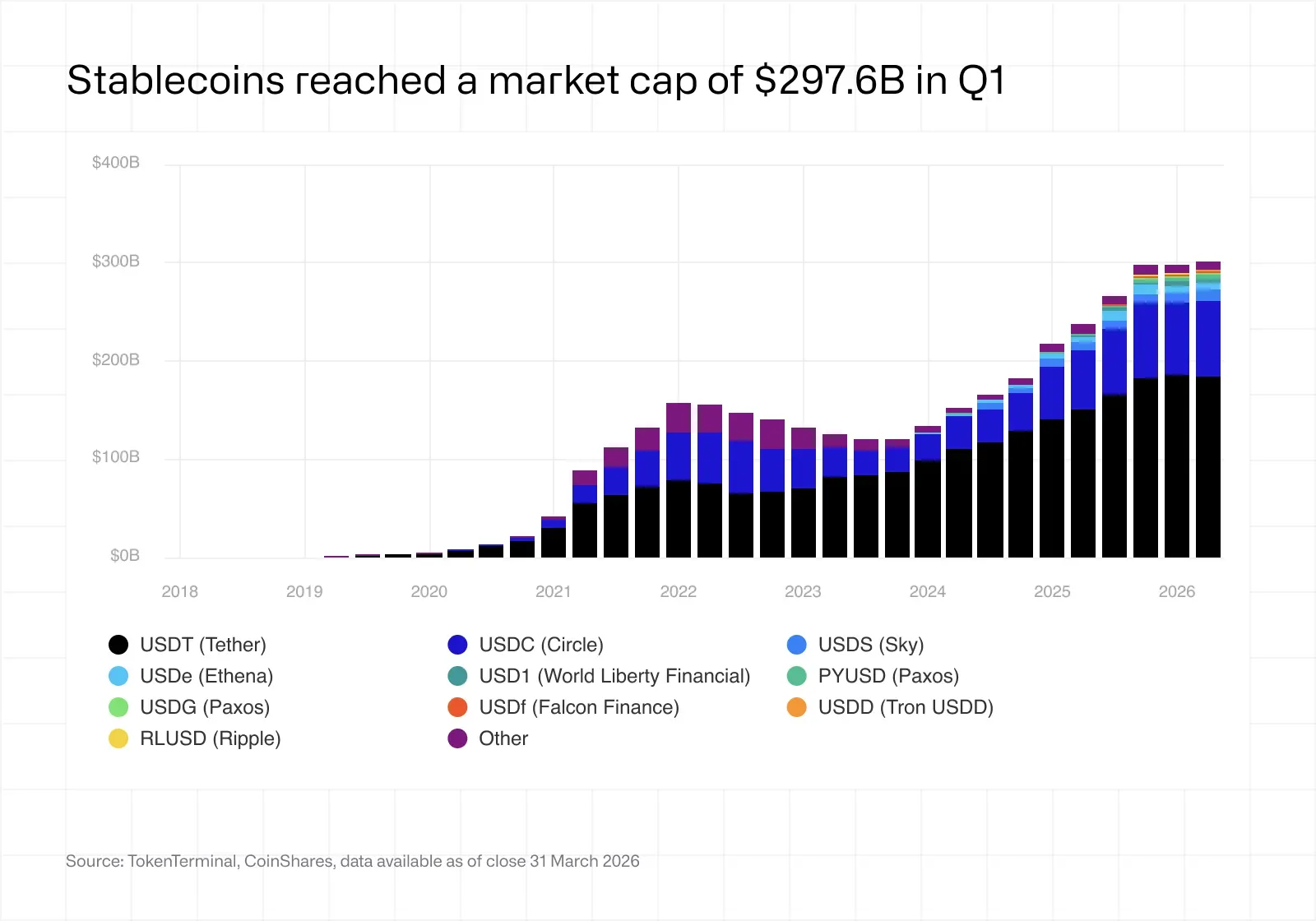
Stablecoins remain the largest segment of hybrid finance. In Q1, their total supply reached $297.6 billion, up 37.2% year-over-year. USDT from Tether and USDC from Circle continue to lead the market.
Tokenized fund volume surged 181% over 12 months to $9 billion, with much of the demand driven by products backed by short-term U.S. Treasuries. The market capitalization of tokenized equities grew from $27.6 million to $773.3 million, while tokenized commodities surpassed $4.9 billion. The total RWA (real-world assets) market is estimated at approximately $29 billion.
Where the Revenue Flows
A dedicated section of the report addresses revenue distribution within the new market architecture. The core finding: applications and companies earn far more than the base-layer blockchains they operate on.
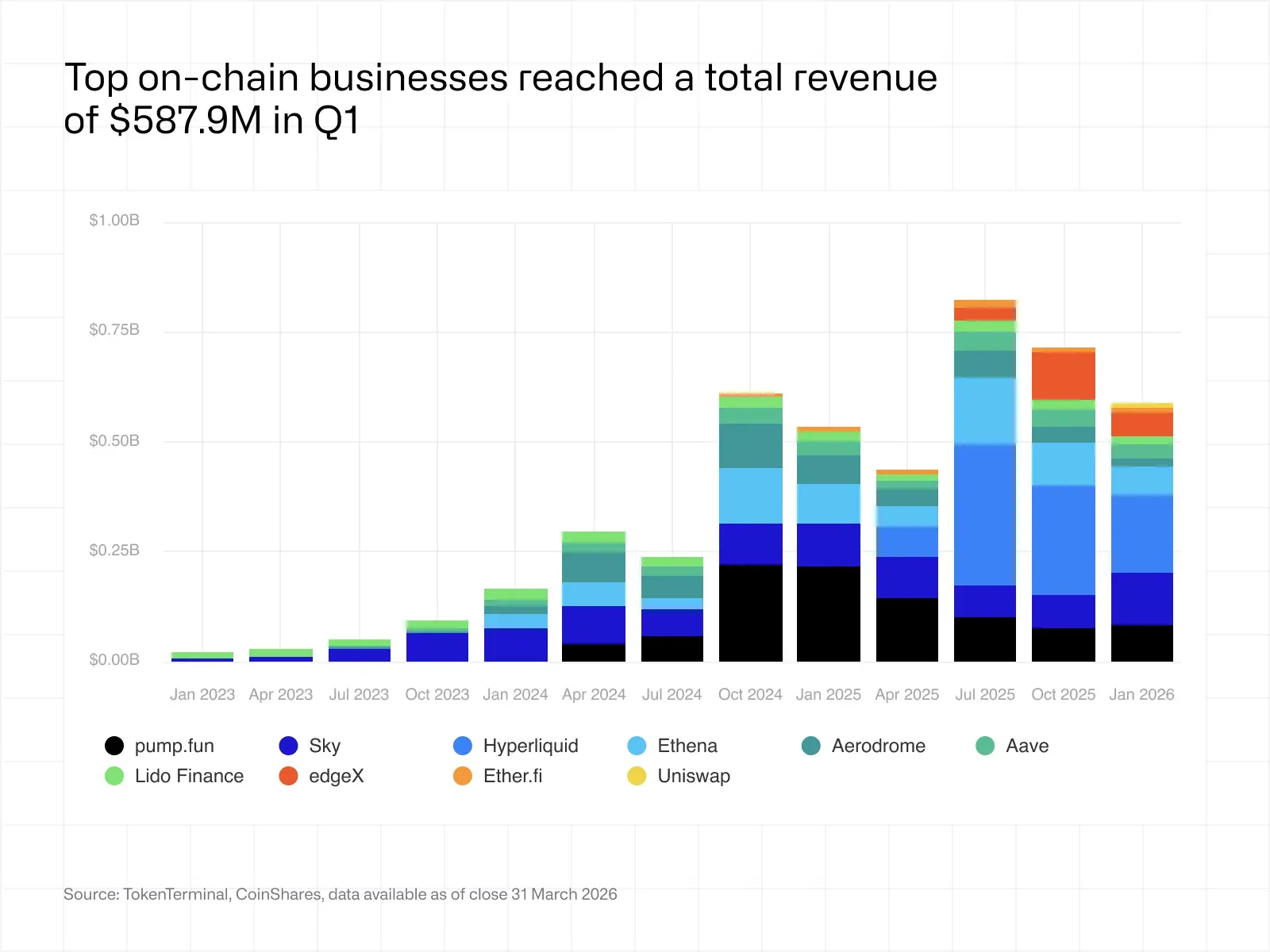
In Q1, leading on-chain businesses generated $587.9 million in revenue. The bulk came from a small group of trading platforms and stablecoin issuers, including Hyperliquid and Sky.
Ethereum settles approximately $180 billion in stablecoins. At a 4% yield on underlying assets, issuers could capture roughly $7 billion in annual revenue, while the network itself earns only transaction fees. CoinShares described this as a "structural gap" between the economic value a blockchain facilitates and the revenue it actually captures.
The Hyperliquid Case Study
CoinShares highlighted Hyperliquid as a prime example of the hybrid model. The platform combines its own L1 blockchain with a perpetual DEX. In Q1, Hyperliquid generated $178.7 million in revenue, with approximately 96% coming from trading activity and a minimal contribution from the base chain.
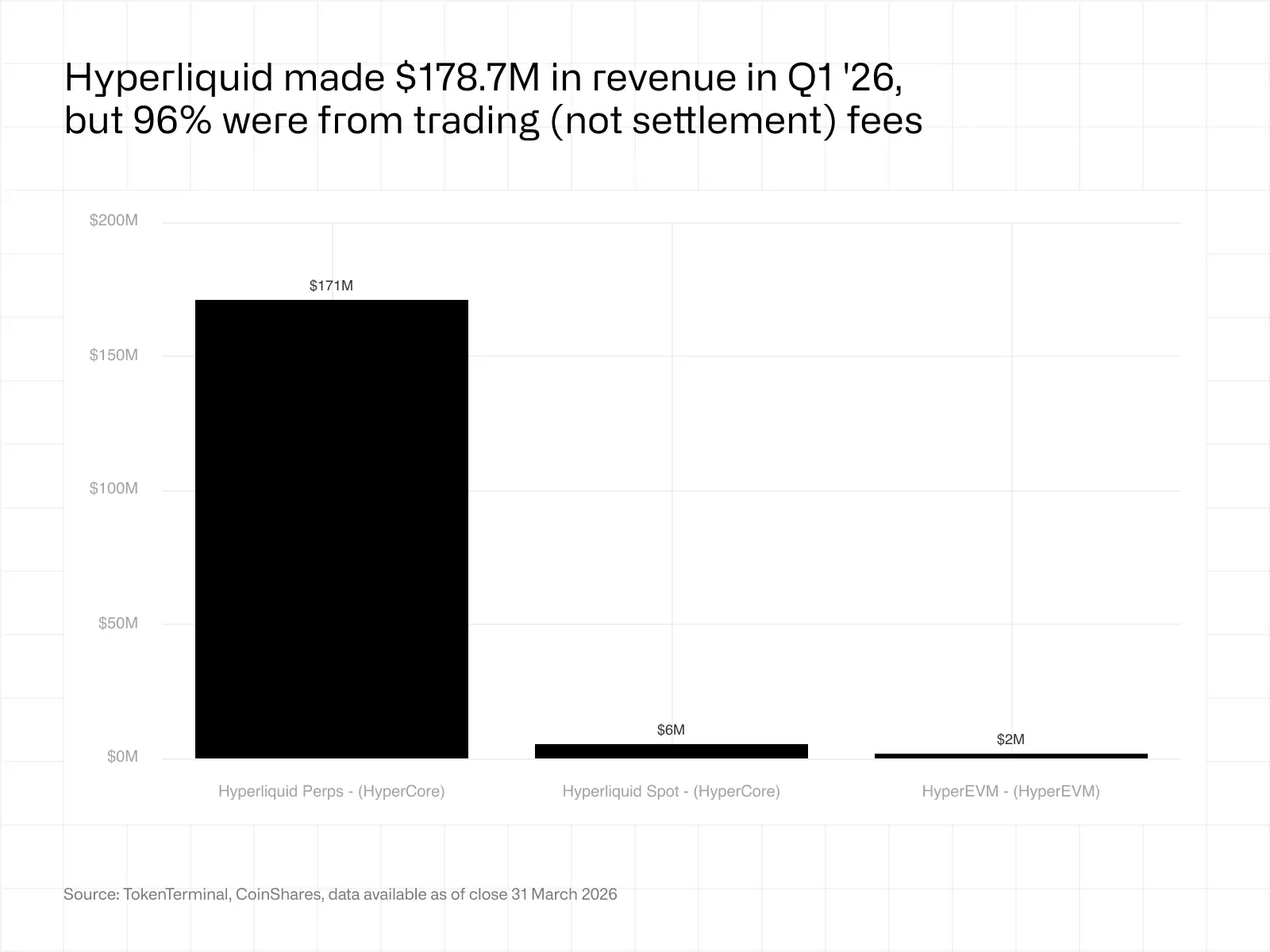
According to CoinShares, the Hyperliquid case demonstrates that the primary economic value in on-chain finance can concentrate at the application layer. A vertically integrated platform captures revenue directly from user activity, unlike general-purpose blockchains that primarily earn through fees.
This model puts pressure on general-purpose networks. If revenue continues to concentrate in applications, blockchains will need to move up the stack — either by launching their own services or integrating more closely with key protocols.
An Emerging Market Structure
The report concludes that hybrid finance can now be evaluated through specific segments: stablecoins, tokenized funds, equities, commodities, on-chain businesses, and settlement networks. The value distribution mechanism works as follows: assets attract liquidity, applications convert it into revenue, and blockchains monetize the associated transactional activity.
The critical question for the market going forward is which issuers, applications, and networks will be able to retain liquidity and user activity in the coming quarters. Earlier in April, analysts at Jefferies warned that recent DeFi hacks could temporarily slow traditional financial firms' interest in adopting blockchain technology.
Frequently Asked Questions
What is hybrid finance according to CoinShares?
Hybrid finance is a system formed at the intersection of settlement infrastructure for real economic activity, tokenization of traditional assets like treasuries and equities, and on-chain applications with sustainable revenue. CoinShares argues this segment has moved from a trend to a measurable market structure in 2026.
How big is the stablecoin market in 2026?
According to the CoinShares and Token Terminal report, total stablecoin supply reached $297.6 billion in Q1 2026, representing a 37.2% year-over-year increase. USDT and USDC remain the market leaders.
How much revenue did Hyperliquid generate in Q1 2026?
Hyperliquid earned $178.7 million in revenue during Q1 2026. Approximately 96% of this came from trading activity on its perpetual DEX, with minimal contribution from its base L1 chain.
What is the structural gap in blockchain revenue?
CoinShares highlights that Ethereum settles roughly $180 billion in stablecoins, yet earns only transaction fees. Meanwhile, stablecoin issuers could capture about $7 billion in annual revenue at 4% yield on underlying assets. This disparity between the economic value a blockchain facilitates and what it actually earns is the structural gap.
What is the total RWA market size in 2026?
The total real-world assets (RWA) market is estimated at approximately $29 billion. Tokenized funds grew 181% year-over-year to $9 billion, tokenized equities surged from $27.6 million to $773.3 million, and tokenized commodities exceeded $4.9 billion.
Read also
Weekly Recap: Bitcoin Tests $74K, Miners Dump Holdings, ChatGPT Boycott Grows
Bitcoin briefly touched $74,000 before retreating to $67,500. Public miners sold over 15,000 BTC in five months, traders flocked to Hyperliquid for oil and gold futures, and a ChatGPT boycott gained major traction.
Stablecoin Transfer Volume Hits $10.5 Trillion in January — Highest Since April 2022
January stablecoin transaction volume surpassed $10.5 trillion, marking the highest monthly figure since April 2022. USDC led transfers while USDT maintained market cap dominance.
Bernstein Calls $60,000 a 'Clear Bottom' for Bitcoin, Expects Extended Bull Cycle
Analysts at Bernstein have identified $60,000 as a firm floor for Bitcoin, projecting a structurally longer bull cycle. On-chain data from Glassnode confirms a resurgence of buying activity.
Top 10 Dollar Stablecoins in 2026: From Dominant Players to Exit Candidates
The stablecoin market has surpassed $311 billion in total capitalization. Here's a breakdown of the ten largest USD-pegged stablecoins — from undisputed leaders Tether and Circle to ambitious newcomers.
TON Wallet Introduces Yield Vaults for BTC, ETH, and USDT Directly in Telegram
TON Wallet has launched yield vaults for BTC, ETH, and USDT directly within Telegram, offering up to 18% APY on stablecoins through partnerships with Morpho, TAC, and Re7.
Weekly Recap: Aave Ecosystem Rescue Mobilizes 100,000 ETH and Quantum Computer Cracks 15-Bit ECC Key
Bitcoin held near $78,000, the DeFi community rallied over 100,000 ETH to help Aave recover from the Kelp hack, and a researcher cracked a 15-bit ECC key on a quantum computer.