
Weekly Recap: Bitcoin Tests $76K, SEC Greenlights Tokenized Stocks on Nasdaq
 BinanceEXCHANGE
Bitcoin briefly touched $76,000 before retreating to $68,800. The SEC approved tokenized stock trading on Nasdaq, while mining difficulty dropped 7.76% amid growing miner losses.
Bitcoin Surges to $76,000 Then Gives It All Back
Bitcoin kicked off the week with a strong rally, climbing from $71,000 to $74,000 on Monday before pushing to $76,000 on Tuesday — its highest level since early February. The momentum stalled on Wednesday, March 18, as escalating tensions in the Middle East and rising oil prices dampened appetite for risk assets.
The Federal Reserve's decision to hold rates steady at 3.5–3.75% added to investor caution. While the outcome was widely expected, market participants typically reduce exposure to volatile assets around Fed meetings. By Thursday, bitcoin had erased all its gains, falling to $69,000 and trading in a narrow $68,000–$70,000 range through the end of the week.
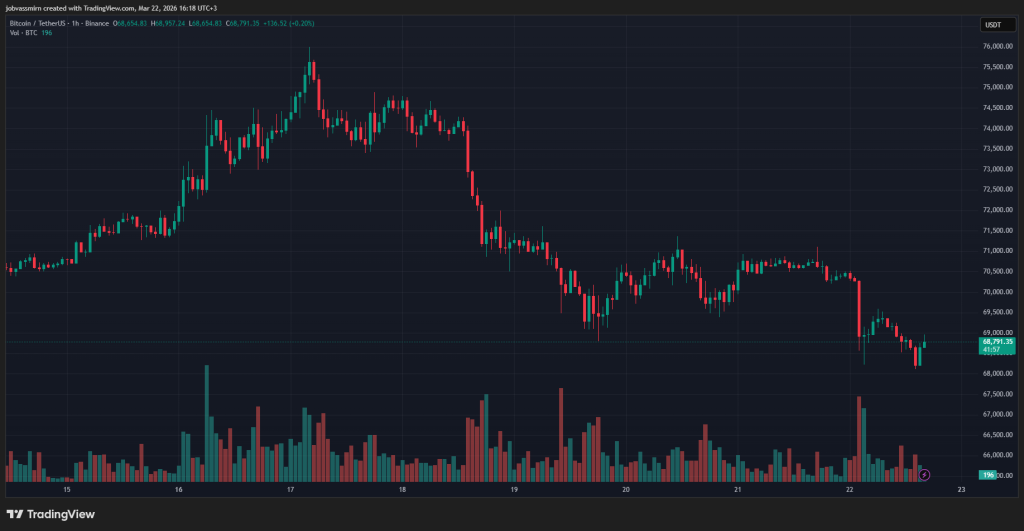
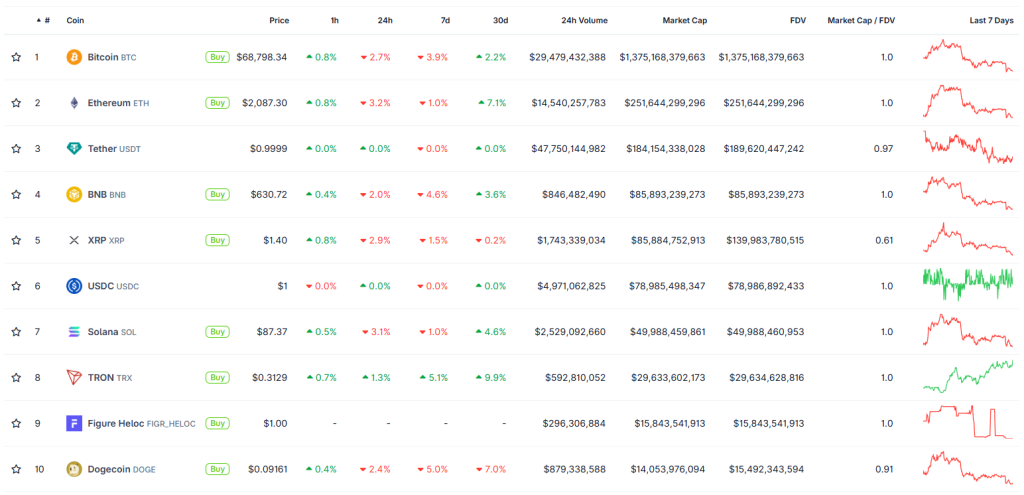
At the time of writing, BTC trades at $68,800, down 4% over seven days. Ethereum held near $2,000, losing just 1% on the week.
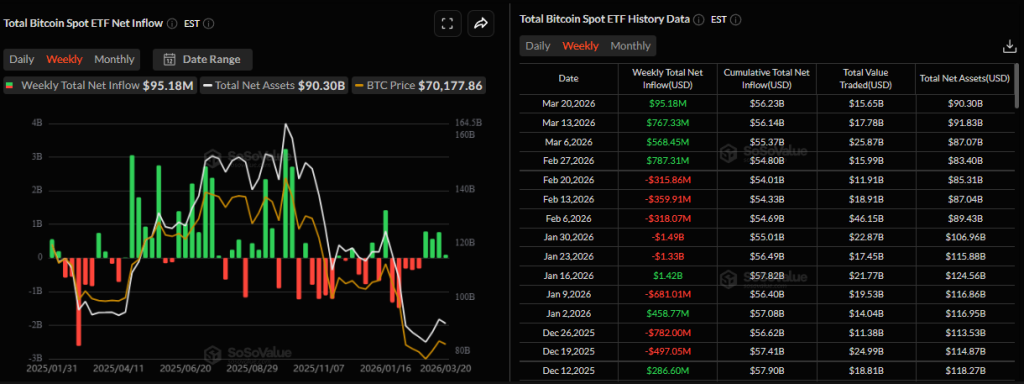
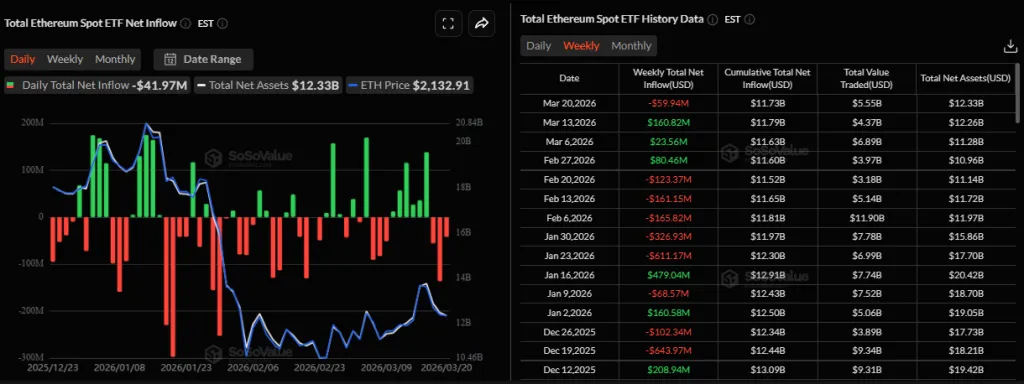
Despite the pullback, spot bitcoin ETFs recorded their fourth consecutive week of net inflows, attracting $95 million between March 16 and 20. Ethereum funds, however, broke their three-week positive streak with $59 million in outflows.
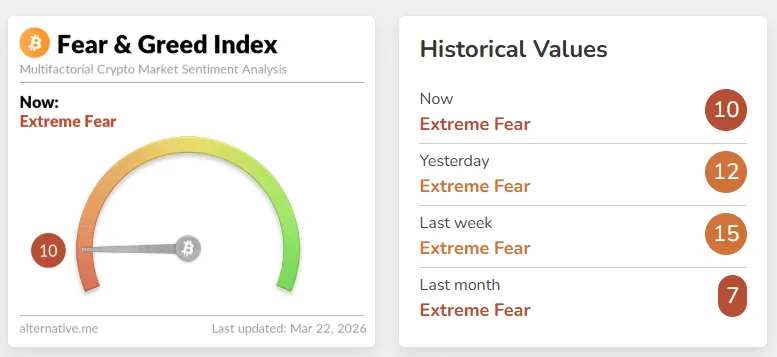
Total crypto market capitalization stands at $2.44 trillion, with BTC dominance at 56.5% and ETH at 10.3%. The Crypto Fear & Greed Index remains deep in extreme fear territory at 10 points.
Why This Matters
The simultaneous decline in bitcoin's price and sharp drop in mining difficulty signals mounting stress across the entire BTC value chain. With the average production cost exceeding $82,000 per coin (according to _checkonchain), miners face roughly 15% losses per block at current prices. Meanwhile, the SEC's approval of tokenized stocks on Nasdaq marks a watershed moment for the convergence of traditional and digital finance.
Mining Difficulty Sees Second-Largest Drop of 2026
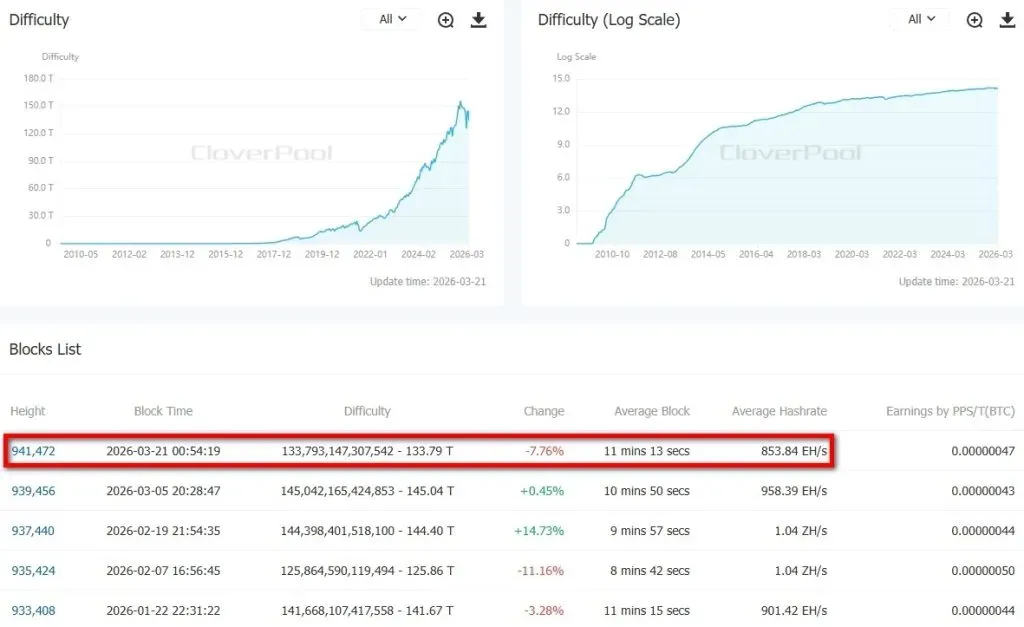
On March 21, bitcoin's mining difficulty fell 7.76% to 133.79 T — the second-deepest correction this year. The only steeper decline occurred on February 7, when a winter storm across the US knocked more than 11% off the metric by forcing widespread equipment shutdowns.
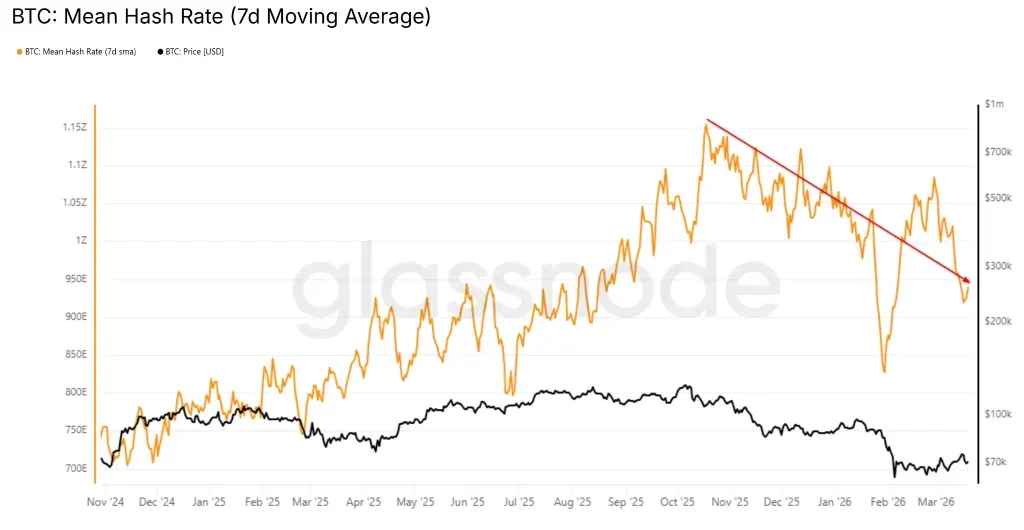
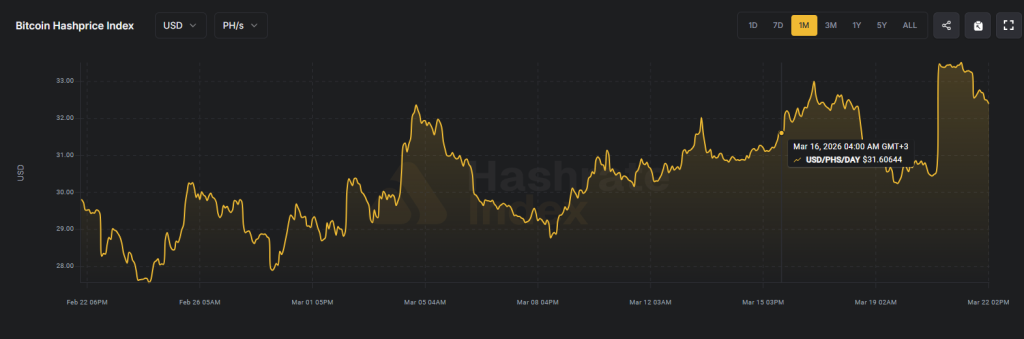
Network hashrate continues its downward trajectory, sliding to 940 EH/s from a peak of 1.15 ZH/s in mid-October 2025. The difficulty drop pushed hashprice up to $32 per PH/s per day, but industry specialists peg the average breakeven level at approximately $40 per PH/s.
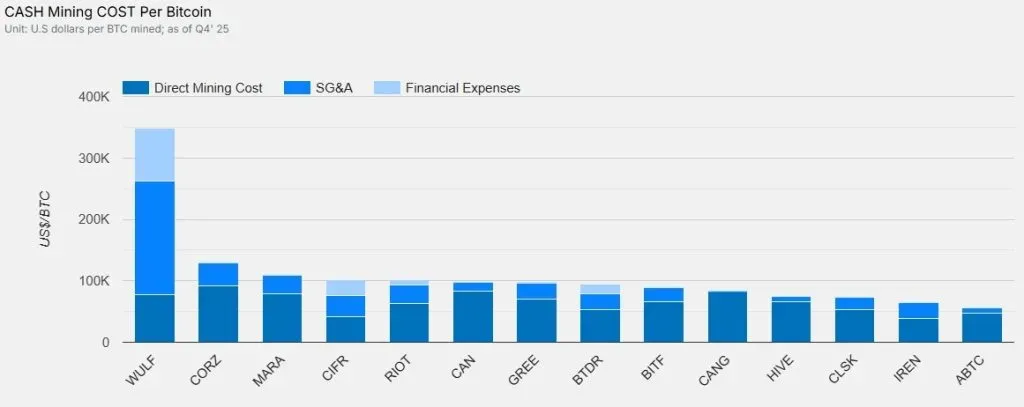
According to TheEnergyMag, only two of the 14 largest publicly traded US mining companies — IREN and American Bitcoin Corp (affiliated with the Trump family) — are currently mining at a profit. Rising oil prices are driving up electricity costs, forcing operators to sell holdings and redirect capacity toward more profitable AI computing services.
SEC Clears Tokenized Stock Trading on Nasdaq
The Securities and Exchange Commission approved Nasdaq's proposal to trade tokenized equities. The initiative covers stocks from the Russell 1000 index and select ETFs. Tokenized versions will retain all properties of their traditional counterparts — ownership rights, ticker symbols, and trade priorities — with clearing and settlement conducted through existing market infrastructure.
Under the approved mechanism, brokers can flag RWA orders at submission. After execution, Nasdaq sends settlement instructions to the Depository Trust Company (DTC). If DTC cannot process the request due to network or other constraints, settlement defaults to the standard non-tokenized format.
The SEC emphasized that placing a security on a blockchain does not alter its legal status — the asset remains a stock, not a technology product.
SEC Chair Paul Atkins also unveiled a new token taxonomy with four categories that fall outside the securities classification: digital commodities, digital collectibles, digital instruments, and payment stablecoins (under the GENIUS Act). Only "digital securities" — tokenized versions of traditional financial instruments — fall under securities law. Atkins additionally announced work on Regulation Crypto Assets, a new rulebook featuring startup exemptions and a safe harbor for investment contracts.
OpenClaw Sparks Security Crisis in China
The AI agent-building tool OpenClaw became the center of a security controversy in China. A paid service for removing the application emerged on Chinese social media — ironically, users had previously paid to install it. One Alibaba user from Shanghai advertised uninstallation for 299 yuan ($43.55).
The mass exodus began after China's National Computer Incident Response Center warned that OpenClaw ships with extremely weak default security settings. Several Chinese universities issued advisories recommending users stick to the latest official version and restrict the app's internet access.
Outside China, OpenClaw is being weaponized for crypto theft. According to OX Security, scammers created fake GitHub accounts and lured developers with promises of $5,000 in CLAW tokens, directing victims to a phishing site that closely replicated the official OpenClaw page to drain cryptocurrency wallets.
Tokenized Real-World Assets Hit Records on Hyperliquid
Open interest on Hyperliquid's HIP-3 real-world asset markets surged to a record $1.43 billion — a 100x increase in just six months since launch. Trade.xyz, built by the Hyperunit division, dominates the segment with roughly 90% of total OI and daily trading volume reaching $22 billion.
Only seven of Trade.xyz's top 30 instruments are crypto pairs; the rest include oil benchmarks and equity indices. On March 18, S&P Dow Jones Indices licensed Trade.xyz to launch the first official perpetual contracts on the S&P 500 index. Within four days, open interest exceeded $52 million with daily volume hitting $22 million.
The appeal of non-crypto derivatives lies in 24/7 availability — the ability to trade on weekends and after traditional market hours draws a new audience from beyond the crypto-native community.
Frequently Asked Questions
Why did Bitcoin drop after hitting $76,000?
The rally stalled due to escalating Middle East tensions and rising oil prices. The Fed's decision to hold rates at 3.5–3.75% further dampened risk appetite, causing BTC to retreat to the $68,000–$70,000 range by week's end.
What are tokenized stocks on Nasdaq?
These are blockchain-based versions of traditional equities from the Russell 1000 index and select ETFs. They retain all properties of conventional stocks, including ownership rights and ticker symbols, with clearing handled through existing market infrastructure.
How much does it cost to mine one Bitcoin in March 2026?
According to _checkonchain, the average production cost per bitcoin exceeds $82,000. At the current price of $69,000, miners face approximately 15% losses per block created.
Why is OpenClaw being removed in China?
China's National Computer Incident Response Center warned that OpenClaw has extremely weak default security settings. Multiple Chinese universities also issued advisories recommending users limit the app's internet access and permissions.
What record did Hyperliquid's real-world asset market set?
Open interest on Hyperliquid's HIP-3 real-world asset markets reached a record $1.43 billion, representing a 100x increase in six months. Trade.xyz accounts for roughly 90% of total OI with daily volumes reaching $22 billion.
Read also
Bitcoin Down 2.5% Weekly: Jane Street Accusations & 7 Ethereum Forks
Bitcoin lost ~2.5% over the week amid macro shocks and geopolitical tensions. Jane Street faced market manipulation allegations while Ethereum unveiled an ambitious seven hard fork roadmap through 2029.
Institutional Investors Dump ETF Shares Worth 25,000 BTC During Market Crash
Institutional investors massively sold Bitcoin ETF positions in Q4 2025, offloading shares equivalent to 25,098 BTC during the crypto market correction.
Options Traders Bet on Bitcoin Rally to $80,000 by Summer
Bitcoin consolidates near $70,000 after a volatility spike. Options market participants are increasingly positioning for a rally to $80,000 by early summer, despite macroeconomic headwinds.
Bitcoin Drops Below $67,000 as Ethereum Foundation Unveils Quantum Defense Roadmap
Bitcoin lost 3% over the week amid Middle East tensions and ETF outflows, miner activity hit historic lows, and Ethereum Foundation outlined a four-hardfork plan for quantum resistance by 2029.
Weekly Recap: 20M BTC Mined, US Treasury Backs Crypto Mixer Privacy Rights
Less than 1 million bitcoins remain to be mined, the US Treasury reversed its stance on crypto mixers to support privacy rights, and Hyperliquid crossed $4 trillion in cumulative trading volume.
TON Wallet Introduces Yield Vaults for BTC, ETH, and USDT Directly in Telegram
TON Wallet has launched yield vaults for BTC, ETH, and USDT directly within Telegram, offering up to 18% APY on stablecoins through partnerships with Morpho, TAC, and Re7.