
Traditional Exchange Closures Trigger Global On-Chain Trading Surge
U.S. strikes on Iran during the weekend, when stock markets were closed, drove investors to crypto platforms en masse. Bitwise CIO Matt Hougan declared crypto the "world's primary trading venue."
Crypto Becomes the World's Financial Hub Over the Weekend
News of U.S. military strikes on Iranian territory broke overnight on February 28 — while traditional stock exchanges were shuttered. With no conventional instruments available to react to the geopolitical shock, investors flocked to 24/7 on-chain platforms in unprecedented numbers.
Bitwise Chief Investment Officer Matt Hougan described cryptocurrencies as the "world's primary trading venue" in the wake of the events. According to Hougan, on-chain space remained the center of the financial world for nearly the entire Sunday, marking the first time in his memory that crypto markets became simply "the market, period."
Why This Matters
The episode highlighted a fundamental advantage of decentralized finance — round-the-clock availability regardless of traditional market schedules. The migration of investor activity to on-chain infrastructure during a critical geopolitical moment could accelerate the convergence of blockchain-based systems with conventional finance.
The capital shift to decentralized venues produced dramatic spikes across multiple platforms:
- Hyperliquid saw surging futures volumes for both oil and crypto;
- Daily trading volume for Tether's tokenized gold (XAUT) exceeded $300 million;
- Prediction markets Kalshi and Polymarket hit record trading volumes;
- Bitcoin and Ethereum attracted heightened trader attention.
Hougan Revises His On-Chain Timeline
The Bitwise executive acknowledged that the weekend's events forced him to fundamentally reassess his forecasts. He previously expected on-chain markets to develop on the periphery over the next 5–10 years. Now he believes their integration into traditional finance will happen far more rapidly.
Hougan argues that banks, hedge funds, and corporate traders essentially have no choice: they will need to set up stablecoin wallets, learn to trade on DEXes, and familiarize themselves with tokenized assets. As the Bitwise director put it: "Even if you don't, someone else will."
Bitcoin in the 60/40 Portfolio: Updated Bitwise Research
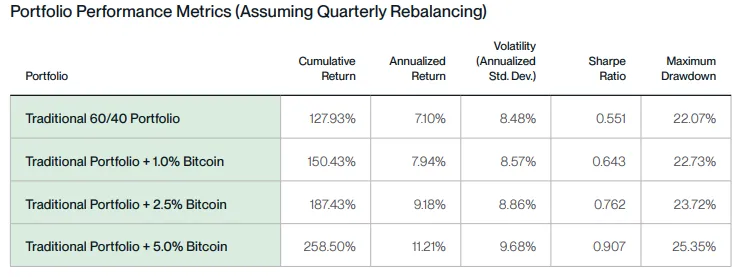
Alongside the market commentary, Hougan and quantitative analyst Mallika Kolar published an updated study examining Bitcoin's impact on the classic 60% equities / 40% bonds investment portfolio. The analysis covered market data from January 2014 through December 2025.
"New study update: Adding bitcoin to a 60/40 portfolio has increased cumulative and risk-adjusted returns in 100% of three-year holding periods. The win rate over two years is 93%! Updated study from @Bitwise with data through year-end 2025." — Matt Hougan (@Matt_Hougan), original post
Key findings from the research:
- The baseline 60/40 strategy delivered cumulative returns of 127.9% (7.1% annualized) over the study period;
- A 2.5% Bitcoin allocation with quarterly rebalancing boosted the result to 187.4%;
- A 5% allocation nearly doubled the total return to 258.5%;
- The 2.5% allocation had minimal impact on maximum drawdown: 23.7% versus 22.1% for the classic strategy.
Three Rules: Time Horizon, Rebalancing, and Position Limits
The analysts emphasized that Bitcoin improves risk-adjusted returns only when three conditions are met: extended holding periods, regular rebalancing, and strict position-size limits.
The optimal investment horizon is three years or more. Over one-year periods, Bitcoin improved portfolio returns in 76% of cases. Over two years, the success rate climbed to 94%. For any three-year window, the probability of positive outcomes reached 100%.
Skipping rebalancing dramatically increases risk. A buy-and-hold approach with a 2.5% Bitcoin allocation could have generated 421.4% returns, but the portfolio's maximum drawdown would have ballooned to 50.9%. Quarterly rebalancing was identified as the optimal approach — preserving strong returns while keeping volatility within acceptable bounds.
The researchers also identified a non-linear relationship between Bitcoin allocation size and risk metrics. Allocations ranging from 0.5% to 4.5% have virtually no effect on maximum drawdown. However, beyond the 5% threshold, potential losses begin to escalate sharply while Sharpe ratio gains diminish.
Bitwise stressed that past performance does not guarantee future results, but a decade of data confirms that moderate Bitcoin exposure (up to 5%) structurally improves the metrics of any diversified portfolio.
Earlier, on March 2, analysts at London Crypto Club said the U.S. and Israeli military operation against Iran would have a positive effect on Bitcoin's price.
Frequently Asked Questions
Why did crypto become the primary trading venue over the weekend?
Traditional stock exchanges were closed when news of U.S. strikes on Iran broke overnight on February 28. Investors who needed to react to the geopolitical shock had no choice but to turn to 24/7 on-chain trading platforms.
How much Bitcoin should you add to a 60/40 portfolio?
Bitwise research suggests an optimal Bitcoin allocation of 2.5% to 5% in a traditional 60/40 portfolio. Allocations up to 4.5% barely affect maximum drawdown, while exceeding 5% causes risk metrics to deteriorate sharply.
Which crypto platforms hit record trading volumes?
Hyperliquid saw surging oil and crypto futures volumes. Prediction markets Kalshi and Polymarket set new trading records. Tether's tokenized gold (XAUT) exceeded $300 million in daily volume.
Does a Bitcoin portfolio allocation require rebalancing?
Yes, quarterly rebalancing is essential. Without it, a 2.5% Bitcoin allocation could have yielded 421.4% returns but with a maximum drawdown of 50.9%. Regular rebalancing preserves strong gains while keeping volatility manageable.
What is the optimal holding period for Bitcoin in a portfolio?
According to Bitwise, the ideal investment horizon is three years or longer. Over any three-year period studied, adding Bitcoin improved portfolio returns 100% of the time. The success rate drops to 76% for one-year windows.
Read also
TON Wallet Introduces Yield Vaults for BTC, ETH, and USDT Directly in Telegram
TON Wallet has launched yield vaults for BTC, ETH, and USDT directly within Telegram, offering up to 18% APY on stablecoins through partnerships with Morpho, TAC, and Re7.
Weekly Recap: Aave Ecosystem Rescue Mobilizes 100,000 ETH and Quantum Computer Cracks 15-Bit ECC Key
Bitcoin held near $78,000, the DeFi community rallied over 100,000 ETH to help Aave recover from the Kelp hack, and a researcher cracked a 15-bit ECC key on a quantum computer.
Bitcoin Hits $70,000 as Iran Ceasefire Talks Boost Risk Appetite
Bitcoin surged 4% to test the $70,000 level on April 6 amid reports of ceasefire negotiations between the US, Israel, and Iran. The derivatives market, however, sends mixed signals.
Stablecoin Transfer Volume Hits $10.5 Trillion in January — Highest Since April 2022
January stablecoin transaction volume surpassed $10.5 trillion, marking the highest monthly figure since April 2022. USDC led transfers while USDT maintained market cap dominance.
Bloomberg and Kaiko Partner to Bring Financial Data On-Chain via Canton Network
Bloomberg and Kaiko have partnered to bring institutional-grade financial data on-chain through Canton Network, starting with tokenized US Treasuries and repo operations.
Weekly Recap: Bitcoin Tests $76K, SEC Greenlights Tokenized Stocks on Nasdaq
Bitcoin briefly touched $76,000 before retreating to $68,800. The SEC approved tokenized stock trading on Nasdaq, while mining difficulty dropped 7.76% amid growing miner losses.