
Oil Surpasses $115: CryptoQuant Analyst Warns of Risks for Bitcoin
 BinanceEXCHANGE
A 60%+ surge in oil prices driven by the Middle East conflict threatens the crypto market, according to CryptoQuant analyst Darkfost. Meanwhile, Bitcoin shows surprising resilience as Japanese traders flock to BTC.
Oil Rally Threatens Crypto Markets
Geopolitical turmoil in the Middle East has driven oil prices up more than 60% since the start of 2026. CryptoQuant analyst Darkfost has flagged the surge as a serious headwind for Bitcoin and the broader crypto market.
"Oil Prices Surge Amid Hormuz Tensions: Implications for BTC and Markets. Historically, periods when oil prices regain strength often coincide with BTC end-of-cycle phases." — CryptoQuant.com (@cryptoquant_com), original post
The primary catalyst behind the rally is shipping disruptions in the Strait of Hormuz — a chokepoint handling roughly 20% of global oil exports and nearly 35% of all seaborne shipments. Any incident that blocks or impedes transit immediately ripples through commodity prices.
According to Darkfost, rising oil will inevitably fuel inflation and weigh on financial markets sensitive to supply shocks. For volatile, risk-on assets like Bitcoin, this environment is particularly hostile. The analyst noted that historically, periods of strengthening oil prices have frequently coincided with the final phases of Bitcoin's market cycles.
Asian Stock Markets in Panic Mode
Oil breaking above $115 per barrel triggered a broad sell-off across global equities. Asian indices opened sharply lower given the region's heavy dependence on Middle Eastern energy imports. Japan's Nikkei 225 plunged more than 6%, while South Korea's Kospi dropped roughly 8%.
Amid the equity rout, trading activity on Japan's Bitflyer exchange surged 200%, outpacing global platforms: Coinbase saw a 119% increase, while Binance recorded 82%. South Korean exchanges showed more restrained growth — Upbit volumes rose 32% and Bithumb 52%.
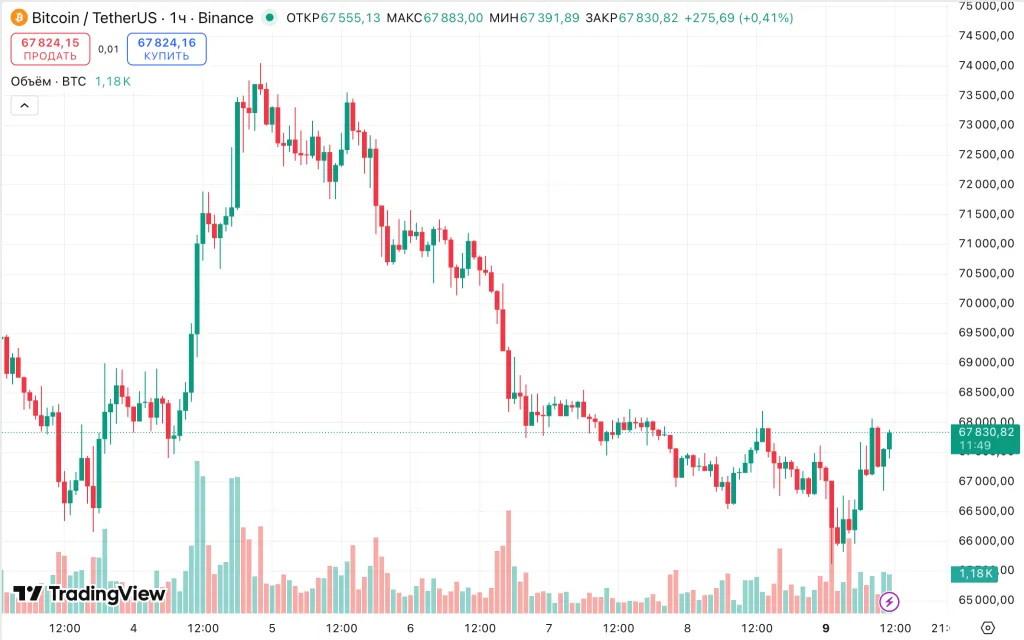
Japanese traders were the most aggressive in rotating into Bitcoin. During Asian hours, BTC gained 2.05% against the yen compared to +1.86% versus the dollar and +1.64% against the won. At the time of the original publication, Bitcoin was trading near $67,800, having briefly dipped to $65,700 on March 9.
Why This Matters
An oil shock reverberates through the entire global economy: surging energy costs accelerate inflation, pressure central banks toward tighter monetary policy, and erode investor appetite for risk assets. Despite the "digital gold" narrative, Bitcoin still tends to correlate with risk-on instruments during macroeconomic disruptions. The current situation is a real-world stress test for the thesis that Bitcoin can serve as a safe haven.
QCP: Bitcoin Showing Unexpected Resilience
Analysts at QCP described Bitcoin's behavior as "surprisingly resilient" despite broad weakness in risk assets and a defensive shift across global equity markets.
"QCP Market Colour, 09 March 2026. Missiles Over Markets. Iran tensions failed to cool over the weekend, pushing oil above $115 on fears of sustained disruption through the Strait of Hormuz and wider Middle East instability. Global equities have turned defensive." — QCP (@QCPgroup), original post
Some crypto investors continue hedging downside risk through short-term contracts targeting the $61,000–$64,000 range. However, options flow paints a more nuanced picture: a 500x BTC straddle purchase with an April 24 expiry at a $72,000 strike signals expectations of elevated volatility rather than an inevitable crash.
The March open interest structure is concentrated around call options at $75,000 and $125,000 strikes. QCP considers both targets unlikely to be reached, yet the persistence of these positions suggests sustained demand. The firm concluded that while Bitcoin is still far from achieving true "digital gold" status, its role as a "digital escape hatch" is becoming increasingly apparent — especially in Gulf states where currency volatility and political instability are constant features.
Hyperliquid Absorbs Oil Derivatives Demand
The crude oil perpetual contract (ticker CL-USDC) on decentralized exchange Hyperliquid hit a local peak near $117, up 20% in 24 hours, before correcting to $101. Daily trading volume for the instrument exceeded $1 billion.
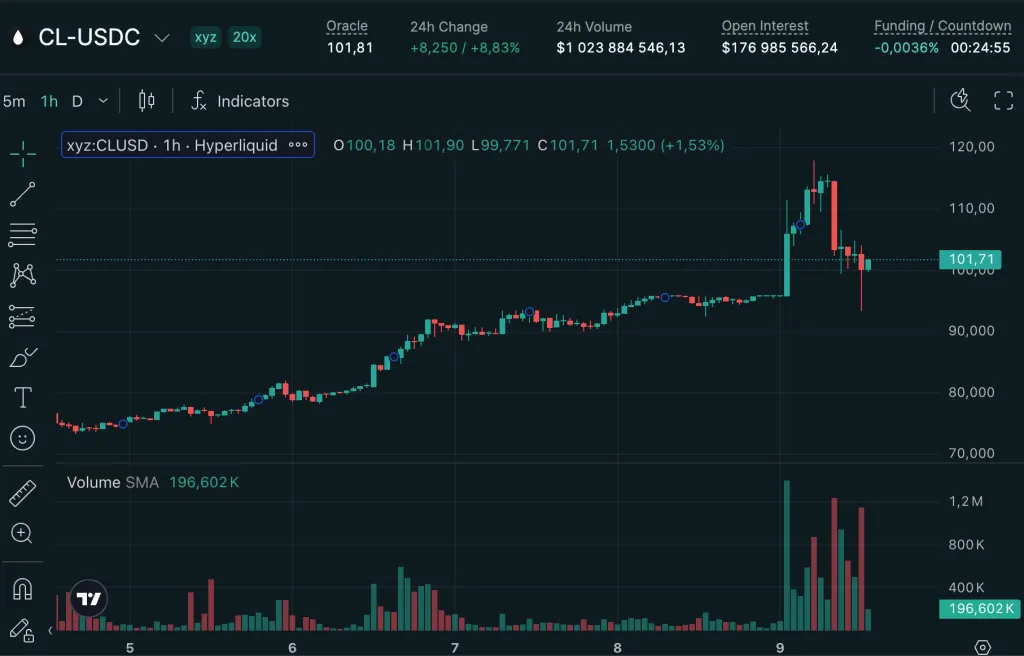
According to Pine Analytics, on March 8 the combined daily volume for oil derivatives in Hyperliquid's HIP-3 segment reached $720 million — an all-time record for weekend trading sessions.
"Today is the highest volume day in terms of HIP-3 volume on a weekend, and this is driven by @tradexyz." — Pine Analytics (@PineAnalytics), original post
The activity spike was driven by the US and Israel launching military operations against Iran over the weekend, when traditional exchanges were closed. Traders pivoted en masse to Hyperliquid, which operates 24/7. A similar pattern emerged in January during the silver rally: the metal surged from $85 to $114 in two weeks, with futures volumes peaking at $4.67 billion on weekdays and $460 million on weekends.
Pine Analytics suggested that if Hyperliquid continues capturing demand for traditional assets during off-hours, its native token HYPE stands to benefit and could keep outperforming the broader crypto market. Over the past 24 hours the token gained 1.8%, and over two weeks it rose 10.3%, according to CoinGecko data.
Frequently Asked Questions
How does rising oil affect Bitcoin price?
CryptoQuant analyst Darkfost explained that surging oil prices fuel inflation and hurt risk-sensitive assets, including Bitcoin. Historically, periods of strengthening oil prices have coincided with BTC end-of-cycle phases.
Why are Japanese traders buying Bitcoin during the oil crisis?
The Nikkei 225 crashed over 6% due to the oil shock, prompting Japanese investors to rotate into Bitcoin. Bitflyer trading activity surged 200%, and BTC gained 2.05% against the yen — more than against the dollar or won.
What is happening with oil derivatives on Hyperliquid?
The CL-USDC crude oil perpetual on Hyperliquid peaked near $117 with daily volume exceeding $1 billion. On March 8, HIP-3 segment oil derivatives volume reached $720 million — an all-time weekend record.
Is Bitcoin acting as a safe haven during the Middle East conflict?
QCP analysts called Bitcoin's performance "surprisingly resilient" amid global equity weakness. While BTC is not yet true "digital gold," its role as a "digital escape hatch" is growing, particularly in Gulf states facing currency volatility and political instability.
Why does Hyperliquid benefit from geopolitical crises?
Hyperliquid operates 24/7, unlike traditional exchanges. When military actions begin on weekends, traders shift to the platform for commodity derivatives trading. A similar surge occurred in January during the silver rally, when futures volumes peaked at $4.67 billion on weekdays.
Read also
Bitcoin Hits $70,000 as Iran Ceasefire Talks Boost Risk Appetite
Bitcoin surged 4% to test the $70,000 level on April 6 amid reports of ceasefire negotiations between the US, Israel, and Iran. The derivatives market, however, sends mixed signals.
Weekly Recap: 20M BTC Mined, US Treasury Backs Crypto Mixer Privacy Rights
Less than 1 million bitcoins remain to be mined, the US Treasury reversed its stance on crypto mixers to support privacy rights, and Hyperliquid crossed $4 trillion in cumulative trading volume.
Bernstein Calls $60,000 a 'Clear Bottom' for Bitcoin, Expects Extended Bull Cycle
Analysts at Bernstein have identified $60,000 as a firm floor for Bitcoin, projecting a structurally longer bull cycle. On-chain data from Glassnode confirms a resurgence of buying activity.
Bitcoin Down 2.5% Weekly: Jane Street Accusations & 7 Ethereum Forks
Bitcoin lost ~2.5% over the week amid macro shocks and geopolitical tensions. Jane Street faced market manipulation allegations while Ethereum unveiled an ambitious seven hard fork roadmap through 2029.
TON Wallet Introduces Yield Vaults for BTC, ETH, and USDT Directly in Telegram
TON Wallet has launched yield vaults for BTC, ETH, and USDT directly within Telegram, offering up to 18% APY on stablecoins through partnerships with Morpho, TAC, and Re7.
Weekly Recap: Aave Ecosystem Rescue Mobilizes 100,000 ETH and Quantum Computer Cracks 15-Bit ECC Key
Bitcoin held near $78,000, the DeFi community rallied over 100,000 ETH to help Aave recover from the Kelp hack, and a researcher cracked a 15-bit ECC key on a quantum computer.