
K33: Bitcoin Enters Third-Deepest Oversold Zone in History — 'The Worst Is Behind Us'
K33 head of research Vetle Lunde declared that bitcoin's five-month selloff is nearing its end, with the weekly RSI dropping to 26.84 — one of the lowest readings in the asset's history.
Bitcoin Plunges Into Historic Oversold Territory
After five consecutive months of decline — one of the longest losing streaks on record — bitcoin's weekly RSI has dropped to 26.84. K33 head of research Vetle Lunde highlighted that such extreme readings have occurred only a handful of times throughout BTC's entire trading history.
According to the analytics firm, the primary selling pressure in recent months came from long-term holders and institutional investors. The fourth quarter saw several notable developments:
- A sharp decline in the supply of coins aged six months or older;
- ETFs shedding nearly 100,000 BTC;
- Open interest in CME futures falling to two-year lows.
However, Lunde noted that the pace of outflows has started to decelerate.
Why This Matters
Extreme RSI oversold conditions have historically signaled proximity to market bottoms. When institutional investors and large holders stop aggressively selling, the market gains a foothold for stabilization and potential recovery. The current situation carries additional weight as it unfolds against a backdrop of geopolitical turmoil — the escalating Middle East conflict that has rattled equity markets and sent energy prices soaring.
Derivatives Signal Peak Bearishness
K33 analysts identified the derivatives market as one of the most telling indicators of current sentiment. The 30-day average funding rate on bitcoin perpetual futures recently turned negative — only the tenth such occurrence since 2018. Negative funding rates indicate that traders are aggressively closing long positions or opening shorts, pushing perpetual contracts to trade at a discount to spot prices.
A similar pattern has emerged in the options market, where traders are actively buying downside protection and paying significant premiums for bearish bets, according to Lunde.
Yet historical precedent offers grounds for optimism. Following previous episodes of deeply negative funding, bitcoin's average 30-day return was approximately 13% (with a 56% success rate), the 90-day return averaged 62% (78% success rate), and the six-month return reached a mean of 101% with the same 78% probability of a positive outcome.
Resilience Amid Geopolitical Shock
Despite the defensive positioning across derivatives markets, bitcoin showed notable resilience as the Middle East conflict escalated. Following strikes by the U.S. and Israel on Iran and retaliatory actions, oil and gas prices surged while equity markets fell. Bitcoin, meanwhile, posted a modest gain.
Lunde attributed this dynamic to the extensive risk reduction that had already taken place in prior months. Institutional players on CME cut their exposure by roughly a third, while ETF investors withdrew approximately 90,000 BTC over the past five months. At the same time, selling pressure from long-term holders is easing — the supply of coins older than six months is beginning to grow again.
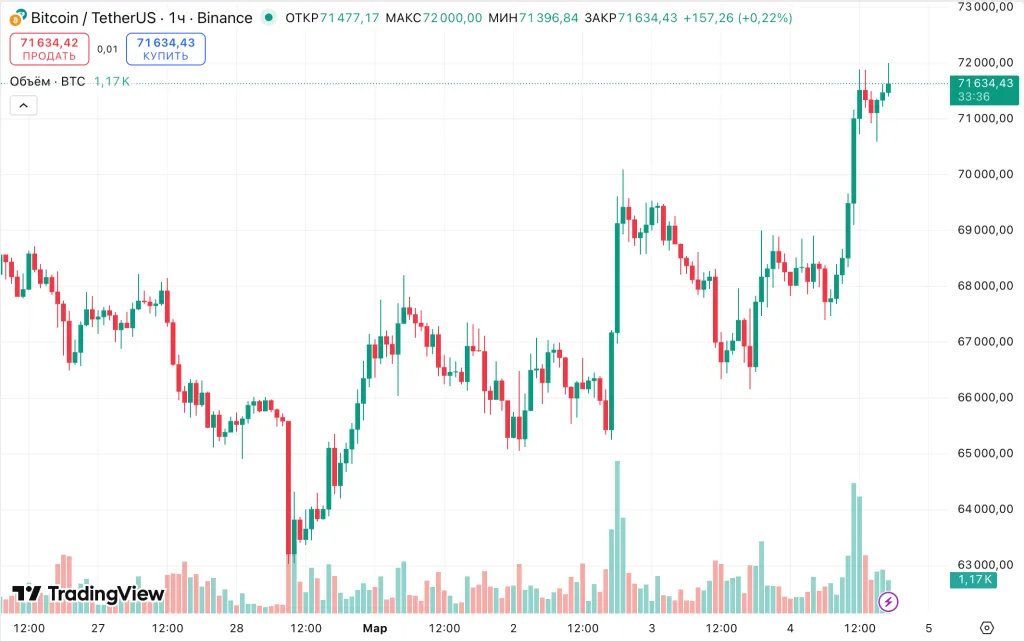
BTC/USDT hourly chart on Binance. Source: TradingView
Consolidation at a Key Technical Level
Bitcoin is currently consolidating near its 200-week moving average — a level that has historically coincided with market bottoms. At the time of the original report, the asset was trading around $71,600, having jumped 6.7% over the preceding 24 hours.
Lunde concluded that the worst is behind us and that K33 sees no reason to sell bitcoin at current levels.
Earlier in March, VanEck CEO Jan van Eck similarly stated that bitcoin's price had approached a local bottom, adding that the four-year halving cycle continues to drive price action.
Frequently Asked Questions
What is bitcoin's RSI level and why does it matter?
Bitcoin's weekly RSI has dropped to 26.84, marking the third-deepest oversold reading in the asset's entire history. Such extreme levels have historically been rare and have often preceded significant price recoveries.
How much BTC have bitcoin ETFs lost recently?
According to K33, bitcoin ETFs shed nearly 100,000 BTC. Over the past five months, ETF investors withdrew approximately 90,000 BTC, contributing to sustained downward pressure on the price.
What are bitcoin's historical returns after negative funding rates?
Historical data from K33 shows that after periods of deeply negative funding, bitcoin averaged roughly 13% returns over 30 days, 62% over 90 days, and 101% over six months. The probability of a positive outcome at the 90-day and 6-month horizons was 78%.
What price is bitcoin trading at according to K33's analysis?
At the time of K33's report, bitcoin was trading around $71,600, having gained 6.7% in the preceding 24 hours. The asset is consolidating near its 200-week moving average, a level historically associated with market bottoms.
Why didn't bitcoin crash during the Middle East conflict escalation?
K33's Vetle Lunde attributed bitcoin's resilience to the fact that significant risk reduction had already occurred in prior months. Institutional players on CME cut exposure by roughly a third, and long-term holder selling pressure was already easing.
Read also
Options Traders Bet on Bitcoin Rally to $80,000 by Summer
Bitcoin consolidates near $70,000 after a volatility spike. Options market participants are increasingly positioning for a rally to $80,000 by early summer, despite macroeconomic headwinds.
Bitcoin Down 2.5% Weekly: Jane Street Accusations & 7 Ethereum Forks
Bitcoin lost ~2.5% over the week amid macro shocks and geopolitical tensions. Jane Street faced market manipulation allegations while Ethereum unveiled an ambitious seven hard fork roadmap through 2029.
Institutional Investors Dump ETF Shares Worth 25,000 BTC During Market Crash
Institutional investors massively sold Bitcoin ETF positions in Q4 2025, offloading shares equivalent to 25,098 BTC during the crypto market correction.
Bitcoin Hits $70,000 as Iran Ceasefire Talks Boost Risk Appetite
Bitcoin surged 4% to test the $70,000 level on April 6 amid reports of ceasefire negotiations between the US, Israel, and Iran. The derivatives market, however, sends mixed signals.
Bitcoin Rebounds to $70,000 as Leverage Drops and ETF Inflows Continue
BTC recovered above $70,000 on March 10, erasing weekend losses. Spot ETFs attracted $568M in weekly inflows while the estimated leverage ratio on Binance fell sharply from 0.198 to 0.152.
Wintermute Links Bitcoin Stagnation to Macroeconomic Regime Shift
The market maker explains crypto weakness through structural economic changes: AI sector reassessment and deglobalization. Bitcoin behaves as a high-risk asset alongside tech stocks.