
Google Exposes DarkSword Exploit Chain Targeting Crypto Wallets on iPhones
Google's Threat Intelligence Group has uncovered DarkSword, a sophisticated full-chain iOS exploit. Its Ghostblade module specifically targets cryptocurrency wallet data and seed phrases.
A Full-Chain Attack on Apple Devices
Researchers at Google's Threat Intelligence Group have uncovered a sophisticated full-chain exploit for iOS dubbed DarkSword. The exploit package chains together multiple vulnerabilities in Apple's operating system to achieve complete device compromise. Of particular concern to crypto holders is the Ghostblade component — a module designed specifically to harvest cryptocurrency application data and seed phrases.
«#CertiKInsight 🚨Google Threat Intelligence has exposed "DarkSword", a full-chain iOS exploit using 6 vulnerabilities to silently compromise iPhones. Your seed phrases and wallet credentials are a target.🧵 Here's what you need to know 👇» — CertiK Alert (@CertiKAlert), original post
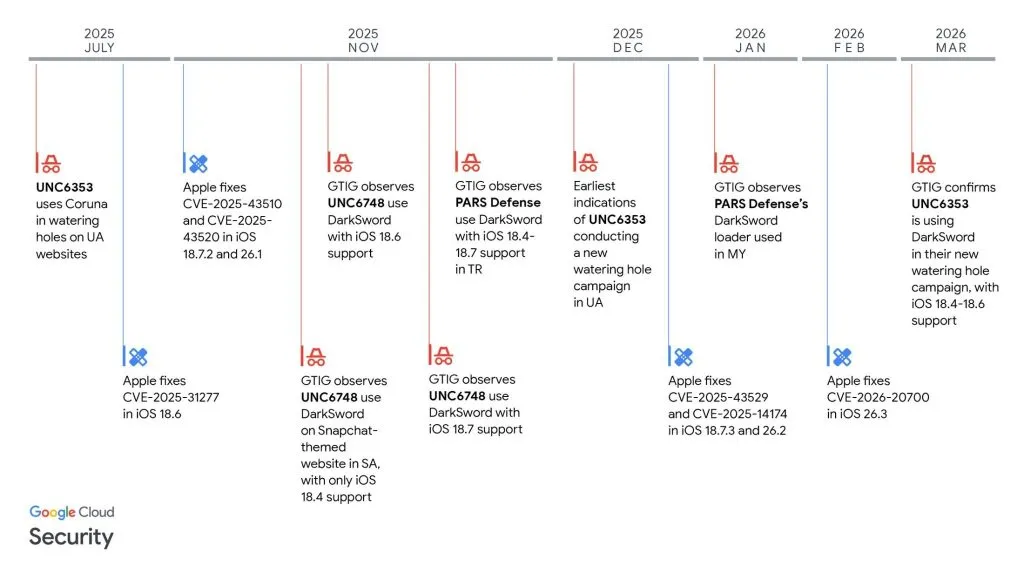
According to the findings, DarkSword has been employed by multiple hacking groups as well as commercial spyware vendors. Infection occurs via malicious websites: simply visiting a compromised page triggers the exploit chain, granting attackers access to the victim's data without any user interaction or awareness.
Why This Matters
DarkSword represents a new class of threat. Sophisticated exploit chains incorporating zero-day vulnerabilities — tools once reserved for nation-state intelligence agencies — are now proliferating among a much broader range of threat actors. For cryptocurrency holders, this translates to a qualitative leap in risk: the attack is silent, requires no action beyond visiting an infected webpage, and specifically targets digital asset credentials.
The framework is not a monolithic piece of malware. Different groups have adapted and modified its components for their own objectives, making detection significantly more challenging.
How DarkSword Works
The exploit chain leverages multiple iOS vulnerabilities, including previously unknown zero-days, to bypass the operating system's built-in security mechanisms and escalate privileges. Once a device is compromised, attackers can:
- Access messages, credentials, and files stored on the device;
- Track the owner's location;
- Extract data from applications, including cryptocurrency wallets;
- Execute arbitrary code remotely.
Ghostblade — The Primary Threat to Crypto Assets
The most dangerous component within DarkSword is the Ghostblade module. Its core function is to establish persistence after the initial breach and maintain a communication channel with the attackers' command-and-control server. Ghostblade handles the filtering and collection of high-value information: crypto application account data, seed phrases, and login credentials.
The module actively evades iOS security tools and can download additional payloads, expanding the scope of the attack after the initial compromise.
Security Recommendations
CertiK's security team has published a set of protective measures for iPhone users who hold crypto assets:
- Update iOS to version 26.3, which patches the exploited vulnerabilities;
- Enable Lockdown Mode if the update is not immediately available;
- Audit active sessions and revoke any unrecognized logins;
- Use hardware wallets and never store seed phrases on a phone.
Who Used DarkSword
According to Google's report, the exploit package was deployed by both commercial spyware vendors and hacking groups with suspected government ties. Attacks were recorded across several regions, including Ukraine, Turkey, and Middle Eastern countries.
The researchers emphasized that DarkSword reflects a troubling trend: nation-state-grade cyber espionage tools are becoming accessible to an increasingly broad spectrum of threat actors, dramatically amplifying the risks faced by everyday users and cryptocurrency holders alike.
Frequently Asked Questions
What is DarkSword and how does it threaten crypto holders?
DarkSword is a full-chain iOS exploit discovered by Google's Threat Intelligence Group that chains multiple vulnerabilities, including zero-days, to fully compromise iPhones. Its Ghostblade module specifically targets cryptocurrency wallet data and seed phrases, posing a direct threat to digital asset holders.
How can I protect my iPhone crypto wallet from DarkSword?
CertiK recommends updating iOS to version 26.3, enabling Lockdown Mode if the update isn't available, and auditing all active login sessions. Additionally, users should use hardware wallets and never store seed phrases on their phone.
How does DarkSword infect an iPhone?
DarkSword infects devices through malicious websites. Simply visiting a compromised webpage triggers the exploit chain, which silently gains access to the user's data without requiring any additional interaction or awareness from the device owner.
Who is behind the DarkSword attacks?
According to Google's research, DarkSword has been used by both commercial spyware vendors and hacking groups with suspected government affiliations. Attacks have been observed in Ukraine, Turkey, and Middle Eastern countries.
What is the Ghostblade module in DarkSword?
Ghostblade is the core persistence module within DarkSword responsible for maintaining communication with attackers' command-and-control servers. It filters and collects high-value data including crypto app credentials and seed phrases, and can download additional malicious payloads to expand the attack.
Read also
AI Audit Uncovers Critical Liveness Bug in Ethereum's Nethermind Client
Octane Security's AI discovered a high-severity vulnerability in the Nethermind execution client that could have halted block production for 38% of Ethereum mainnet validators. The Ethereum Foundation awarded a maximum $50,000 bounty.
Fake Ledger Live App in Apple's App Store Used to Steal $9.5M in Crypto
A fraudulent Ledger Live app that passed Apple's App Store review was used to siphon over $9.5M in cryptocurrency from more than 50 victims across multiple blockchain networks.
April 2026 Sets All-Time Record for Number of Crypto Hacks
April 2026 saw a record-breaking 24 crypto hacks resulting in approximately $651 million in total losses. Kelp and Drift Protocol suffered the largest exploits.
Google Enhances Opal AI Platform with New Autonomous Agents
Google has upgraded its visual AI workflow builder Opal with agent functionality that automatically analyzes tasks and selects appropriate tools for completion.
GPU Memory Attacks, $21B in Cybercrime Losses, and Chrome's Chip-Level Protection: Cybersecurity Roundup
The FBI reported record $21 billion in cybercrime losses for 2025, Google introduced hardware-bound session protection in Chrome, and researchers demonstrated three new attack methods targeting Nvidia GPU memory.
Drift Protocol on Solana Hacked for $280M in Sophisticated Durable Nonce Attack
Solana-based DeFi platform Drift Protocol lost at least $280 million in a hack on April 1. The DRIFT token dropped 37% while Circle faces criticism for failing to freeze stolen USDC.