Drift Protocol on Solana Hacked for $280M in Sophisticated Durable Nonce Attack
 CircleINFRASTRUCTURE
Solana-based DeFi platform Drift Protocol lost at least $280 million in a hack on April 1. The DRIFT token dropped 37% while Circle faces criticism for failing to freeze stolen USDC.
Drift Protocol Loses $280M in Major Exploit
On April 1, 2026, Drift Protocol — a prominent DeFi platform on Solana — suffered a devastating hack that drained at least $280 million in user funds. The attacker employed an elaborate scheme involving durable nonces and social engineering to compromise the protocol's Security Council multisig.
«We are observing unusual activity on the protocol. We are currently investigating. Please do not deposit funds into the protocol while we investigate. This is not an April Fools joke. Proceed with caution until further notice.» — Drift (@DriftProtocol), original post
The Drift team urged users to stop depositing funds and stressed that the incident was not an April Fools' Day prank.
Why This Matters
The Drift exploit ranks among the largest DeFi hacks ever recorded. It exposed critical vulnerabilities in multisig governance mechanisms even within established protocols. Statistics suggest that 80% of DeFi platforms fail to recover from major exploits of this magnitude. The incident also highlighted a systemic concern: centralized stablecoin issuers don't always act swiftly to freeze stolen assets, raising questions about the effectiveness of the industry's safety nets.
How the Attack Unfolded
According to Drift's developers, the hacker had been planning the operation for days. On March 23, the attacker created four wallets utilizing durable nonce mechanisms. Two of these wallets were linked to members of Drift's Security Council, while the other two remained under the hacker's direct control.
«Earlier today, a malicious actor gained unauthorized access to Drift Protocol through a novel attack involving durable nonces, resulting in a rapid takeover of Drift's Security Council administrative powers. This was a highly sophisticated operation that appears to have involved…» — Drift (@DriftProtocol), original post
At least two of the five multisig signatories approved transactions from these wallets. The development team believes the attacker used sophisticated social engineering techniques to secure these approvals.
When Drift performed a scheduled rotation of its Security Council days later, the hacker adapted by creating a new wallet for the updated multisig configuration on March 30. The attack itself came on April 1: shortly after Drift's team executed a legitimate test withdrawal from the insurance fund, the attacker triggered two pre-signed transactions. The first created and approved a malicious authority transfer, and the second executed it.
Stolen Assets Breakdown
The exploit affected all deposit types — lending, trading, and vault positions. DSOL tokens outside the Drift ecosystem and the Insurance Fund itself remained untouched.
On-chain analyst Vladimir S. published a detailed breakdown of the stolen assets:
«Assets stolen in dollars: $5.3M USDS, $60.4M USDC, $5.65M USDT, $430K JUP, $540K USDY, $590K ZBTC, $680K EURC, $1M BSOL, $2.5M INF, $2M MSOL, $3.3M SYRUPUSDC, $4.1M FARTCOIN, $4.4M WBTC, $3.6M JITOSOL, $4.7M WETH, $4.5M DSOL, $11.3M CBBTC, $155.6M JPL» — Vladimir S. | Officer's Notes (@officer_secret), original post
The stolen haul included wrapped Bitcoin variants, Jito tokens, the memecoin Fartcoin, stablecoins pegged to the US dollar, euro, and Japanese yen, along with various other altcoins. The hacker subsequently distributed the funds across multiple wallets.
Market Fallout
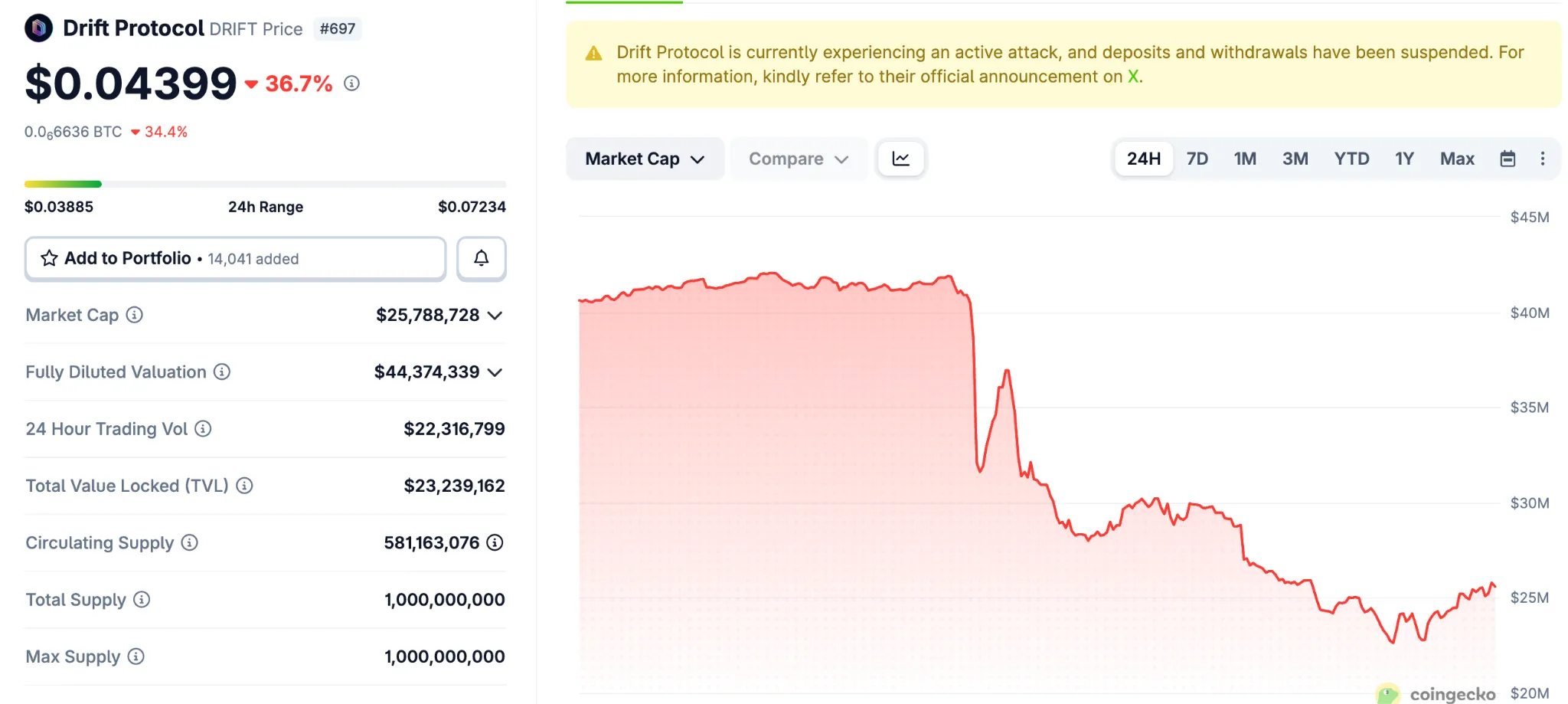
The protocol's native token DRIFT crashed nearly 37%, dropping from $0.07 to $0.04. Market capitalization was essentially cut in half — from $41 million to $25 million.
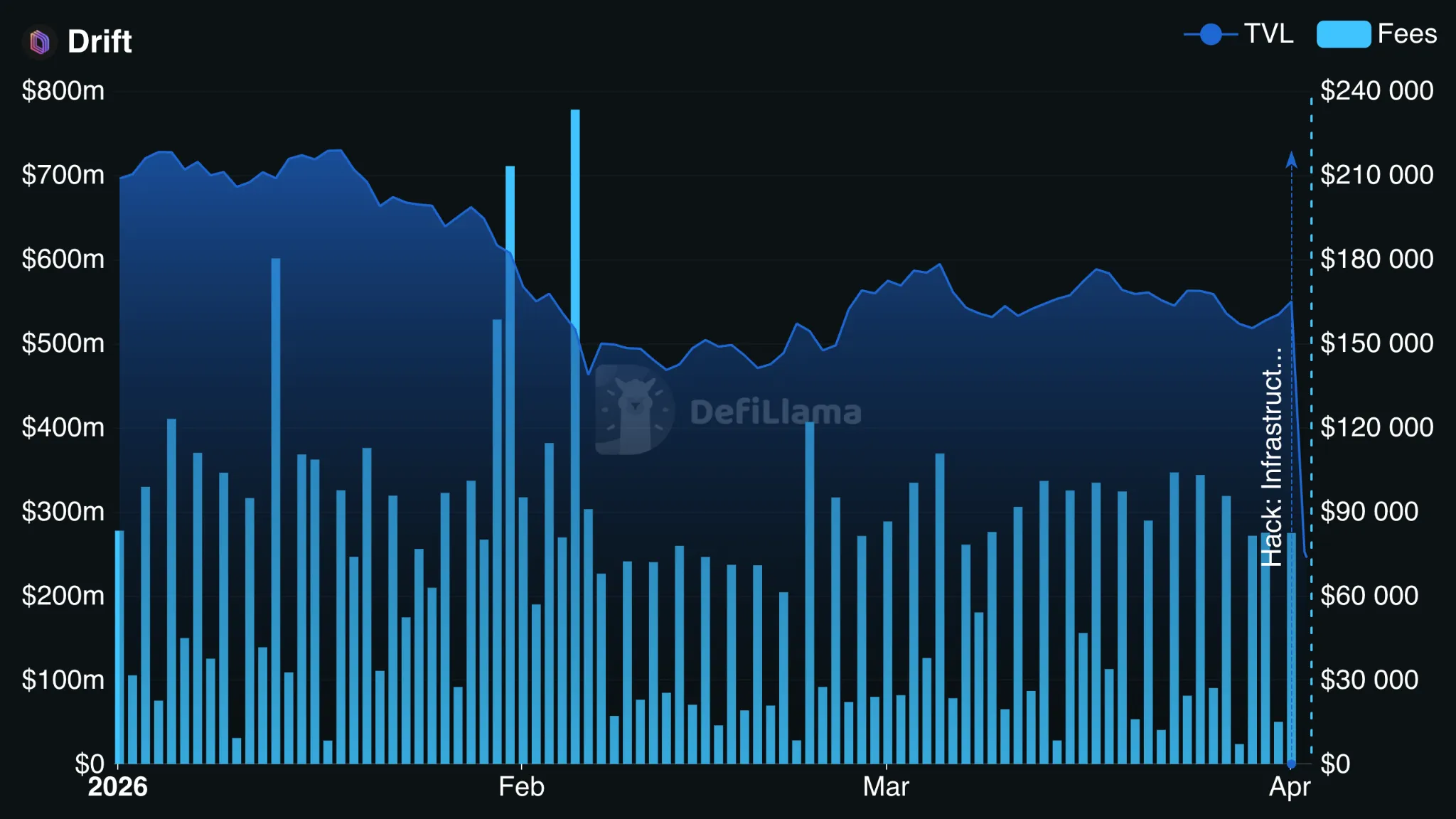
Drift's TVL stands at roughly $245 million. Community members are deeply skeptical about the protocol's ability to survive.
«I think Drift just… dies here? ByBit was able to get a billion dollar loan immediately after their hack because their yearly revenue numbers justified it. Drift doesn't make nearly enough money for a company/bank to comfortably underwrite a loan to fill the hole here. rip :/» — Eddie (@DancingEddie_), original post
Drift has frozen core protocol functions, updated its multisig, and removed the compromised wallet. The team is working with cybersecurity firms, cross-chain bridges, exchanges, and law enforcement to trace and block the stolen funds.
Circle Under Fire
The response — or lack thereof — from Circle, the company behind the USDC stablecoin, drew sharp criticism from multiple industry figures.
«Circle not freezing the USDC is hilarious because we know it's centralized but they're like nah, we'll let the money freely flow to North Korea. I like USDC since it's a programmable stablecoin for all of DeFi and enables innovation. But we can freeze the money flowing to NK» — Tommy (@Shaughnessy119), original post
Delphi Digital co-founder Tommy Shaughnessy called the situation absurd, noting that everyone is aware USDC is centralized yet Circle apparently chose not to freeze the stolen funds.
On-chain investigator ZachXBT pointed out that the hacker moved hundreds of millions of dollars from Solana to Ethereum via CCTP during US business hours, and Circle did nothing to intervene. As of publication, the company still had not taken any action. Notably, ZachXBT had already criticized Circle just days earlier — for mistakenly freezing 16 wallets in late March.
Frequently Asked Questions
How was Drift Protocol hacked?
The attacker prepared over several days, creating wallets with durable nonce mechanisms starting March 23. At least two of five Security Council multisig signatories were compromised through social engineering. On April 1, the hacker activated pre-signed transactions to seize administrative control and drain funds.
How much was stolen in the Drift Protocol hack?
At least $280 million was stolen, including $155.6M JPL, $60.4M USDC, $11.3M CBBTC, $5.65M USDT, $4.7M WETH, $4.4M WBTC, $4.1M FARTCOIN, and numerous other tokens. The stolen assets included stablecoins pegged to USD, EUR, and JPY.
Why is Circle being criticized after the Drift hack?
Industry figures accused Circle of failing to freeze stolen USDC despite having the technical capability. On-chain investigator ZachXBT noted the hacker moved hundreds of millions from Solana to Ethereum via CCTP during US business hours with no intervention from Circle.
What happened to the DRIFT token price after the exploit?
The DRIFT token crashed approximately 37%, falling from $0.07 to $0.04. Market capitalization dropped from $41 million to roughly $25 million, nearly halving in value.
Can Drift Protocol survive this hack?
Community members are deeply skeptical about recovery prospects. Statistics show 80% of protocols don't survive major exploits. Unlike Bybit, which secured a billion-dollar loan after its hack, Drift likely lacks the revenue to justify such financing from any lender.
Read also
Drift Protocol Hack Victims File Class Action Lawsuit Against Circle Over $230M in USDC
Over 100 victims of the Drift Protocol exploit have filed a class action lawsuit against Circle in Massachusetts court, accusing the USDC issuer of negligence and enabling hackers.
Stablecoin Transfer Volume Hits $10.5 Trillion in January — Highest Since April 2022
January stablecoin transaction volume surpassed $10.5 trillion, marking the highest monthly figure since April 2022. USDC led transfers while USDT maintained market cap dominance.
Top 10 Dollar Stablecoins in 2026: From Dominant Players to Exit Candidates
The stablecoin market has surpassed $311 billion in total capitalization. Here's a breakdown of the ten largest USD-pegged stablecoins — from undisputed leaders Tether and Circle to ambitious newcomers.
AI Audit Uncovers Critical Liveness Bug in Ethereum's Nethermind Client
Octane Security's AI discovered a high-severity vulnerability in the Nethermind execution client that could have halted block production for 38% of Ethereum mainnet validators. The Ethereum Foundation awarded a maximum $50,000 bounty.
TON Wallet Introduces Yield Vaults for BTC, ETH, and USDT Directly in Telegram
TON Wallet has launched yield vaults for BTC, ETH, and USDT directly within Telegram, offering up to 18% APY on stablecoins through partnerships with Morpho, TAC, and Re7.
Weekly Recap: Aave Ecosystem Rescue Mobilizes 100,000 ETH and Quantum Computer Cracks 15-Bit ECC Key
Bitcoin held near $78,000, the DeFi community rallied over 100,000 ETH to help Aave recover from the Kelp hack, and a researcher cracked a 15-bit ECC key on a quantum computer.