
Gemini Exchange Faces Crisis After IPO Amid Crypto Market Turmoil
Gemini exchange lost 85% of its market cap post-IPO, cut 25% of staff, and exited three regions. What went wrong for the Winklevoss empire?
The Winklevoss brothers' cryptocurrency exchange Gemini is experiencing one of the most challenging periods in its history. Following a successful IPO in September 2025, the company's market capitalization has plummeted by 85%, forcing management to fundamentally reconsider its business strategy.

Gemini founders Cameron and Tyler Winklevoss face significant challenges
Dramatic Post-IPO Collapse
Last September, Gemini made a triumphant debut on Nasdaq, pricing shares above the initial range. The company placed 15.18 million Class A shares at $28 each, raising $425 million. At its peak, the exchange's market value approached $4 billion.
However, reality proved harsh. Gemini's current market capitalization stands at just $661.5 million — a nearly 85% decline. GEMI shares have closed lower every single month, reflecting broader industry struggles.
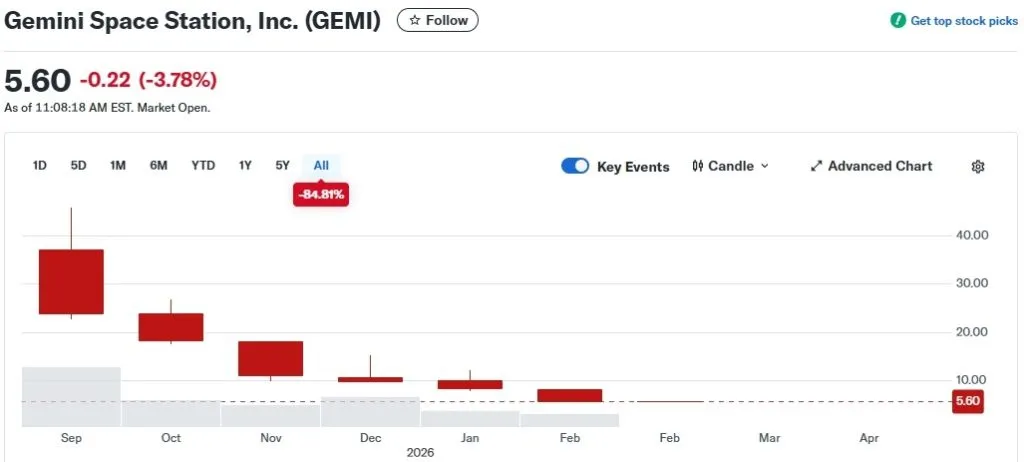
Gemini stock performance following IPO debut
Mass Layoffs and Leadership Exodus
In early February, management implemented drastic measures. The company announced a 25% workforce reduction and shuttered operations in the United Kingdom, European Union, and Australia. Additional quiet layoffs affected US offices, though their scope remains undisclosed.
The restructuring reached executive ranks: Chief Information Officer Marshall Bird, Chief Financial Officer Dan Chen, and General Counsel Tyler Mead all departed. No replacement Chief Operating Officer will be hired — co-founder Cameron Winklevoss will assume those responsibilities.
Why This Matters
Gemini's situation demonstrates the vulnerability of even major crypto platforms during bear markets. An exchange that initially positioned itself as an institutional alternative with high compliance standards now fights for survival. This underscores the critical importance of revenue diversification and conservative risk management in the volatile crypto industry.
Market Position Continues to Erode
Trading volume data reveals the scale of problems. Gemini's share of the spot crypto trading market dropped from 0.6% in June 2025 to a critical 0.1% in January. Truist Securities analysts note that the company's strategy requires fundamental revision.
"The main problem is that Gemini's management made a big bet on continued crypto market growth through 2027, but instead faced a collapse in digital asset prices," commented analysts Matthew Coad, Lucas Ramadan, and Cameron MacLeod.
New Survival Strategy
The Winklevoss brothers announced a radical shift in priorities. Instead of global expansion, the company will focus on developing prediction markets platforms, custodial services, and credit card offerings. In trading, the primary focus will be the US and Singapore markets.
Leadership acknowledged that international expansion proved more complex than anticipated. The company became "overwhelmed by increased organizational complexity," leading to unjustified cost increases.
Mixed Signals from Founders
Despite difficulties, Tyler Winklevoss maintains public optimism, citing poor market sentiment as reason for hope. However, critics point to contradictions between his words and actions — over the past year, the Winklevoss Capital family office sold approximately half of its bitcoin position, reducing holdings from 23,000 to 11,000 BTC.
Financial Outlook Under Question
Gemini's financial metrics raise serious concerns. For 2025, expected net revenue totaled $175 million against operating expenses of $530 million. At this "burn rate," the $425 million raised from the IPO doesn't provide long-term sustainability.
Public company status paradoxically complicates raising additional financing. Shareholders displeased with the stock collapse fear dilution from new equity offerings.
Analyst Matthew Coad notes the likelihood of additional capital injections from the founding brothers but acknowledges investors' justified concerns about the company's solvency. The situation is complicated by a recent SEC settlement regarding the discontinued Gemini Earn product.
Read also
Bitcoin Drops Below $67,000 as Ethereum Foundation Unveils Quantum Defense Roadmap
Bitcoin lost 3% over the week amid Middle East tensions and ETF outflows, miner activity hit historic lows, and Ethereum Foundation outlined a four-hardfork plan for quantum resistance by 2029.
Bitcoin Surges to $78,000 as Strait of Hormuz Reopens
Bitcoin rallied to $78,000 after Iran's foreign minister announced the reopening of the Strait of Hormuz. Oil crashed 10%, while S&P 500 and Nasdaq hit all-time highs.
Google Enhances Opal AI Platform with New Autonomous Agents
Google has upgraded its visual AI workflow builder Opal with agent functionality that automatically analyzes tasks and selects appropriate tools for completion.
Bitcoin at a Crossroads: Analysts Torn Between $35,000 Crash and $80,000 Rally
Bitcoin analysts are sharply divided: Crypto Patel forecasts a drop to $35,000–$44,000, while ETF inflows and short liquidity data suggest a potential move toward $80,000.
Bitcoin Holds $75,000 as US-Iran Tensions Flare Up Again
BTC remains near $75,000 despite the collapse of US-Iran negotiations. The crypto market shows growing resilience to geopolitical shocks while oil and equities react sharply.
Bitcoin Dips to $65,112 as Analysts Warn of Deeper Correction to $46K–$54K
Bitcoin fell to $65,112 on March 30, hitting its lowest level since late February. On-chain analysts Willy Woo and Joao Wedson suggest a potential bottom in the $46,000–$54,000 range.