
Eureka Labs Raises $6.7M to Build 'Programmable Blocks' for Ethereum
 EthereumEXCHANGE
Infrastructure startup Eureka Labs closed a $6.7M seed round to develop programmable Ethereum blocks that transform passive transaction containers into active execution environments.
Tel Aviv Startup Reimagines Ethereum Block Construction
Eureka Labs, an infrastructure startup based in Tel Aviv, has closed a $6.7 million seed round to advance its vision of "programmable blocks" on Ethereum. The concept reimagines blocks from passive containers that merely package and order transactions into active execution environments capable of running logic on the fly.
According to The Block, the approach represents a fundamental shift in how Ethereum blocks function. Project lead Nir Magenheim explained that the architecture enables embedding logic directly into the block construction process, unlocking capabilities that go beyond what smart contracts alone can offer.
Why It Matters
Programmable blocks extend Ethereum's capabilities to a layer that was previously untouched by developers. While smart contracts operate within their own execution environment, this new approach provides guarantees at the block level itself. This enables applications that temporarily need significant capital, strict operation sequencing, or complex computations unsuitable for direct on-chain execution.
Magenheim stated that these new capabilities will facilitate more sophisticated trading strategies, efficient DeFi protocols, and entirely new categories of decentralized applications.
Core Technical Features
The Eureka Labs architecture introduces four key capabilities:
- Intra-block credit — users can access uncollateralized loans within a single block, provided they are repaid before finalization;
- State-aware pre-computation — complex calculations are performed during block assembly using the precise network state, reducing fees and improving system stability;
- Execution-time external data access — off-chain data is integrated in real time during the execution process;
- Deterministic transaction placement — guaranteed execution of transactions in a strictly defined order.
Business Model and Market Position
Eureka Labs builds on Ethereum's PBS (Proposer-Builder Separation) architecture, where specialized builders — rather than validators — are responsible for constructing blocks. Magenheim believes these operators will eventually evolve into a new execution layer for the blockchain, much like smart contracts once expanded the network's base functionality.
The startup generates revenue through fees on transactions included in its constructed blocks. The team comprises 12 people, with headquarters in Tel Aviv and a recently established research center in Poland. Both offices are actively hiring.
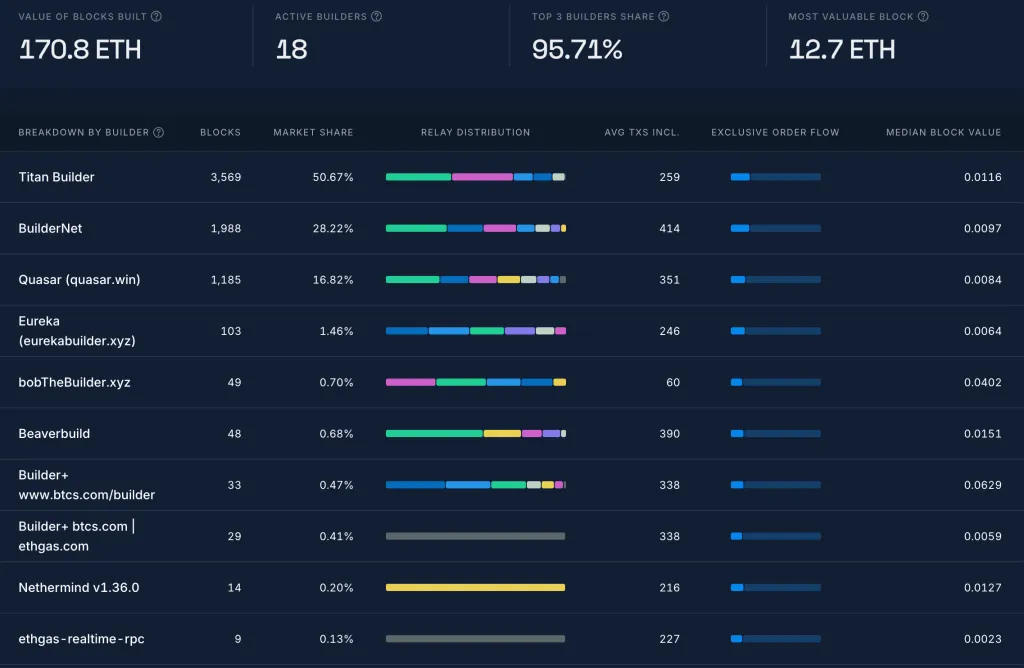
Ethereum block producer rankings. Source: Rated Network
According to Rated Network data, Eureka began operations in December 2024 and has already become the fourth-largest Ethereum builder by number of blocks produced. However, the company's market share sits at a modest 1.5%, while nearly 96% of the segment is controlled by three dominant players: Titan Builder, BuilderNet, and Quasar Builder.
Funding Details
The seed round was co-led by venture firms Spark Capital and Collider Ventures. Other participants included Varrock Ventures, Node Capital, Reverie, Very Early Ventures, Atka, Synergis, Masterkey, and several angel investors, including CoinList president Scott Keto.
As part of the deal, Collider Ventures founding partner Avishai Ovadia joined Eureka's board of directors. According to co-founder and CEO Nir Magenheim, the capital was raised in two tranches: $4.7 million in April 2025 and the remaining $2 million from Spark Capital in June. The deal was structured as a SAFE with token warrants.
Frequently Asked Questions
What are Ethereum programmable blocks?
Programmable blocks are a concept developed by Eureka Labs that transforms Ethereum blocks from passive transaction containers into active execution environments. This allows logic to be embedded directly into the block construction process, enabling features like uncollateralized loans and real-time off-chain data integration.
How much funding did Eureka Labs raise?
Eureka Labs raised $6.7 million in a seed round co-led by Spark Capital and Collider Ventures. The funding came in two tranches: $4.7 million in April 2025 and $2 million from Spark Capital in June, structured as a SAFE with token warrants.
What is Eureka Labs' market share as an Ethereum block builder?
According to Rated Network, Eureka Labs is the fourth-largest Ethereum builder by block count but holds only 1.5% market share. Nearly 96% of the market is dominated by Titan Builder, BuilderNet, and Quasar Builder.
What is intra-block credit in Ethereum?
Intra-block credit is a feature of programmable blocks that allows users to access uncollateralized loans within a single block. The loan must be repaid before the block is finalized, similar in concept to flash loans but operating at the block level.
How does Eureka Labs generate revenue?
Eureka Labs earns fees from transactions included in the blocks it constructs. The company operates within Ethereum's PBS (Proposer-Builder Separation) architecture, where specialized builders are responsible for block formation rather than validators.
Read also
TON Wallet Introduces Yield Vaults for BTC, ETH, and USDT Directly in Telegram
TON Wallet has launched yield vaults for BTC, ETH, and USDT directly within Telegram, offering up to 18% APY on stablecoins through partnerships with Morpho, TAC, and Re7.
Bitcoin Down 2.5% Weekly: Jane Street Accusations & 7 Ethereum Forks
Bitcoin lost ~2.5% over the week amid macro shocks and geopolitical tensions. Jane Street faced market manipulation allegations while Ethereum unveiled an ambitious seven hard fork roadmap through 2029.
AI Audit Uncovers Critical Liveness Bug in Ethereum's Nethermind Client
Octane Security's AI discovered a high-severity vulnerability in the Nethermind execution client that could have halted block production for 38% of Ethereum mainnet validators. The Ethereum Foundation awarded a maximum $50,000 bounty.
Weekly Recap: Aave Ecosystem Rescue Mobilizes 100,000 ETH and Quantum Computer Cracks 15-Bit ECC Key
Bitcoin held near $78,000, the DeFi community rallied over 100,000 ETH to help Aave recover from the Kelp hack, and a researcher cracked a 15-bit ECC key on a quantum computer.
Bitcoin Hits $70,000 as Iran Ceasefire Talks Boost Risk Appetite
Bitcoin surged 4% to test the $70,000 level on April 6 amid reports of ceasefire negotiations between the US, Israel, and Iran. The derivatives market, however, sends mixed signals.
Bitcoin Rebounds to $70,000 as Leverage Drops and ETF Inflows Continue
BTC recovered above $70,000 on March 10, erasing weekend losses. Spot ETFs attracted $568M in weekly inflows while the estimated leverage ratio on Binance fell sharply from 0.198 to 0.152.