
End of the "Cheap Ether" Era: Buterin Rewrites the L2 Playbook
Vitalik Buterin has signaled a fundamental shift away from Ethereum's rollup-centric roadmap. With the Strawmap plan targeting 10,000 TPS on L1, Layer 2 projects must find new reasons to exist.
For years, the crypto market operated under an unspoken assumption: Ethereum's mainnet was whale territory, while everyday users belonged on Layer 2. Rollups built billion-dollar ecosystems by purchasing block space in bulk and reselling it as affordable transactions. That model appeared unshakeable — until February 2026, when Ethereum co-founder Vitalik Buterin signaled a seismic shift: the base layer is gearing up for a technological leap, and the network no longer needs centralized "branded shards." The Strawmap roadmap now threatens to turn L1 into a direct competitor to its own rollups.
The Scaling Paradox: When the Foundation Outgrows the Superstructure
Since 2020, Ethereum's architecture revolved around the rollup-centric model. The mainnet served as a secure but slow and expensive foundation, while user activity was channeled into networks like Optimism, Arbitrum, and Base. In early 2026, Buterin effectively tore up this social contract through a series of programmatic statements.
"There have recently been some discussions on the ongoing role of L2s in the Ethereum ecosystem, especially in the face of two facts: L2s' progress to stage 2 (and, secondarily, on interop) has been far slower and more difficult than originally expected. L1 itself is scaling…" — vitalik.eth (@VitalikButerin), original post
For L2 token holders, this is a signal to reassess investment theses built entirely on the narrative of "saving Ethereum from high fees." For developers, it amounts to an ultimatum: deliver genuinely unique products or become redundant intermediaries in the gas distribution chain.
Why This Matters
Ethereum's strategic pivot affects an ecosystem worth billions of dollars. Hundreds of rollups have built infrastructure and attracted capital on the premise that the mainnet would remain slow forever. Revising this paradigm challenges the business models of entire DeFi sectors and could redirect liquidity flows across the ecosystem. Institutional investors who have already committed capital to L2 infrastructure face particular exposure.
Trust Crisis: The Training Wheels Won't Come Off
Buterin's frustration was triggered by technical stagnation across L2 projects. In 2022, he proposed a three-stage maturity framework for rollups: from Stage 0 (full developer control) to Stage 2 (security guaranteed exclusively by code and cryptography). By early 2026, progress toward Stage 2 had fallen dramatically short of Ethereum Foundation's expectations — the vast majority of major networks remained stuck at Stage 1.
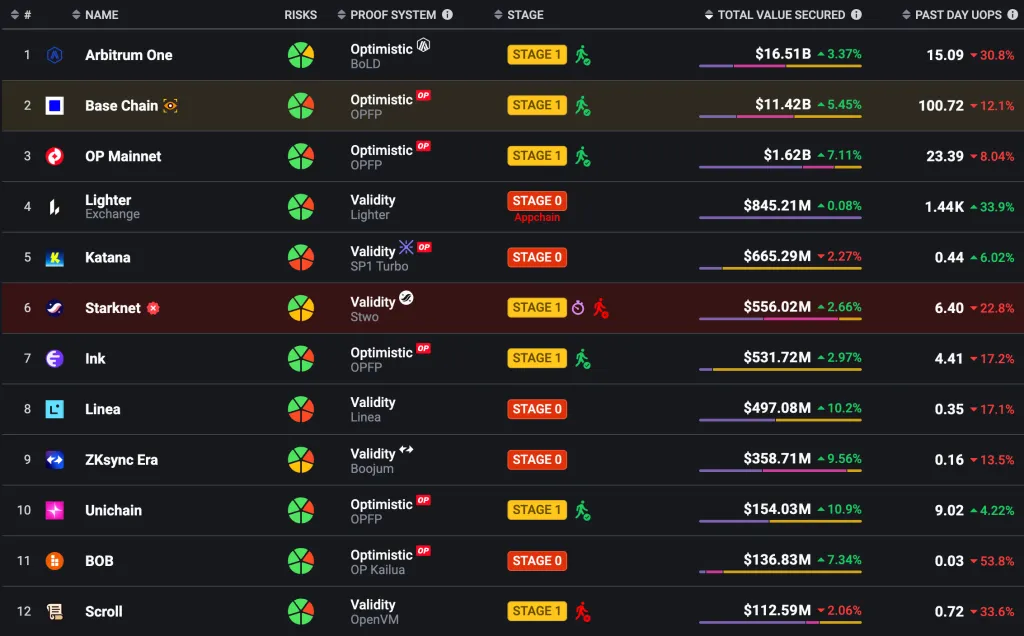
Projects retain security councils, multisigs, and admin keys that allow manual state changes. Buterin pointed to a systemic conflict of interest: some teams deliberately delay transferring governance to their communities — either to preserve business models or to meet regulatory requirements. Certain developers have openly refused decentralization to accommodate institutional clients who require transaction censorship capabilities.
Key systemic issues plaguing current L2 solutions:
- Illusion of continuity — projects leverage the Ethereum brand while remaining isolated systems with centralized sequencers and week-long withdrawal delays;
- Mass cloning — the market is flooded with EVM copies offering no genuine innovation in performance or privacy;
- Multisig dependency — smart contract security relies on human factors rather than mathematics;
- Liquidity fragmentation — hundreds of rollups splinter liquidity, degrading user experience.
Strawmap: Seven Hard Forks by 2029
While the L2 sector stalled, Ethereum Foundation researcher Justin Drake unveiled Strawmap — a comprehensive document outlining approximately seven hard forks by 2029, scheduled every six months. Drake noted that AI-assisted development could accelerate this timeline.
The two nearest upgrades — Glamsterdam and Hegota — are planned for 2026. The stated performance targets:
- Up to 10,000 TPS on L1 — achieved through a 1 GB-per-second gas limit, protocol-level zkEVM implementation, and real-time cryptographic proof generation;
- Up to 10 million TPS for L2 — via data availability sampling mechanisms enabling rollups to publish up to 1 GB of data per second;
- Native rollup precompile — a built-in ZK-proof verification function ensuring L2 networks update synchronously with the mainnet.
Block creation time will be reduced in stages: from the current 12 seconds to 8, then 6, 4, and ultimately 2 seconds. Transaction finality is set to drop from 16 minutes to 6–16 seconds, requiring post-quantum cryptography with hash-based signatures.
The L2 Counterattack: From Confrontation to Irony
Offchain Labs co-founder Steven Goldfeder took the hardest stance, emphasizing that Arbitrum was never conceived as "a service for Ethereum." The mainnet, he argued, is merely a settlement security layer, while L2 networks represent independent economies. Goldfeder pointed out that during peak load periods, Arbitrum and Base collectively processed over 1,000 TPS while the mainnet sat at 15–20 TPS. He warned that devaluing rollups' role would push institutional players toward sovereign L1 blockchains, deepening liquidity fragmentation.
Base creator Jesse Pollak struck a conciliatory tone, agreeing that L2 solutions should move beyond being "just cheap ether." He shifted focus to account abstraction, simplified onboarding, and unique features — user-friendly interfaces that the mainnet inherently cannot provide.
StarkWare co-founder Eli Ben-Sasson responded with irony, noting that Buterin's "new vision" essentially describes what Starknet has been building for years — a ZK-STARK-based system with high throughput and a trajectory toward Stage 2.
Spectrum Over Binary: New Classification and the CROPS Framework
Buterin proposed replacing the rigid L1/L2 binary with a "spectrum of possibilities," where projects are evaluated by technical architecture and actual security contributions. He identified three tracks: app-specific systems (game engines, decentralized identity), institutional networks (enterprise blockchains publishing ZK proofs to mainnet), and non-financial applications (social platforms, AI agents, reputation systems).
The foundation for all applications is the CROPS framework, introduced in early March 2026:
- Censorship Resistance;
- Open source;
- Privacy;
- Security.
The Ethereum Foundation is expanding teams focused on integrating privacy tools into the base layer, including Kohaku — a modular open-source stack for building secure wallets. Buterin envisions future interfaces deeply integrated with AI tools that simulate transactions before signing, showing users clear outcomes and requiring manual confirmation only in critical situations.
Native Rollups and the "Adoption Paradox"
The Ethrex team, working alongside Ethereum Foundation and L2BEAT, has delivered a working implementation of native rollups based on EIP-8079, introducing a new mechanism — the EXECUTE precompile. It allows L2 blocks to be re-executed directly on the mainnet, eliminating the need for external fraud proofs or ZK schemes.
Despite developer momentum, ETH's price continues to stagnate. CryptoQuant analysts identified a divergence between growing blockchain utilization and token value, which has fallen more than 50% from recent peaks. A sharp spike in smart contract activity was attributed to automated protocols rather than organic user growth. Researcher Julio Moreno suggested ETH could decline to $1,500 by late Q3 or early Q4 absent meaningful market catalysts.
The record network activity may also be partially explained by widespread "address poisoning." Etherscan data shows that following the Fusaka upgrade, "dust" USDT transfers surged by 612% — a consequence of lower fees creating opportunities for scammers.
The era of profiting from simple EVM infrastructure cloning is drawing to a close. Ethereum is evolving toward a model where the base layer either becomes a global computer processing 10,000 TPS natively, or serves as a verification environment for thousands of specialized platforms meeting CROPS standards. Rollups must now prove their independent value — or step aside.
Frequently Asked Questions
What is the Ethereum Strawmap roadmap?
Strawmap is a comprehensive development plan presented by Ethereum Foundation researcher Justin Drake. It outlines approximately seven hard forks through 2029, targeting 10,000 TPS on L1 and 10 million TPS for L2 networks through zkEVM implementation and data availability sampling.
Why is Vitalik Buterin criticizing L2 networks?
Buterin is frustrated that most major rollups have stalled at early decentralization stages, retaining centralized control through multisigs and admin keys. He argues that projects unable or unwilling to reach Stage 2 decentralization cannot be considered genuine parts of the Ethereum ecosystem.
What happens to L2 tokens if Ethereum L1 scales successfully?
If Ethereum's base layer achieves its stated performance targets, the value proposition of L2 tokens built on the 'saving Ethereum from high fees' narrative will weaken significantly. L2 projects will need to justify their value through unique features, user experience innovations, and specialized solutions.
What is the CROPS framework in Ethereum?
CROPS is a framework proposed in early March 2026 that establishes four core principles: Censorship Resistance, Open source, Privacy, and Security. It serves as the foundational standard for all applications in the Ethereum ecosystem.
Could ETH drop to $1,500?
CryptoQuant researcher Julio Moreno suggested ETH could decline to $1,500 by late Q3 or early Q4 2026 due to the 'adoption paradox' — growing network activity driven by automated protocols rather than capital inflows, while the token price has already fallen over 50% from recent peaks.
Read also
TON Wallet Introduces Yield Vaults for BTC, ETH, and USDT Directly in Telegram
TON Wallet has launched yield vaults for BTC, ETH, and USDT directly within Telegram, offering up to 18% APY on stablecoins through partnerships with Morpho, TAC, and Re7.
Bitcoin Down 2.5% Weekly: Jane Street Accusations & 7 Ethereum Forks
Bitcoin lost ~2.5% over the week amid macro shocks and geopolitical tensions. Jane Street faced market manipulation allegations while Ethereum unveiled an ambitious seven hard fork roadmap through 2029.
AI Audit Uncovers Critical Liveness Bug in Ethereum's Nethermind Client
Octane Security's AI discovered a high-severity vulnerability in the Nethermind execution client that could have halted block production for 38% of Ethereum mainnet validators. The Ethereum Foundation awarded a maximum $50,000 bounty.
Weekly Recap: Aave Ecosystem Rescue Mobilizes 100,000 ETH and Quantum Computer Cracks 15-Bit ECC Key
Bitcoin held near $78,000, the DeFi community rallied over 100,000 ETH to help Aave recover from the Kelp hack, and a researcher cracked a 15-bit ECC key on a quantum computer.
Bitcoin Hits $70,000 as Iran Ceasefire Talks Boost Risk Appetite
Bitcoin surged 4% to test the $70,000 level on April 6 amid reports of ceasefire negotiations between the US, Israel, and Iran. The derivatives market, however, sends mixed signals.
Bitcoin Rebounds to $70,000 as Leverage Drops and ETF Inflows Continue
BTC recovered above $70,000 on March 10, erasing weekend losses. Spot ETFs attracted $568M in weekly inflows while the estimated leverage ratio on Binance fell sharply from 0.198 to 0.152.