Gnosis and Zisk Unveil Ethereum Economic Zone to Address L2 Fragmentation
Gnosis and Zisk, backed by the Ethereum Foundation, have launched the Ethereum Economic Zone (EEZ) — a framework designed to unify fragmented Layer 2 rollups with shared liquidity and base-layer settlements.
A Unified Framework for Synchronously Composable Rollups
Gnosis and Zisk, with support from the Ethereum Foundation (EF), have introduced the Ethereum Economic Zone (EEZ) — a framework aimed at merging the fragmented landscape of Layer 2 networks into a single, synchronously composable environment. The initiative enables applications to share infrastructure across rollups while maintaining settlements on Ethereum's base layer.
"Welcome to the Ethereum Economic Zone (EEZ), a framework for synchronously composable rollups. One deployment. Shared liquidity. Single transactions across L1 & L2. Identity verified anywhere. Smart wallets connected everywhere. No additional trust…" — The Ethereum Economic Zone (@etheconomiczone), original post
According to the project description, EEZ will reduce service duplication and eliminate the need for cross-chain transfers, streamlining interactions between ecosystems. ETH serves as the default gas token within the economic zone.
Why This Matters
Ethereum's rollup-centric scaling strategy has significantly boosted throughput, but at a cost. Dozens of L2 solutions have fragmented liquidity, infrastructure, and user activity across isolated environments. Each rollup effectively operates as a separate island, complicating development and forcing users to constantly bridge assets between networks.
EEZ arrives at a pivotal moment for the Ethereum ecosystem. In February 2026, Ethereum co-founder Vitalik Buterin acknowledged that the original L2 vision had become outdated and proposed a new model for ecosystem development. The Ethereum Foundation subsequently shared its own perspective on the division of responsibilities between the base layer and rollups, emphasizing differentiation — L2 solutions should offer unique features rather than replicate one another.
EEZ Alliance and Founding Members
Alongside the framework, an informal group called the EEZ Alliance has been formed to coordinate standards and support adoption. Founding members include lending protocol Aave, block builders Titan and Beaver Build, real-world asset platform Centrifuge, and tokenized stock project xStocks.
The Ethereum Economic Zone will be registered as a Swiss non-profit organization. All software will be released as open source. Technical specifications and performance benchmarks are expected in the coming weeks.
Ethereum Foundation Co-Funding
The Ethereum Foundation has agreed to co-fund EEZ — a notable decision given the organization's shift toward fiscal conservatism. EF paused its grants program in mid-2025, aiming to keep annual spending at 5%. The foundation later released an updated roadmap with a "proactive approach," naming mainnet scaling and L2 interoperability as key priorities. EEZ fits squarely within this focus.
Record ETH Staking by the Foundation
In parallel with backing EEZ, the Ethereum Foundation continues to ramp up its ETH staking activity. On March 30, the organization locked 22,517 ETH worth $46.2 million — a record single-day staking amount for the foundation.
"The Ethereum Foundation just staked $46.2M of ETH. This is more ETH than they have EVER staked before." — Arkham (@arkham), original post
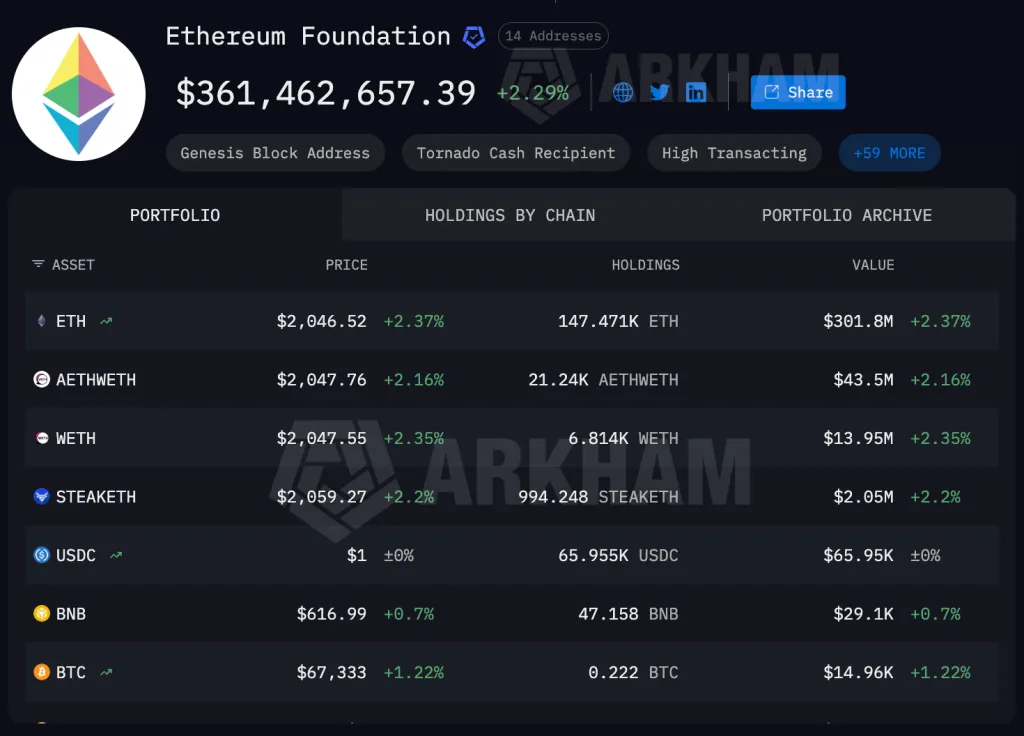
Reports about the foundation's staking plans first emerged in late February, when EF indicated it would lock a total of 70,000 ETH in the initial phase, directing all proceeds toward ecosystem support. According to Arkham data, the foundation managed 147,471 ETH worth $301 million at the time of reporting.
Frequently Asked Questions
What is the Ethereum Economic Zone (EEZ)?
EEZ is a framework for synchronously composable rollups developed by Gnosis and Zisk with Ethereum Foundation support. It allows applications to share infrastructure and liquidity across L2 networks while settling on Ethereum's base layer.
How does EEZ solve Ethereum's L2 fragmentation?
EEZ unifies isolated rollup environments by providing shared liquidity and single transactions across L1 and L2. This eliminates the need for cross-chain transfers and reduces service duplication across separate L2 networks.
Who are the founding members of EEZ Alliance?
The EEZ Alliance founders include Aave, block builders Titan and Beaver Build, RWA platform Centrifuge, and tokenized stock project xStocks. The alliance will be registered as a Swiss non-profit organization.
How much ETH has the Ethereum Foundation staked?
On March 30, 2026, the Ethereum Foundation staked 22,517 ETH worth $46.2 million — a record amount. The foundation plans to stake 70,000 ETH in total during the initial phase, with all proceeds directed toward ecosystem support.
Is Ethereum Foundation funding the EEZ project?
Yes, the Ethereum Foundation has agreed to co-fund EEZ. This aligns with the foundation's updated priorities of mainnet scaling and L2 interoperability, announced after pausing its general grants program in mid-2025.
Read also
TON Wallet Introduces Yield Vaults for BTC, ETH, and USDT Directly in Telegram
TON Wallet has launched yield vaults for BTC, ETH, and USDT directly within Telegram, offering up to 18% APY on stablecoins through partnerships with Morpho, TAC, and Re7.
Bitcoin Down 2.5% Weekly: Jane Street Accusations & 7 Ethereum Forks
Bitcoin lost ~2.5% over the week amid macro shocks and geopolitical tensions. Jane Street faced market manipulation allegations while Ethereum unveiled an ambitious seven hard fork roadmap through 2029.
AI Audit Uncovers Critical Liveness Bug in Ethereum's Nethermind Client
Octane Security's AI discovered a high-severity vulnerability in the Nethermind execution client that could have halted block production for 38% of Ethereum mainnet validators. The Ethereum Foundation awarded a maximum $50,000 bounty.
Weekly Recap: Aave Ecosystem Rescue Mobilizes 100,000 ETH and Quantum Computer Cracks 15-Bit ECC Key
Bitcoin held near $78,000, the DeFi community rallied over 100,000 ETH to help Aave recover from the Kelp hack, and a researcher cracked a 15-bit ECC key on a quantum computer.
Bitcoin Hits $70,000 as Iran Ceasefire Talks Boost Risk Appetite
Bitcoin surged 4% to test the $70,000 level on April 6 amid reports of ceasefire negotiations between the US, Israel, and Iran. The derivatives market, however, sends mixed signals.
Bitcoin Rebounds to $70,000 as Leverage Drops and ETF Inflows Continue
BTC recovered above $70,000 on March 10, erasing weekend losses. Spot ETFs attracted $568M in weekly inflows while the estimated leverage ratio on Binance fell sharply from 0.198 to 0.152.