
Curve Founder Michael Egorov Proposes Tokenizing Bad Debts Instead of DAO Bailouts
Curve Finance founder Michael Egorov introduced a mechanism to convert bad debts into tradable assets. The pilot targets LlamaLend's $700,000 stuck debt from October 2024.
Turning Bad Debts Into Tradable Assets
Curve Finance founder Michael Egorov has put forward a novel approach to handling bad debts in DeFi: tokenizing deficit positions and transforming them into tradable investment instruments that market participants can freely buy and sell.
The pilot project for this mechanism will be the LlamaLend lending market, where a $700,000 bad debt formed in October 2024. This unresolved debt has prevented some users from fully withdrawing their funds.
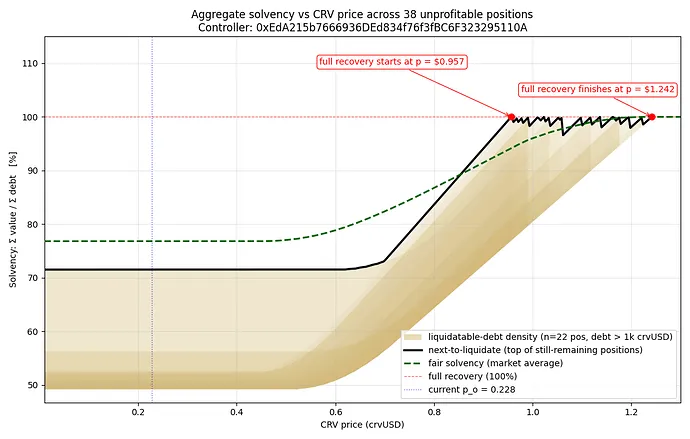
Why This Matters
Bad debt remains one of the most persistent vulnerabilities in DeFi lending. Protocols typically address it through emergency treasury injections or direct compensation to affected users. Egorov's proposal charts a fundamentally different course — handing the problem over to free market dynamics.
Under this model, there is no need for a DAO treasury bailout. Instead, the balance sheet gap gets filled by market forces: traders buy debt at a discount, arbitrageurs seek profit from price discrepancies, and liquidity providers earn rewards through trading fees.
How the Mechanism Works
According to Egorov, the distressed assets in the LlamaLend pool are not worthless. Their actual value depends on the CRV token price — if the token appreciates, the debt can be repaid through liquidations. The developer compared these positions to options with limited downside risk.
To put the concept into practice, Egorov has already seeded liquidity in a Curve Stableswap pool. Users can now exchange their stuck tokens at a discount or become liquidity providers to earn fees while waiting for a market recovery.
Context: Kelp DAO Hack and Market Response
Egorov's initiative comes amid ongoing discussions about the fallout from the Kelp DAO hack, which created significant risks for the Aave protocol. While other projects are considering emergency loans and direct compensations, the Curve founder advocates for market-based solutions.
In April, protocols affected by the Kelp attack formed a support fund that attracted over 102,000 ETH. The amount nearly covered the total damage caused by the exploit, estimated at approximately $290 million.
Community Pushback
Community reception has been mixed. Several users pointed out that finding buyers for such assets would be challenging given the lack of immediate yield. Critics also questioned whether professional investors would show interest in the instrument without additional subsidies from the Curve DAO.
Nevertheless, the concept of a market-driven approach to resolving bad debts offers a distinct alternative to the established practice of direct bailouts. If the LlamaLend pilot proves viable, it could set a precedent for the broader DeFi industry in handling similar situations going forward.
Frequently Asked Questions
What is Curve's bad debt tokenization proposal?
Curve founder Michael Egorov proposed converting bad debts into tradable investment instruments instead of using DAO treasury funds for bailouts. Traders can buy the debt at a discount, while liquidity providers earn fees from the Stableswap pool.
How much bad debt exists on LlamaLend?
LlamaLend accumulated $700,000 in bad debt in October 2024. This has prevented some users from fully withdrawing their deposited funds from the platform.
How does CRV token price affect the LlamaLend bad debt?
According to Egorov, the distressed assets' value is tied to the CRV token price. If CRV appreciates, the debt can be repaid through liquidation mechanisms. He compared these positions to options with limited downside risk.
How much was raised for the Kelp DAO hack recovery fund?
Protocols affected by the Kelp DAO exploit formed a support fund that collected over 102,000 ETH. This amount nearly covered the total damage from the hack, estimated at approximately $290 million.
Why is the community skeptical about Curve's debt tokenization?
Community members noted that finding buyers for tokenized bad debt would be difficult due to the absence of immediate yield. Critics also questioned whether professional investors would participate without additional subsidies from the Curve DAO.
Read also
CoinShares: TradFi and DeFi Are Merging Into a Hybrid Finance System
A joint report by CoinShares and Token Terminal documents the convergence of traditional and decentralized finance into a measurable market structure, with stablecoins at $297.6 billion and the RWA market approaching $29 billion.
TON Wallet Introduces Yield Vaults for BTC, ETH, and USDT Directly in Telegram
TON Wallet has launched yield vaults for BTC, ETH, and USDT directly within Telegram, offering up to 18% APY on stablecoins through partnerships with Morpho, TAC, and Re7.
Weekly Recap: Aave Ecosystem Rescue Mobilizes 100,000 ETH and Quantum Computer Cracks 15-Bit ECC Key
Bitcoin held near $78,000, the DeFi community rallied over 100,000 ETH to help Aave recover from the Kelp hack, and a researcher cracked a 15-bit ECC key on a quantum computer.
Stablecoin Transfer Volume Hits $10.5 Trillion in January — Highest Since April 2022
January stablecoin transaction volume surpassed $10.5 trillion, marking the highest monthly figure since April 2022. USDC led transfers while USDT maintained market cap dominance.
Bloomberg and Kaiko Partner to Bring Financial Data On-Chain via Canton Network
Bloomberg and Kaiko have partnered to bring institutional-grade financial data on-chain through Canton Network, starting with tokenized US Treasuries and repo operations.
Bernstein Calls $60,000 a 'Clear Bottom' for Bitcoin, Expects Extended Bull Cycle
Analysts at Bernstein have identified $60,000 as a firm floor for Bitcoin, projecting a structurally longer bull cycle. On-chain data from Glassnode confirms a resurgence of buying activity.