
Federal Court Fully Dismisses Fraud Case Against Uniswap
A federal court in New York has completely dismissed the class action lawsuit against DEX Uniswap and founder Hayden Adams, ruling that open-source developers are not liable for third-party fraud.
Judge Throws Out All Remaining Claims Against Uniswap
The U.S. District Court for the Southern District of New York has issued a final ruling in the class action lawsuit against decentralized exchange Uniswap and its founder Hayden Adams. Judge Katherine Polk Failla dismissed the case entirely, rejecting plaintiffs' demands for compensation over losses incurred trading fraudulent tokens on the platform.
A group of users had lost funds through scam projects listed on Uniswap, including classic Pump & Dump schemes and exit scams. The plaintiffs argued that Uniswap effectively aided bad actors by providing them a venue to find buyers for their fraudulent tokens.
Judge Failla rejected this reasoning outright. She ruled that holding the creators of smart contract code responsible for third-party abuse is absurd. Simply providing a functioning platform does not make developers complicit in fraud, the court determined.
Why This Matters
This ruling sets a significant legal precedent for the entire decentralized finance industry. The question of whether DeFi protocol creators bear responsibility for user actions remains one of the most contentious issues in crypto regulation. The court has now affirmed — twice — that open-source tool developers are not obligated to answer for those who misuse their technology.
The case had been ongoing since 2022. Back in 2023, the same court dismissed federal securities law claims against Uniswap. This latest ruling closes the matter completely: plaintiffs failed to prove either deception or unjust enrichment on the part of the protocol's creators.
Uniswap Labs Responds
Uniswap Labs Chief Legal Officer Brian Nistler called the decision precedent-setting for the DeFi sector. He emphasized that the court has now protected open-source code authors from liability for others' actions for the second time.
"Another day, another precedent-setting ruling for DeFi. Today, Judge Failla dismissed with prejudice the Risley class action against @Uniswap Labs and @haydenzadams. The Federal charges had previously been dismissed, and today the various state claims are dismissed. Again, the…" — Brian (@N0th1n3), original post
Protocol founder Hayden Adams also commented on the outcome, stating that when scammers exploit open-source smart contracts, the scammers themselves are responsible — not the developers. — Hayden Adams, original post
Market Reaction
Following the legal victory and a broader crypto market uptrend, Uniswap's native token UNI rose 2.1% to reach $3.88.
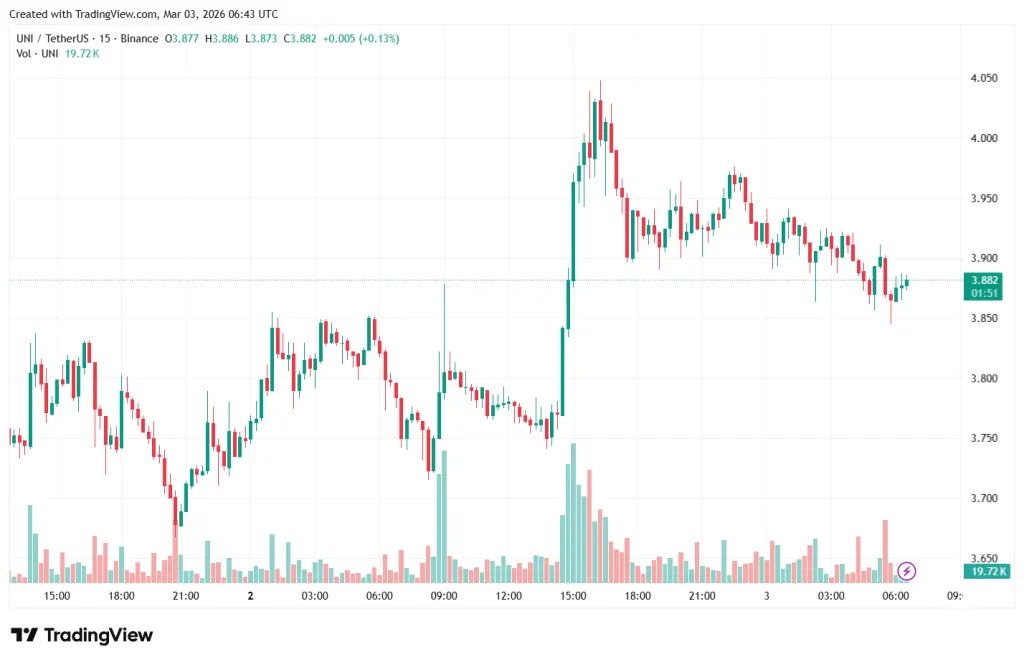
15-minute UNI/USDT chart on Binance. Source: TradingView
The Uniswap ruling fits into a broader trend of U.S. courts siding with crypto companies in platform liability disputes. In January 2026, the Securities and Exchange Commission withdrew its lawsuit against Bitcoin exchange Gemini. American courts are increasingly recognizing that technology providers should not bear the burden of policing every user interaction on their platforms.
Frequently Asked Questions
Why were fraud charges against Uniswap dismissed?
Judge Katherine Polk Failla ruled that holding smart contract code creators responsible for third-party abuse is absurd. The plaintiffs failed to demonstrate any deception or unjust enrichment by the protocol developers.
What was the class action lawsuit against Uniswap about?
A group of users filed a class action in 2022 seeking compensation for losses from trading fraudulent tokens on the Uniswap DEX. They claimed the platform facilitated scammers by providing a venue for Pump & Dump schemes and exit scams.
Is this ruling a precedent for DeFi regulation?
Uniswap Labs Chief Legal Officer Brian Nistler described the ruling as precedent-setting for the DeFi sector. The court confirmed for the second time that open-source code authors are not liable for the actions of third parties using their technology.
How did UNI token price react to the court ruling?
Following the legal victory and a broader crypto market rally, UNI rose 2.1% to $3.88.
Read also
TON Wallet Introduces Yield Vaults for BTC, ETH, and USDT Directly in Telegram
TON Wallet has launched yield vaults for BTC, ETH, and USDT directly within Telegram, offering up to 18% APY on stablecoins through partnerships with Morpho, TAC, and Re7.
Weekly Recap: Aave Ecosystem Rescue Mobilizes 100,000 ETH and Quantum Computer Cracks 15-Bit ECC Key
Bitcoin held near $78,000, the DeFi community rallied over 100,000 ETH to help Aave recover from the Kelp hack, and a researcher cracked a 15-bit ECC key on a quantum computer.
Stablecoin Transfer Volume Hits $10.5 Trillion in January — Highest Since April 2022
January stablecoin transaction volume surpassed $10.5 trillion, marking the highest monthly figure since April 2022. USDC led transfers while USDT maintained market cap dominance.
Top 10 Dollar Stablecoins in 2026: From Dominant Players to Exit Candidates
The stablecoin market has surpassed $311 billion in total capitalization. Here's a breakdown of the ten largest USD-pegged stablecoins — from undisputed leaders Tether and Circle to ambitious newcomers.
Weekly Recap: Bitcoin Tests $74K, Miners Dump Holdings, ChatGPT Boycott Grows
Bitcoin briefly touched $74,000 before retreating to $67,500. Public miners sold over 15,000 BTC in five months, traders flocked to Hyperliquid for oil and gold futures, and a ChatGPT boycott gained major traction.
End of the "Cheap Ether" Era: Buterin Rewrites the L2 Playbook
Vitalik Buterin has signaled a fundamental shift away from Ethereum's rollup-centric roadmap. With the Strawmap plan targeting 10,000 TPS on L1, Layer 2 projects must find new reasons to exist.