Cango Reports $452.8M Net Loss in First Year of Industrial Bitcoin Mining
Mining firm Cango posted a $452.8 million net loss for 2025 despite generating $688.1 million in revenue. The company is now selling BTC reserves and pivoting toward AI infrastructure.
First Full Year of Mining Delivers Massive Losses
Cango has released its financial results for 2025, revealing a net loss of $452.8 million. Revenue for the period totaled $688.1 million, with the vast majority — $675.5 million — coming directly from bitcoin mining operations.
Over its first complete year of industrial-scale operations, Cango produced 6,594.6 BTC — roughly 18 coins per day on average. CFO Michael Zhang attributed the loss to one-time costs associated with the company's business transformation and broader market volatility.
Operating expenses exceeded $1.1 billion. The largest cost items included:
- Depreciation of mining equipment — $338.3 million;
- Revaluation of bitcoin-collateralized loans — $96.5 million.
The fourth quarter proved particularly painful: the company lost $285 million on revenue of $179.5 million against operating expenses of $456 million. The cost of mining a single BTC surged to $106,251, while bitcoin's market price hovered around $73,900 — rendering mining deeply unprofitable.
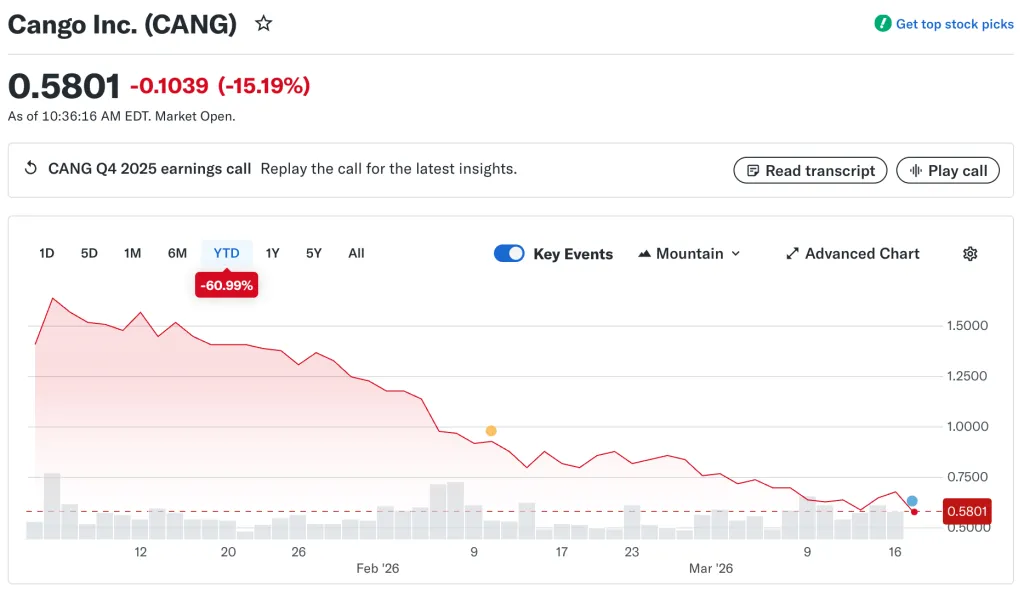
Cango's stock dropped 14.4% following the earnings release. Over the past year, shares have declined by more than 60%.
Why This Matters
Cango's predicament illustrates a structural crisis engulfing the bitcoin mining industry. Following the latest halving and a prolonged decline in cryptocurrency prices, mining costs have exceeded market value for many operators. The gap between Cango's production cost ($106,251 per BTC) and the market price ($73,900) makes traditional mining economically unviable and is forcing major players to fundamentally rethink their business models.
The trend of miners pivoting from cryptocurrency production to servicing AI workloads is accelerating across the sector, and Cango is the latest high-profile example of this shift.
Reserve Liquidation and the AI Pivot
In February 2026, Cango sold 4,451 BTC to reduce its debt burden and shore up its balance sheet. In March, the company disclosed that it had taken 30% of its hashrate offline.
Cango's strategy has undergone a fundamental transformation: rather than accumulating and mining bitcoin, the company now treats BTC as a treasury asset to fund new business verticals. CEO Paul Yu indicated that Cango is moving toward AI infrastructure. Near-term plans include deploying modular container-based solutions designed for neural network computing tasks.
The shift toward artificial intelligence has become one of the most prominent trends among former mining-focused companies. Demand for high-performance computing (HPC) continues to grow, and miners possess infrastructure well-suited to these workloads. AI hosting also generates significantly higher margins than digital asset mining, which has become unprofitable following the last halving and the extended drawdown in crypto prices.
TeraWulf Ramps Up Debt Financing for HPC Expansion
TeraWulf is pursuing a similar strategy, steadily increasing its debt financing to support a transition toward high-performance computing. The firm has secured a $500 million credit facility with a one-year term, with proceeds earmarked for the construction of a data center in Hayesville, USA.
By the end of February 2026, TeraWulf had completed fundraising totaling approximately $6.5 billion. The company's total contracted HPC infrastructure capacity now stands at 522 megawatts of critical IT load, distributed between the Lake Mariner and Abernathy facilities.
TeraWulf's aggressive debt-funded expansion underscores how seriously major mining industry players are betting on AI computing as their primary revenue driver in the years ahead.
Frequently Asked Questions
How much did Cango lose in 2025 from bitcoin mining?
Cango reported a net loss of $452.8 million for 2025. Despite generating $688.1 million in revenue, operating expenses exceeded $1.1 billion, driven primarily by equipment depreciation and loan revaluation costs.
What is Cango's bitcoin mining cost per BTC?
By Q4 2025, Cango's cost of mining one bitcoin rose to $106,251. With bitcoin trading around $73,900 at the time, the operation became deeply unprofitable.
Why are bitcoin miners pivoting to AI infrastructure?
Following the latest halving and prolonged crypto price declines, mining has become uneconomical for many operators. AI hosting generates higher margins, and miners already possess suitable infrastructure for high-performance computing workloads.
How many BTC did Cango mine in 2025?
Cango produced 6,594.6 BTC during 2025, averaging approximately 18 coins per day. In February 2026, the company sold 4,451 BTC to reduce its debt burden and strengthen its balance sheet.
How much funding has TeraWulf raised for its HPC transition?
By late February 2026, TeraWulf completed fundraising totaling approximately $6.5 billion. The company also secured a $500 million credit line specifically for building a data center in Hayesville, USA.
Read also
Bitcoin Miners Dump Crypto Reserves to Fund AI Infrastructure Pivot
Major public Bitcoin mining companies are liquidating their BTC holdings to finance a transition toward AI data center infrastructure. MARA Holdings, the largest public miner by reserves, denied rumors of a massive sell-off of its 53,822 BTC.
Trader Ran Neuner Warns Bitcoin Faces 'Death' as Miners Pivot to AI — Critics Push Back
AI hosting generates up to eight times more revenue per megawatt than Bitcoin mining. Ran Neuner argues this is killing the BTC network, but prominent crypto figures strongly disagree.
Riot Platforms Sells 3,778 BTC Worth $289.5M to Fund AI Infrastructure Pivot
Bitcoin miner Riot Platforms sold 3,778 BTC for $289.5 million in Q1 2026, redirecting proceeds toward AI and high-performance computing infrastructure in Texas.
Wintermute Says Traditional Bitcoin Mining Model Is No Longer Viable
Wintermute analysts have declared the traditional Bitcoin mining business model outdated, suggesting miners must either pivot to AI hosting or actively manage their BTC reserves as working capital to survive.
Public Bitcoin Miners Sell Record 32,000 BTC in Q1 2026 as Hash Price Hits Rock Bottom
The six largest public mining companies collectively sold over 32,000 BTC in Q1 2026 — more than total sales for all of 2025. Plunging hash price below the breakeven threshold is forcing miners to liquidate reserves.
Bitcoin Drops Below $67,000 as Ethereum Foundation Unveils Quantum Defense Roadmap
Bitcoin lost 3% over the week amid Middle East tensions and ETF outflows, miner activity hit historic lows, and Ethereum Foundation outlined a four-hardfork plan for quantum resistance by 2029.