
Wintermute Says Traditional Bitcoin Mining Model Is No Longer Viable
Wintermute analysts have declared the traditional Bitcoin mining business model outdated, suggesting miners must either pivot to AI hosting or actively manage their BTC reserves as working capital to survive.
Wintermute analysts have concluded that the conventional Bitcoin mining business model has run its course. Miners are experiencing widespread losses amid declining profitability, and survival now depends on either embracing AI hosting or transforming idle BTC holdings into actively managed working capital.
Why This Matters
Bitcoin mining has long been a foundational pillar of the crypto ecosystem. A structural crisis in this sector has implications far beyond the miners themselves — affecting network hashrate, BTC market supply, and investor sentiment. When a major market maker like Wintermute publicly declares the existing model obsolete, it signals a fundamental transformation underway in the industry.
A Structural Profitability Crisis
For the first time in a four-year cycle, Bitcoin failed to deliver the twofold profit increase that traditionally offset post-halving revenue declines. Peak gross margins have dropped to levels previously seen only at bear market bottoms.
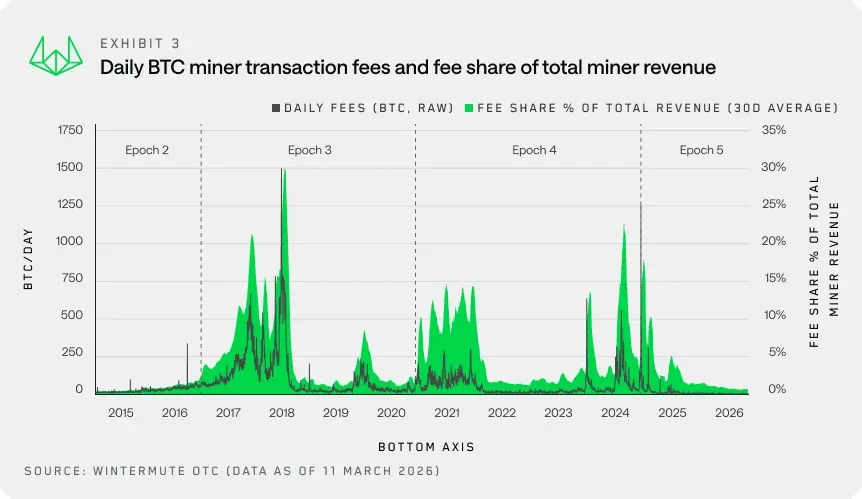
Transaction fees offer no relief — they account for roughly 1% of miners' total revenue. Meanwhile, energy costs remain persistently high, continuing to squeeze already thin margins.
Untapped Potential of BTC Reserves
According to Wintermute's estimates, miners collectively hold approximately 1% of Bitcoin's total supply. The firm characterized the passive storage of these assets as a "legacy of the HODL era," noting that the full toolkit of treasury management remains virtually unused.
While crypto-native yield strategies have traditionally been limited to staking and DeFi protocols, Wintermute proposed a broader set of instruments for miners:
- Monetizing market risk through derivatives
- Selling covered call options
- Cash-secured put options
- Passive lending through credit protocols for interest income
Wintermute considers active balance sheet management the most undervalued lever available to miners. The firm believes that companies capable of converting Bitcoin from a passive reserve into a productive asset will gain a structural edge heading into the next halving.
The AI Infrastructure Pivot
The alternative path leads to artificial intelligence. Mining companies have spent years building energy infrastructure in regions with cheap electricity. As a result, they now control a resource that is critically needed by the AI industry — and one that cannot be replicated quickly from scratch.
The transition to leasing capacity for neural network workloads is already underway. In March, Core Scientific announced the sale of all its Bitcoin holdings and secured a $500 million credit facility from Morgan Stanley. The bulk of the proceeds will fund the conversion of data centers for AI applications. Similar moves have been made by Riot Platforms, MARA Holdings, Terawulf, Cango, and several other players.
Wintermute analysts cautioned that pivoting to AI demands radical steps and substantial capital, which may prove insurmountable for many market participants. Nevertheless, they view the current upheaval as a "healthy shakeout" that will ultimately make the industry more efficient.
Investor Perspective
Investment firms are echoing this trend. In March, VanEck's head of digital assets Matthew Sigel stated that the pivot toward AI makes mining company stocks more attractive to investors. This reinforces the argument that the future of mining lies in business model diversification — whether through treasury strategies or providing infrastructure for artificial intelligence workloads.
Frequently Asked Questions
Why is Bitcoin mining no longer profitable?
According to Wintermute, for the first time in a four-year cycle, Bitcoin failed to deliver the twofold profit increase that traditionally offset post-halving revenue declines. Transaction fees account for only about 1% of total revenue while energy costs remain high.
What alternatives do Bitcoin miners have?
Wintermute suggests two paths: active treasury management of BTC reserves using derivatives, options, and lending protocols, or pivoting infrastructure to serve the AI industry. Both approaches aim to create new revenue streams beyond traditional block rewards.
Which mining companies are pivoting to AI?
Core Scientific sold all its Bitcoin and secured a $500 million credit line from Morgan Stanley to convert data centers for AI. Riot Platforms, MARA Holdings, Terawulf, and Cango have made similar moves.
How much Bitcoin do miners hold collectively?
Wintermute estimates that miners collectively control approximately 1% of Bitcoin's total supply. The firm considers this a largely untapped resource that could generate yield through active treasury management strategies.
Read also
AI Audit Uncovers Critical Liveness Bug in Ethereum's Nethermind Client
Octane Security's AI discovered a high-severity vulnerability in the Nethermind execution client that could have halted block production for 38% of Ethereum mainnet validators. The Ethereum Foundation awarded a maximum $50,000 bounty.
Wintermute Links Bitcoin Stagnation to Macroeconomic Regime Shift
The market maker explains crypto weakness through structural economic changes: AI sector reassessment and deglobalization. Bitcoin behaves as a high-risk asset alongside tech stocks.
Bitcoin Drops Below $67,000 as Ethereum Foundation Unveils Quantum Defense Roadmap
Bitcoin lost 3% over the week amid Middle East tensions and ETF outflows, miner activity hit historic lows, and Ethereum Foundation outlined a four-hardfork plan for quantum resistance by 2029.
Weekly Recap: 20M BTC Mined, US Treasury Backs Crypto Mixer Privacy Rights
Less than 1 million bitcoins remain to be mined, the US Treasury reversed its stance on crypto mixers to support privacy rights, and Hyperliquid crossed $4 trillion in cumulative trading volume.
Forbes: American Bitcoin Investors Lost $500M While Eric Trump Grew Wealthier
Forbes estimates retail investors in mining firm American Bitcoin have lost around $500 million since its Nasdaq listing, while Eric Trump's net worth grew from $190M to $280M without investing his own capital.
Analyst Sykodelic: BTC Weekly Close Above $74,400 Could Trigger Rally to $200,000
Crypto analyst Sykodelic argues that a weekly close above $74,400 for Bitcoin would ignite a massive rally toward $200,000. Other analysts offer more moderate targets ranging from $77,000 to $80,000.