
Trader Ran Neuner Warns Bitcoin Faces 'Death' as Miners Pivot to AI — Critics Push Back
AI hosting generates up to eight times more revenue per megawatt than Bitcoin mining. Ran Neuner argues this is killing the BTC network, but prominent crypto figures strongly disagree.
AI Hosting Dwarfs Bitcoin Mining Revenue
Crypto trader Ran Neuner published a provocative thread declaring that artificial intelligence has "killed Bitcoin forever." According to his analysis, Bitcoin mining generates $57–129 per megawatt in revenue, while AI data center hosting brings in $200–500 for the same power capacity — nearly an eightfold difference.
«AI has killed Bitcoin forever. It became Bitcoin mining's biggest competitor. Not another crypto. AI. Because both industries compete for the same thing: electricity. And right now, AI is willing to pay much more for it.» — Ran Neuner (@cryptomanran), original post
Both industries compete for the same energy resources, but AI companies are willing to pay significantly more. Neuner backed his argument with several corporate examples:
- Core Scientific secured a $500 million credit facility from Morgan Stanley to build AI data centers;
- MARA Holdings notified the SEC of plans to sell part of its Bitcoin reserves to pivot toward AI;
- Hut 8 signed a $7 billion agreement with Google to build AI infrastructure;
- Cipher Mining reduced its hashrate to service neural network workloads;
- Bitmain co-founder Jihan Wu left mining entirely to focus on AI.
Neuner stated that if he were a miner, the choice would be obvious — and that is precisely why more participants are leaving the network.
Why This Matters
Neuner highlighted a 14.5% drop in Bitcoin's hashrate from its October peak. As miners exit the network, the theoretical risk of a 51% attack increases. While the difficulty adjustment mechanism has historically smoothed out such transitions, the current energy shortage amplifies the concern, according to the trader.
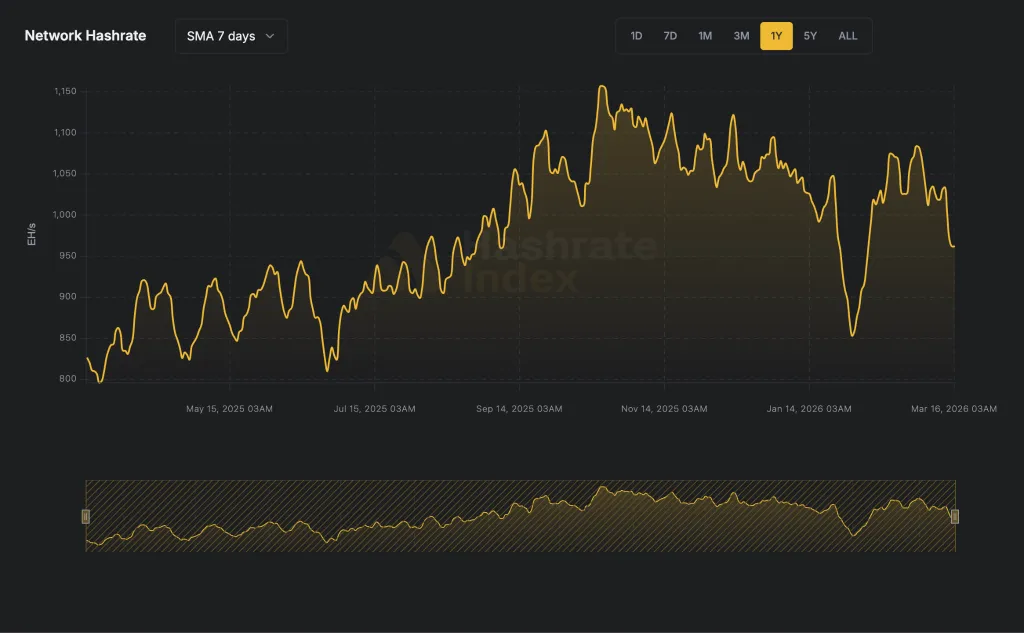
Neuner believes Bitcoin can only compete with AI for energy if its price rises substantially. He expressed hope that an external catalyst — whether geopolitical tensions or regulatory developments — could trigger upward price momentum.
Counterarguments: Why Bitcoin Won't Die
Blockstream CEO and Bitcoin pioneer Adam Back sharply disagreed with Neuner's conclusions. He explained that the difficulty adjustment mechanism functions exactly as designed: less efficient miners leave, difficulty drops, and mining profitability gradually converges with AI hosting returns.
«What happens to Bitcoin is simple: tick tock, next block! Difficult adjusts downwards, least efficient and AI switchers move out and Bitcoin mining profitability converges to AI profitability. QED.» — Adam Back (@adam3us), original post
Analyst Willy Woo echoed this view. He stressed that electricity prices only affect competition among miners themselves, while the amount the network is willing to spend on security is determined by BTC's price and blockchain usage. Woo urged critics to study Bitcoin's difficulty adjustment as a fundamental cornerstone of how BTC operates.
Investor Fred Krueger framed the situation as a normal Bitcoin operating cycle: when more profitable alternatives emerge, miners disconnect until difficulty falls enough to restore mining profitability.
ESG specialist Daniel Batten went further, arguing the dependency runs in the opposite direction — AI expansion actually relies on Bitcoin mining. He cited several strategic synergies: monetizing energy during AI data center construction, leveraging pre-purchased power capacity, and running older hardware on cheap electricity.
«The evidence tells us that AI is dependent upon Bitcoin for its expansion. Bitcoin mining can be used alongside AI for strategic advantages.» — Daniel Batten (@DSBatten), original post
A Growing Industry Debate
Earlier in March, analysts at Wintermute declared the traditional Bitcoin mining model outdated. They argued that miners must either pivot to AI hosting or learn to manage their Bitcoin reserves as working capital to survive. The debate over mining's future continues to intensify as AI's appetite for computing power and energy keeps growing.
Frequently Asked Questions
Why are Bitcoin miners switching to AI hosting?
AI data center hosting generates $200–500 per megawatt compared to Bitcoin mining's $57–129 per megawatt. This nearly eightfold revenue difference makes servicing AI workloads far more attractive for companies that already have energy infrastructure.
Does miners leaving threaten Bitcoin network security?
Trader Ran Neuner argues that a 14.5% hashrate decline from the October peak raises the risk of a 51% attack. However, experts like Adam Back counter that Bitcoin's difficulty adjustment mechanism automatically compensates for miner departures, maintaining network security.
Which mining companies have pivoted to AI?
Core Scientific obtained a $500 million loan from Morgan Stanley for AI data centers. Hut 8 signed a $7 billion deal with Google for AI infrastructure. Cipher Mining reduced its hashrate for AI workloads, and MARA Holdings filed with the SEC to sell Bitcoin reserves for an AI pivot.
What is Bitcoin's difficulty adjustment and how does it work?
Bitcoin's difficulty adjustment is a built-in mechanism that automatically recalibrates mining difficulty based on network participation. When miners leave, difficulty decreases, making mining profitable again for remaining participants and maintaining steady block production.
Can Bitcoin mining and AI coexist?
ESG specialist Daniel Batten argues that AI expansion actually depends on Bitcoin mining. Miners can monetize energy during AI data center construction phases, balance power grids, and run older equipment on cheap electricity, creating strategic synergies between both industries.
Read also
Bitdeer Overtakes MARA as Largest Public Bitcoin Miner by Hashrate
Bitdeer grew its self-mining hashrate to 69.5 EH/s — a 504% year-over-year increase — surpassing MARA and CleanSpark to become the top public Bitcoin miner by deployed capacity.
American Bitcoin Acquires 11,298 ASIC Miners, Restarts Dormant Drumheller Data Center
Hut 8's subsidiary purchased over 11,000 ASIC miners for its Drumheller facility, which has been offline since March 2024. The deployment will push American Bitcoin's total hashrate to 28.1 EH/s.
AI Audit Uncovers Critical Liveness Bug in Ethereum's Nethermind Client
Octane Security's AI discovered a high-severity vulnerability in the Nethermind execution client that could have halted block production for 38% of Ethereum mainnet validators. The Ethereum Foundation awarded a maximum $50,000 bounty.
Bitcoin Drops Below $67,000 as Ethereum Foundation Unveils Quantum Defense Roadmap
Bitcoin lost 3% over the week amid Middle East tensions and ETF outflows, miner activity hit historic lows, and Ethereum Foundation outlined a four-hardfork plan for quantum resistance by 2029.
Weekly Recap: 20M BTC Mined, US Treasury Backs Crypto Mixer Privacy Rights
Less than 1 million bitcoins remain to be mined, the US Treasury reversed its stance on crypto mixers to support privacy rights, and Hyperliquid crossed $4 trillion in cumulative trading volume.
Forbes: American Bitcoin Investors Lost $500M While Eric Trump Grew Wealthier
Forbes estimates retail investors in mining firm American Bitcoin have lost around $500 million since its Nasdaq listing, while Eric Trump's net worth grew from $190M to $280M without investing his own capital.