
Bitcoin Miners Dump Crypto Reserves to Fund AI Infrastructure Pivot
Major public Bitcoin mining companies are liquidating their BTC holdings to finance a transition toward AI data center infrastructure. MARA Holdings, the largest public miner by reserves, denied rumors of a massive sell-off of its 53,822 BTC.
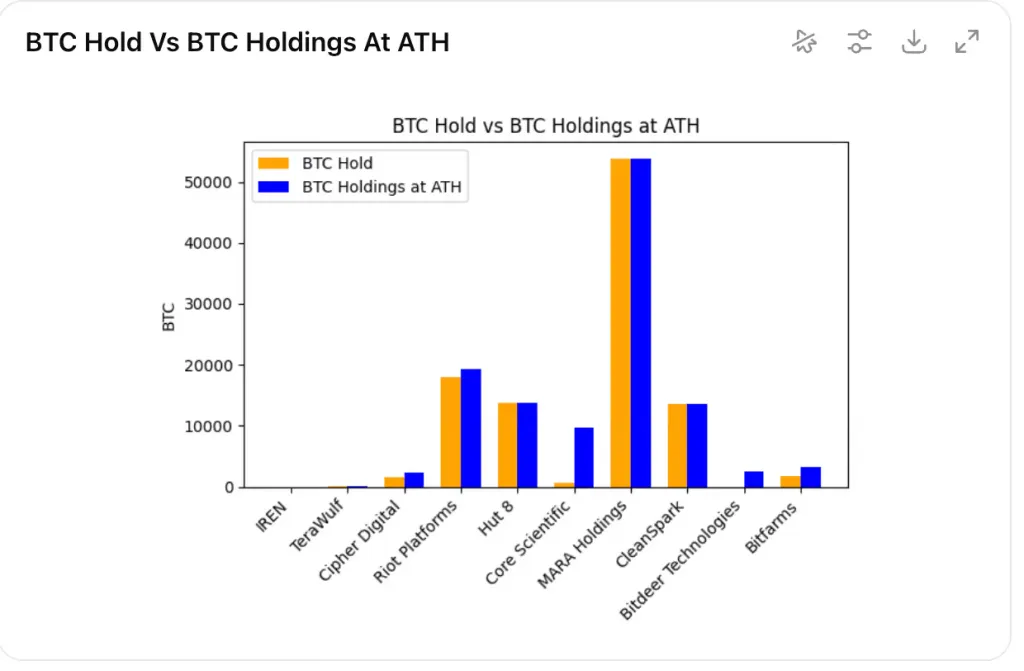
Public Bitcoin mining companies are rapidly selling off their cryptocurrency reserves, redirecting capital toward artificial intelligence infrastructure. Data from BitcoinTreasuries shows the long-standing HODL strategy is losing traction as mining profitability continues to erode.
Why This Matters
Bitcoin mining margins reached as high as 90% back in 2021. Today, that figure has plummeted due to intensifying competition, rising energy costs, and BTC price corrections. Mining firms already operate large-scale data centers — facilities that can be repurposed for neural network computations. While the AI pivot demands significant capital investment, it promises stronger returns than cryptocurrency mining in the current environment.
The scale of this industry-wide transformation is evident in the concrete actions taken by the sector's biggest players.
Which Miners Have Already Changed Course
Bitfarms CEO Ben Gagnon stated in February that the company no longer considers itself a Bitcoin business, positioning instead as an AI and high-performance computing (HPC) data center owner and developer in North America. Bitfarms is reincorporating in Delaware and rebranding as Keel Infrastructure. Its BTC reserves have dropped from a peak of 3,301 to 1,827 BTC.
Bitdeer liquidated its entire Bitcoin stockpile — approximately 943.1 BTC — to accelerate its AI transition. The miner is deploying NVIDIA GB200 NVL72 systems in Malaysia and retrofitting facilities across the US and Europe.
IREN has zeroed out its Bitcoin balance entirely, concentrating fully on HPC workloads.
Core Scientific intends to sell most of its remaining coins by the end of Q1, freeing up $170 million for AI infrastructure development. Its holdings have fallen from an all-time high of 9,618 to just 630 BTC.
Riot Platforms sold $200 million worth of Bitcoin to fund the Rockdale acquisition. Reserves declined from 19,368 to 18,005 BTC. In 2025, Riot posted record revenue of $647.4 million, citing its strategic pivot toward AI as the primary driver.
Cipher Digital (formerly Cipher Mining) described 2025 as a transitional year, selling $40 million in assets and reducing reserves to 1,500 BTC.
Hut 8 announced that Bitcoin is no longer the company's long-term focus. Its BTC allocation (currently 13,696 BTC) will be gradually reduced.
CleanSpark treats its 13,513 BTC as working capital, securing credit lines backed by the cryptocurrency. Simultaneously, the firm is adapting infrastructure for AI workloads and seeking tenants for its computing capacity.
TeraWulf holds just 15 BTC, maintaining balance sheet flexibility for AI expansion. In August 2025, the company signed a ten-year contract with cloud platform Fluidstack. Backed by Google, TeraWulf will provide approximately 250 MW of capacity worth a total of $3.7 billion.
MARA Holdings Denies Sell-Off Rumors
Amid the industry-wide liquidation trend, SwanDesk advisor Jacob King published claims — citing SEC filings — that MARA Holdings was planning a massive Bitcoin sell-off. The post garnered over 377,800 views.
"BREAKING: The largest publicly traded Bitcoin miner, MARA Holdings, is planning to SELL the majority of its Bitcoin reserves. MARA has just updated its treasury policy to allow sales of its accumulated BTC. The company currently holds 53,822 BTC, worth roughly $4.7 billion…" — Jacob King (@JacobKinge), original post
MARA's VP of Investor Relations Robert Samuels called these claims factually incorrect. He clarified that the company had merely expanded its treasury policy to permit Bitcoin sales from its balance sheet — providing financial flexibility without signaling an intent to dump reserves.
"This assertion that @MARA has changed its strategy to sell the majority of our bitcoin holdings is factually incorrect. Our 2026 10-K clearly states we expanded our strategy to allow for sales of bitcoin held on our balance sheet, meaning we may buy or sell from time to time…" — Robert Samuels (@RobSamuelsIR), original post
MARA remains the largest BTC holder among public miners with 53,822 BTC valued at $3.7 billion. The company is nonetheless diversifying — last month it acquired a 64% stake in Exaion, a French computing infrastructure and blockchain services provider. In February, MARA reported losses of $1.7 billion and signaled its intention to shift focus toward artificial intelligence.
Frequently Asked Questions
Why are Bitcoin miners selling their BTC reserves?
Mining profitability has dropped significantly from the 90% margins seen in 2021 due to increased competition, higher energy costs, and BTC price corrections. Miners are redirecting capital toward AI infrastructure, which offers potentially stronger returns using their existing data center facilities.
How many BTC does MARA Holdings own and is it selling?
MARA holds 53,822 BTC worth approximately $3.7 billion, making it the largest public mining company by Bitcoin reserves. The company denied rumors of a mass sell-off, clarifying it only expanded its treasury policy to allow for potential sales as needed.
Which mining companies have completely sold their Bitcoin?
Bitdeer liquidated its entire stockpile of approximately 943.1 BTC, while IREN zeroed out its Bitcoin balance completely. Both companies redirected the proceeds toward high-performance computing and AI infrastructure development.
What is Keel Infrastructure and how is it related to Bitfarms?
Keel Infrastructure is the upcoming new name for Bitfarms, which is reincorporating in Delaware. The rebrand reflects the company's strategic shift from Bitcoin mining to AI and HPC data center development in North America.
How much revenue did Riot Platforms generate in 2025?
Riot Platforms reported record revenue of $647.4 million for 2025. The company attributed this success primarily to its strategic pivot toward artificial intelligence.
Read also
American Bitcoin Acquires 11,298 ASIC Miners, Restarts Dormant Drumheller Data Center
Hut 8's subsidiary purchased over 11,000 ASIC miners for its Drumheller facility, which has been offline since March 2024. The deployment will push American Bitcoin's total hashrate to 28.1 EH/s.
Oracle Lays Off Thousands as AI Infrastructure Spending Reshapes Tech Workforce
Oracle has begun mass layoffs affecting thousands of employees worldwide as the company redirects resources toward AI infrastructure. Meanwhile, Block CEO Jack Dorsey envisions AI replacing middle management entirely.
AI Audit Uncovers Critical Liveness Bug in Ethereum's Nethermind Client
Octane Security's AI discovered a high-severity vulnerability in the Nethermind execution client that could have halted block production for 38% of Ethereum mainnet validators. The Ethereum Foundation awarded a maximum $50,000 bounty.
Bitcoin Drops Below $67,000 as Ethereum Foundation Unveils Quantum Defense Roadmap
Bitcoin lost 3% over the week amid Middle East tensions and ETF outflows, miner activity hit historic lows, and Ethereum Foundation outlined a four-hardfork plan for quantum resistance by 2029.
Weekly Recap: 20M BTC Mined, US Treasury Backs Crypto Mixer Privacy Rights
Less than 1 million bitcoins remain to be mined, the US Treasury reversed its stance on crypto mixers to support privacy rights, and Hyperliquid crossed $4 trillion in cumulative trading volume.
Forbes: American Bitcoin Investors Lost $500M While Eric Trump Grew Wealthier
Forbes estimates retail investors in mining firm American Bitcoin have lost around $500 million since its Nasdaq listing, while Eric Trump's net worth grew from $190M to $280M without investing his own capital.