
Bitcoin Futures Signal Short-Squeeze Risk as Funding Rates Stay Negative for 46 Days
 BinanceEXCHANGE
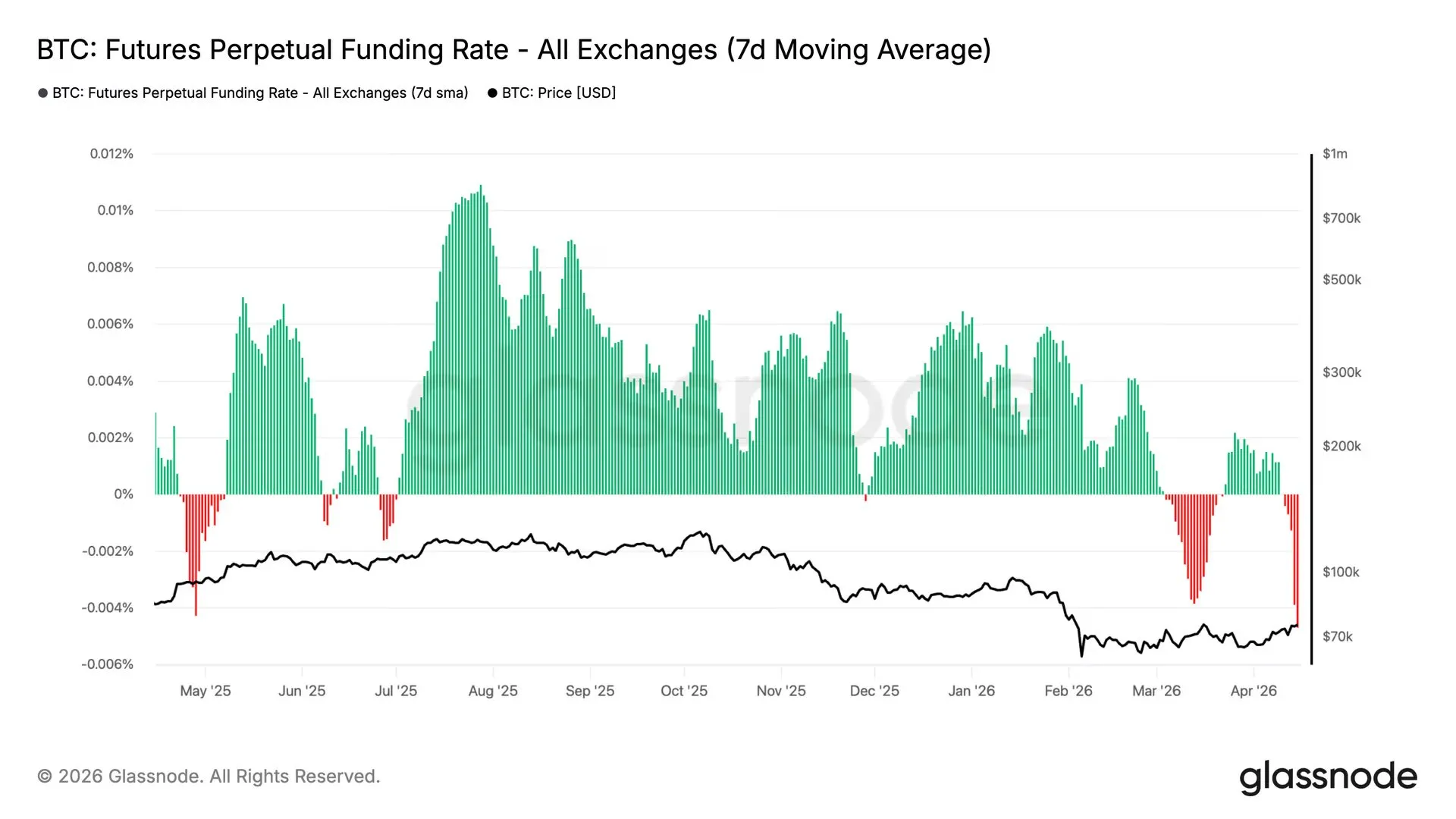
Bitcoin perpetual futures funding rates have remained negative for roughly 46 consecutive days, creating conditions for a potential short squeeze as spot prices climb above $75,000.
Bitcoin has reclaimed the $75,000 level, yet leveraged traders remain firmly positioned against further gains. Funding rates on perpetual futures have stayed negative for roughly 46 consecutive days — one of the longest stretches of bearish sentiment in crypto derivatives history, comparable only to the period following the FTX collapse in late 2022.
Why This Matters
A significant divergence has formed between rising spot prices and persistently bearish futures positioning. According to Bloomberg, such mismatches have historically led to large-scale liquidations. If the uptrend continues, short sellers will face mounting losses and be forced to close positions en masse — a mechanism known as a short squeeze. The longer the pressure from short positions builds, the more powerful the resulting price impulse could be.
K33 head of research Vetle Lunde noted that traders are aggressively building short positions against the breakout, creating conditions where a short squeeze becomes increasingly likely if upward momentum persists.
Fundamental Tailwinds
Despite derivatives market skepticism, bitcoin has gained approximately 11% from its April lows. Several concrete catalysts are driving the recovery.
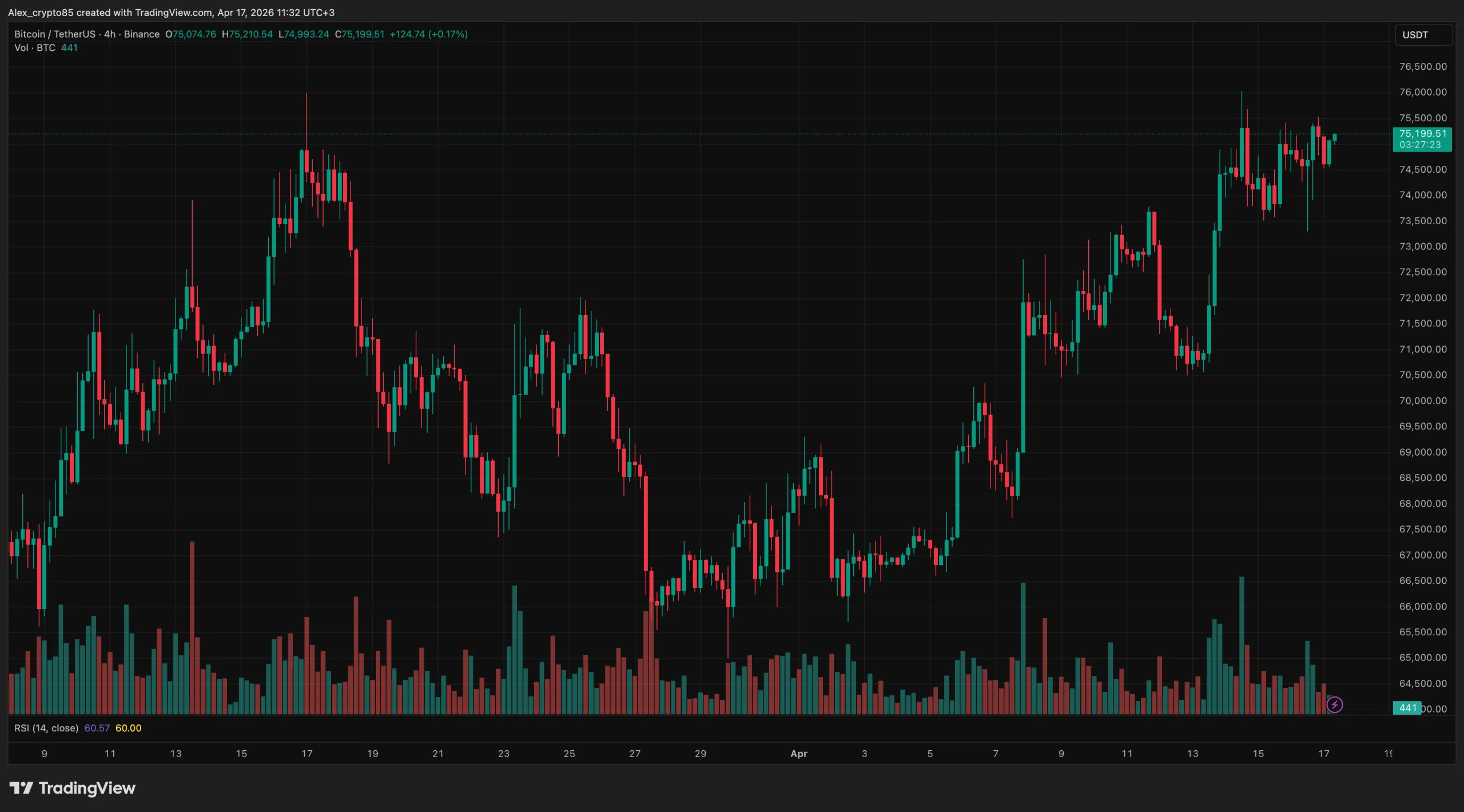
- Spot ETF inflows. US spot bitcoin ETFs have been registering positive capital flows with increasing frequency.
- Institutional buying. Michael Saylor's Strategy acquired $2.6 billion worth of bitcoin over the past two weeks alone. FalconX senior derivatives trader Bohan Jiang said these purchases significantly bolstered market confidence.
- Wall Street initiatives. Brokerage giant Charles Schwab announced the launch of spot crypto trading, allowing up to 8.8% portfolio allocation in digital assets. Morgan Stanley became the first major bank to offer its own bitcoin-based exchange-traded fund.
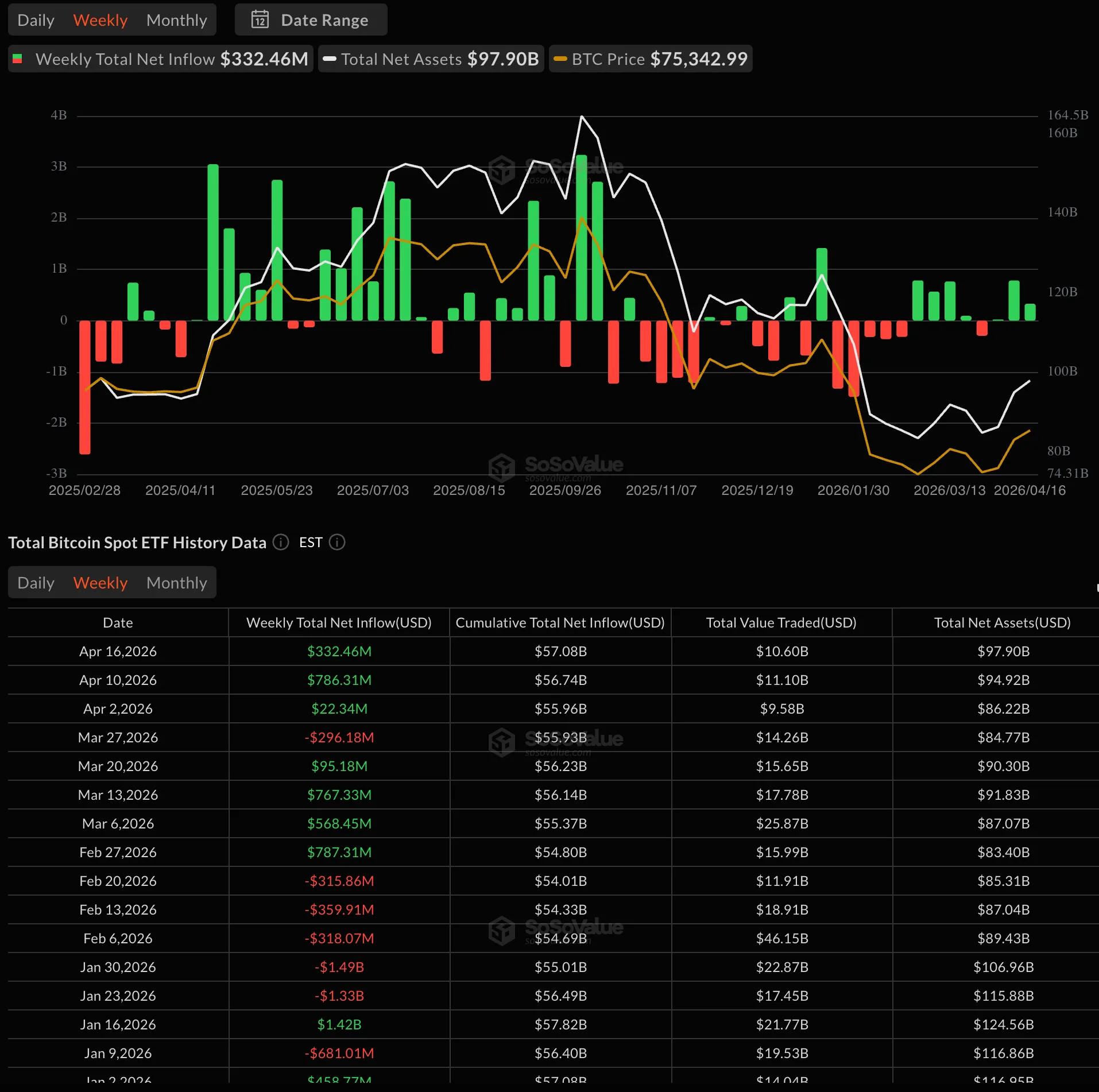
Analysts warn that the abundance of positive news makes short positions highly vulnerable. Any of the aforementioned triggers could spark a volatility spike and force bear capitulation. Kaiko analyst Laurens Frausseen believes a break above $76,000 could propel BTC toward $85,000, catching many traders off guard.
Resistance Zones and Downside Risks
The bearish case has not disappeared entirely. Data from Deribit shows that options market participants are paying elevated premiums for downside protection, with the highest open interest concentrated around put contracts at the $60,000 and $50,000 strike prices.
According to FalconX's Bohan Jiang, options dealers running market-neutral strategies are selling bitcoin on rallies, with their largest positions clustered around $80,000 — forming a substantial resistance zone for further upside.
At the time of writing, BTC is trading near $75,500, approximately 40% below its all-time high of roughly $126,000 set in October.
Frequently Asked Questions
What is a short squeeze in bitcoin?
A short squeeze occurs when a rising price forces traders holding short positions to buy back the asset to cover their losses, creating additional buying pressure. This feedback loop can trigger a sharp price spike. The longer bearish positions accumulate, the more violent the squeeze can be.
Why are bitcoin futures funding rates negative?
Negative funding rates indicate that bearish sentiment dominates the market, with more traders betting on price declines than increases. The current negative funding streak has lasted approximately 46 consecutive days — one of the longest in crypto derivatives history, rivaling only the post-FTX collapse period in late 2022.
What is driving bitcoin's recovery in April 2026?
Key catalysts include positive inflows into US spot bitcoin ETFs, Strategy's $2.6 billion BTC purchase over two weeks, and Wall Street expansion into crypto with Charles Schwab launching spot trading and Morgan Stanley offering its own bitcoin ETF.
Where is the main resistance for bitcoin above $75,000?
According to FalconX's Bohan Jiang, options dealers with market-neutral strategies are concentrated around the $80,000 level, creating significant resistance. However, Kaiko analyst Laurens Frausseen suggests a break above $76,000 could send BTC toward $85,000.
How far is bitcoin from its all-time high?
Bitcoin is trading near $75,500, approximately 40% below its all-time high of roughly $126,000 recorded in October.
Read also
Options Traders Bet on Bitcoin Rally to $80,000 by Summer
Bitcoin consolidates near $70,000 after a volatility spike. Options market participants are increasingly positioning for a rally to $80,000 by early summer, despite macroeconomic headwinds.
Bitcoin Down 2.5% Weekly: Jane Street Accusations & 7 Ethereum Forks
Bitcoin lost ~2.5% over the week amid macro shocks and geopolitical tensions. Jane Street faced market manipulation allegations while Ethereum unveiled an ambitious seven hard fork roadmap through 2029.
Institutional Investors Dump ETF Shares Worth 25,000 BTC During Market Crash
Institutional investors massively sold Bitcoin ETF positions in Q4 2025, offloading shares equivalent to 25,098 BTC during the crypto market correction.
Bitcoin Hits $70,000 as Iran Ceasefire Talks Boost Risk Appetite
Bitcoin surged 4% to test the $70,000 level on April 6 amid reports of ceasefire negotiations between the US, Israel, and Iran. The derivatives market, however, sends mixed signals.
Bitcoin Rebounds to $70,000 as Leverage Drops and ETF Inflows Continue
BTC recovered above $70,000 on March 10, erasing weekend losses. Spot ETFs attracted $568M in weekly inflows while the estimated leverage ratio on Binance fell sharply from 0.198 to 0.152.
Wintermute Links Bitcoin Stagnation to Macroeconomic Regime Shift
The market maker explains crypto weakness through structural economic changes: AI sector reassessment and deglobalization. Bitcoin behaves as a high-risk asset alongside tech stocks.