
Bitcoin Hits $80K Options Wall: $1.5B in Call Options Create Resistance on Deribit
 BinanceEXCHANGE
A $1.5 billion concentration of call options on Deribit is blocking Bitcoin's path to $80,000. Meanwhile, Delphi Digital research shows the worst-ever five-year BTC investment resulted in only a 13% loss.
$1.5 Billion in Call Options Form a Ceiling at $80,000
Bitcoin has run into a formidable barrier near the $80,000 level. According to Bloomberg, the resistance stems from concentrated options positions on the Deribit exchange that are mechanically suppressing upward price movement.
Approximately $1.5 billion worth of call options with May and June expiration dates are clustered around the $80,000 strike price. This concentration forces market makers to sell Bitcoin as the price approaches that level — a standard hedging procedure for short call positions that effectively creates a price ceiling.
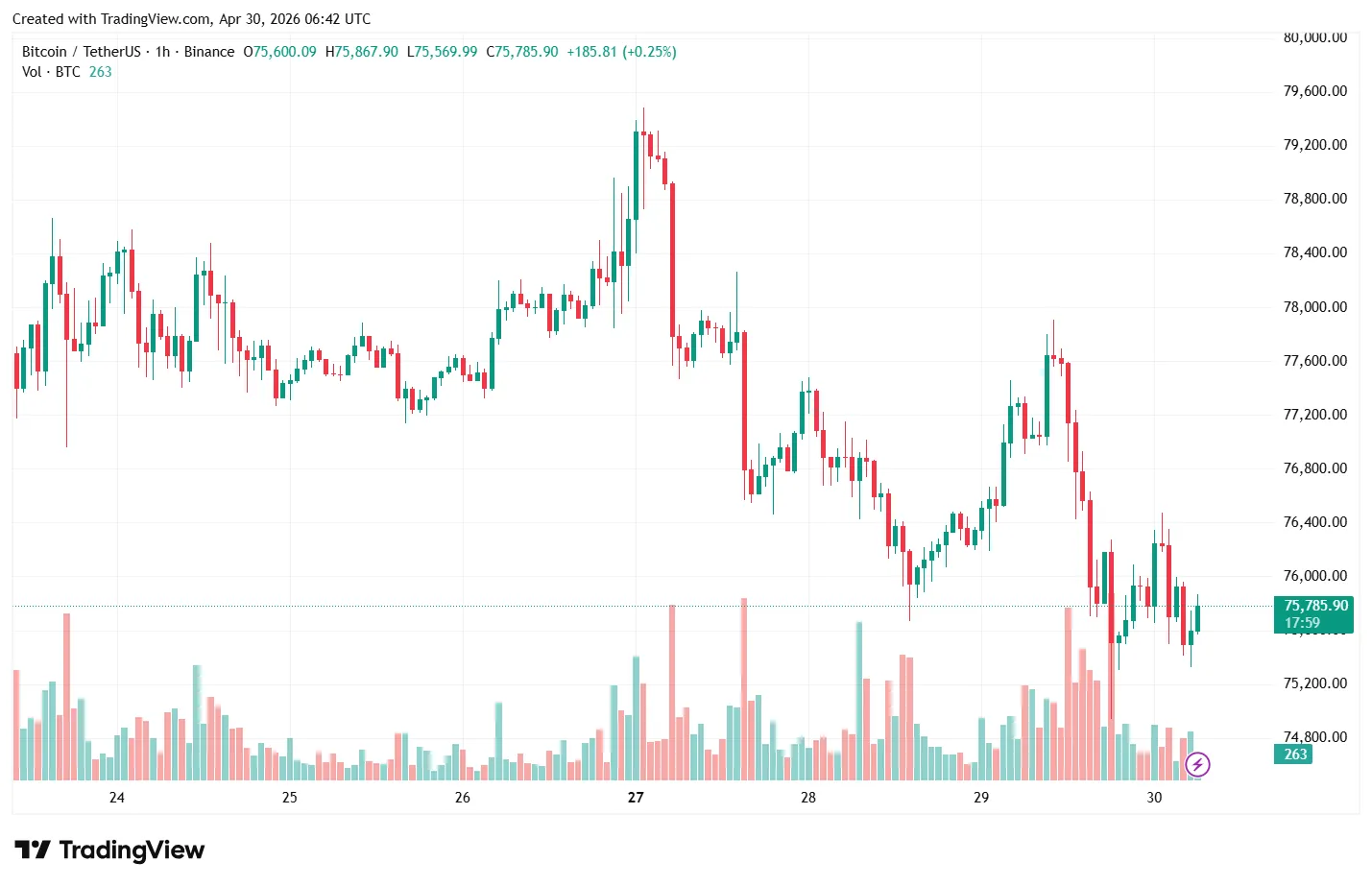
Beyond options-driven selling pressure, the rally is also being weighed down by profit-taking and weakening demand in the spot market. At the time of the original report, BTC was trading at $75,785, down 1.7% over the preceding 24 hours.
Why This Matters
The options market is increasingly dictating Bitcoin's short-term price trajectory. When large volumes of call options accumulate at a single strike, a mechanical effect emerges: market makers who sold those contracts must counteract upward price moves, forming what traders call a "gamma wall." Until these positions expire or are unwound, $80,000 will remain a zone of heightened resistance.
Adding to the bearish pressure, the U.S. Federal Reserve decided on April 29 to hold interest rates steady, triggering a decline in Bitcoin and several other crypto assets.
Five-Year Data: Even the Worst BTC Entry Lost Only 13%
Research from Delphi Digital examined Bitcoin's historical returns by calculating the outcome for every possible five-year holding period using daily prices since May 2016.
"The worst possible 5 Year Bitcoin Entry was down just 13%. Return comparisons can look very different when the start date is a cycle top. Our analyst @yeak__ looked at every possible 5 year holding period for BTC, ETH, and SOL using daily prices since May 2016." — Delphi Digital (@Delphi_Digital), original post
The single worst entry point turned out to be the December 2017 cycle peak. An investor who bought at that top and sold five years later — near the 2022 lows — would have suffered a loss of just 13%. That represents the absolute worst-case scenario across all possible five-year windows.
The median five-year return for Bitcoin exceeded 800%. Ethereum fared even better, with a median five-year return of 1,200%. The analysis confirms that over extended holding periods, crypto assets delivered substantial gains from nearly any entry point. Sensitivity to purchase timing only matters significantly on shorter time frames.
Current Outlook
Breaking through $80,000 will likely require either the expiration of the May and June options contracts or a demand surge powerful enough to overwhelm the gamma wall. Profit-taking and subdued spot demand currently favor the bears in the near term.
The Delphi Digital findings, however, serve as a reminder that short-term price fluctuations carry limited significance for long-term holders. Historical data shows that holding Bitcoin for five years has been a profitable strategy in the vast majority of scenarios to date.
Frequently Asked Questions
Why can't Bitcoin break through $80,000?
Approximately $1.5 billion in call options with May and June expirations are concentrated near the $80,000 strike on Deribit. Market makers who sold these contracts must sell BTC as the price approaches that level to hedge their exposure, creating a mechanical resistance wall.
What is Bitcoin's median 5-year return?
According to Delphi Digital research, Bitcoin's median five-year return exceeds 800%. Even the worst possible five-year entry — buying at the December 2017 cycle peak — resulted in only a 13% loss.
What is a gamma wall in Bitcoin options?
A gamma wall forms when a large volume of options is concentrated at a single strike price. Market makers who sold those contracts are forced to sell the underlying asset as the price rises, creating mechanical selling pressure at that level.
How did the Fed decision affect Bitcoin price in April 2026?
The U.S. Federal Reserve decided on April 29, 2026 to keep interest rates unchanged. This triggered a decline in Bitcoin and other crypto assets, with BTC trading at $75,785 — down 1.7% over 24 hours.
When will Bitcoin options pressure at $80K end?
The call options creating resistance at $80,000 have May and June 2026 expiration dates. Once these contracts expire or positions are closed, the mechanical selling pressure from market makers should diminish.
Read also
Options Traders Bet on Bitcoin Rally to $80,000 by Summer
Bitcoin consolidates near $70,000 after a volatility spike. Options market participants are increasingly positioning for a rally to $80,000 by early summer, despite macroeconomic headwinds.
Bernstein Calls $60,000 a 'Clear Bottom' for Bitcoin, Expects Extended Bull Cycle
Analysts at Bernstein have identified $60,000 as a firm floor for Bitcoin, projecting a structurally longer bull cycle. On-chain data from Glassnode confirms a resurgence of buying activity.
Bitcoin Down 2.5% Weekly: Jane Street Accusations & 7 Ethereum Forks
Bitcoin lost ~2.5% over the week amid macro shocks and geopolitical tensions. Jane Street faced market manipulation allegations while Ethereum unveiled an ambitious seven hard fork roadmap through 2029.
TON Wallet Introduces Yield Vaults for BTC, ETH, and USDT Directly in Telegram
TON Wallet has launched yield vaults for BTC, ETH, and USDT directly within Telegram, offering up to 18% APY on stablecoins through partnerships with Morpho, TAC, and Re7.
Weekly Recap: Aave Ecosystem Rescue Mobilizes 100,000 ETH and Quantum Computer Cracks 15-Bit ECC Key
Bitcoin held near $78,000, the DeFi community rallied over 100,000 ETH to help Aave recover from the Kelp hack, and a researcher cracked a 15-bit ECC key on a quantum computer.
Strategy Becomes Most-Shorted US Stock With $6B in Bets
Strategy tops the list of most-shorted large-cap US stocks with $6 billion in short positions, representing 14% of its market cap, as Bitcoin's decline erodes confidence in the company's debt-fueled BTC accumulation model.