
Immunefi: Average Crypto Hack Now Costs $25 Million Per Incident
Immunefi reports that the average crypto protocol hack causes approximately $24.5 million in damages, while 84% of affected tokens fail to recover their pre-hack prices within six months.
The average financial damage from a single crypto protocol exploit has reached approximately $24.5 million, according to cybersecurity platform Immunefi. This figure does not account for the subsequent decline in native token prices that typically follows an attack, The Block reports.
The Scale: $4.67 Billion Lost in Two Years
Attack frequency across the crypto industry shows no signs of abating. In 2024, researchers documented 94 incidents; in 2025, the number climbed to 97. Across the two-year span, cybercriminals executed 191 successful exploits totaling $4.67 billion in damages. Over a five-year horizon, the tally reaches 425 attacks and $11.9 billion in cumulative losses.
The risk profile, however, is shifting. Median hack losses dropped from $4.5 million to $2.2 million — a sign that defenses against routine exploits are improving. Yet the arithmetic mean remains elevated due to rare but catastrophic breaches that skew the statistics dramatically.
Loss concentration is extreme: the five largest attacks of 2024–2025 accounted for 62% of all stolen funds, while the top ten represented 73%. The Bybit exchange hack alone, at $1.5 billion, comprised 44% of all 2025 industry losses and 32% of the two-year total.
Centralized Exchanges: The Weakest Link
Centralized exchanges were involved in just 20 of the 191 recorded incidents, yet they accounted for more than half of total damages — $2.55 billion. Immunefi analysts stress that custodial risks remain the primary driver behind the industry's most devastating security failures.
Why This Matters
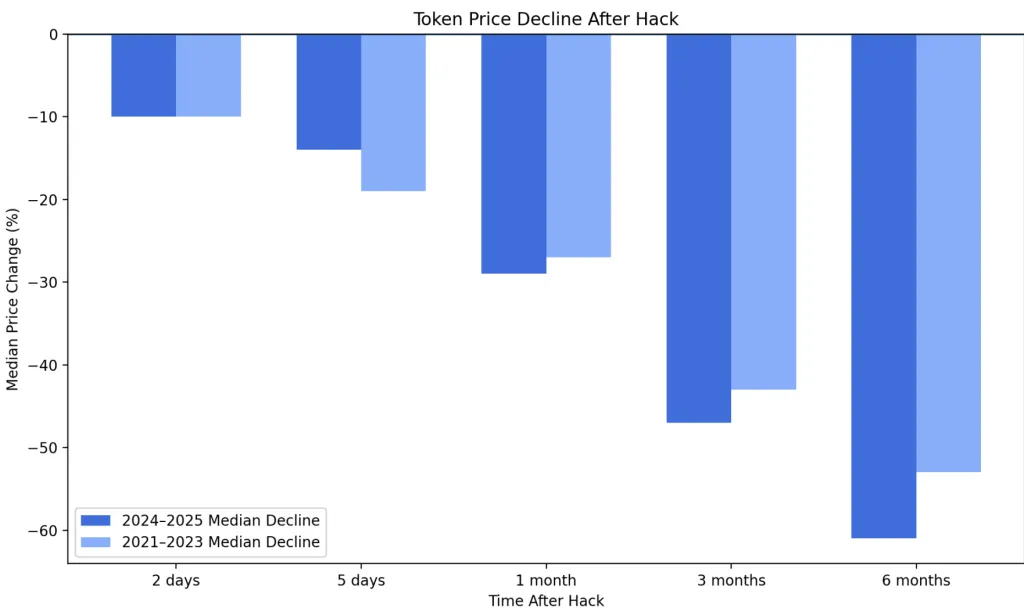
The fallout from exploits extends well beyond the immediate theft. Tokens of compromised protocols lose roughly 10% of their value within the first two days. Six months later, median losses reach 61% — up from 53% in the prior reporting period. Only 16% of affected assets manage to recover and surpass their pre-hack price levels.
For projects that hold native tokens in their treasuries, a 61% drawdown translates directly into slashed operational budgets. This constrains developer hiring and limits funding for protocol upgrades, creating a vicious cycle of decline.
Deep interconnections between protocols amplify fragility across the ecosystem. Immunefi cited the 2025 collapse of the deUSD stablecoin as a case study: losses cascaded through withdrawal freezes, forced liquidations, and TVL crashes across multiple platforms simultaneously.
Internal Chaos After a Breach
The internal operations of affected teams suffer severe disruption. Security departments typically undergo restructuring within weeks of an incident. Product development grinds to a halt as engineering resources are redirected toward damage control. Immunefi estimates that restoring normal operations requires a minimum of three months of concentrated effort.
Immunefi CEO Mitchell Amador previously described a major hack as a "death sentence" for 80% of protocols. He identified the root cause of collapse not as the direct loss of funds, but rather the ensuing management chaos and erosion of user and investor trust.
Frequently Asked Questions
What is the average cost of a crypto hack in 2024-2025?
According to Immunefi, the average damage from a single crypto protocol hack is approximately $24.5 million. The median loss is significantly lower at $2.2 million, indicating that a few massive incidents heavily skew the overall statistics.
How many crypto hacks happened in 2024 and 2025?
There were 94 recorded incidents in 2024 and 97 in 2025, totaling 191 successful attacks over the two-year period. These exploits caused combined damages of $4.67 billion.
Do crypto tokens recover after a protocol hack?
Only 16% of affected tokens manage to recover and surpass their pre-hack price levels. After six months, median losses reach 61%, while tokens typically drop about 10% within the first two days following an attack.
What was the largest crypto hack in recent years?
The Bybit exchange hack, which caused $1.5 billion in damages, was the largest single incident. It accounted for 44% of all industry losses in 2025 and 32% of the two-year total.
Why are centralized exchanges the biggest security risk in crypto?
While centralized exchanges were involved in only 20 of 191 incidents, they accounted for over half of all damages at $2.55 billion. Custodial risks remain the primary driver behind the industry's most catastrophic security failures.
Read also
April 2026 Sets All-Time Record for Number of Crypto Hacks
April 2026 saw a record-breaking 24 crypto hacks resulting in approximately $651 million in total losses. Kelp and Drift Protocol suffered the largest exploits.
AI Audit Uncovers Critical Liveness Bug in Ethereum's Nethermind Client
Octane Security's AI discovered a high-severity vulnerability in the Nethermind execution client that could have halted block production for 38% of Ethereum mainnet validators. The Ethereum Foundation awarded a maximum $50,000 bounty.
GPU Memory Attacks, $21B in Cybercrime Losses, and Chrome's Chip-Level Protection: Cybersecurity Roundup
The FBI reported record $21 billion in cybercrime losses for 2025, Google introduced hardware-bound session protection in Chrome, and researchers demonstrated three new attack methods targeting Nvidia GPU memory.
Drift Protocol on Solana Hacked for $280M in Sophisticated Durable Nonce Attack
Solana-based DeFi platform Drift Protocol lost at least $280 million in a hack on April 1. The DRIFT token dropped 37% while Circle faces criticism for failing to freeze stolen USDC.
Infostealer Targets 700+ Crypto Wallets, Hackers Use Solana as Dead Drop, and UK Sanctions Xinbi
Weekly cybersecurity roundup: Torg Grabber infostealer targets 728 browser-based crypto wallets, GlassWorm campaign hides C2 addresses in Solana blockchain, and the UK imposes sanctions on crypto marketplace Xinbi linked to scam compounds.
Ethereum Address Poisoning Attacks Surge 612% After Fusaka Upgrade
The Fusaka upgrade's reduced gas fees have triggered an explosion in address poisoning attacks on Ethereum, with dust transfers of USDT soaring 612% in just 90 days.