
Ethereum Address Poisoning Attacks Surge 612% After Fusaka Upgrade
 BinanceEXCHANGE
The Fusaka upgrade's reduced gas fees have triggered an explosion in address poisoning attacks on Ethereum, with dust transfers of USDT soaring 612% in just 90 days.
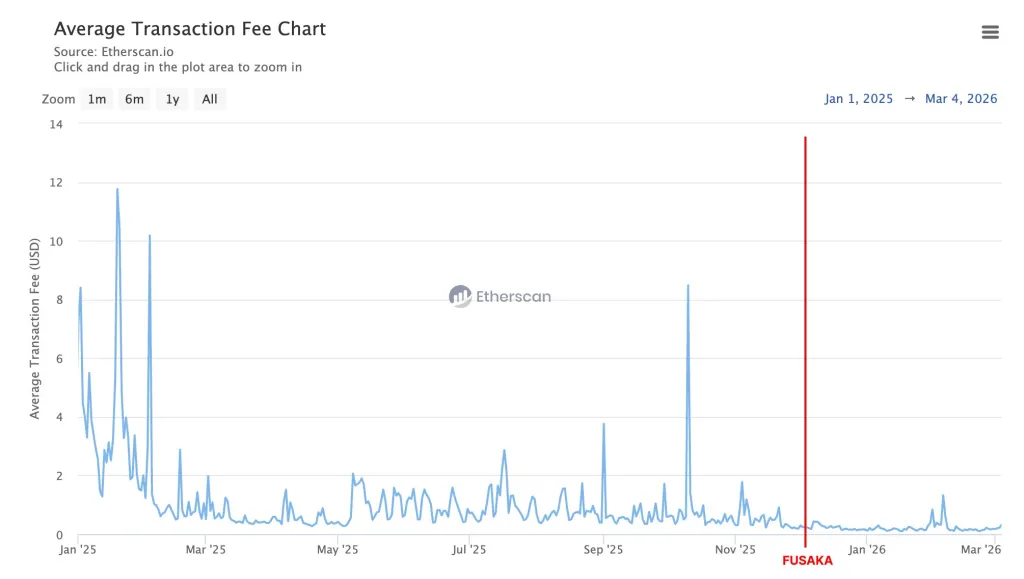
Ethereum's Fusaka upgrade, activated on December 3, 2025, has dramatically lowered transaction costs — and scammers have seized the opportunity. According to Etherscan data, USDT dust transfers surged 612% in the 90 days following the upgrade, marking an unprecedented spike in address poisoning attacks across the network.
«Original post» — etherscan.eth (@etherscan), March 12, 2026
Why This Matters
Address poisoning is among the most insidious crypto scams because it requires no wallet compromise or private key theft. Victims unknowingly send funds to a spoofed address copied from their own transaction history. With Fusaka slashing gas fees, the cost of broadcasting millions of fake micro-transactions has dropped to near zero, giving attackers an economic green light to scale operations massively.
Dust Transfer Growth Across Major Tokens
Comparing the 90-day windows before and after Fusaka's activation reveals a dramatic surge in micro-transactions valued below $0.01:
- USDT: +612% — from 4.2 million to 29.9 million transfers;
- USDC: +473% — from 2.6 million to 14.9 million;
- DAI: +470% — from 142,000 to 811,000;
- ETH: +62% — from 104.5 million to 169.7 million.
Regular transactions above the $0.01 threshold remained stable throughout the same period. This disparity clearly demonstrates that the spike is driven by deliberate malicious activity rather than organic network growth.
How Address Poisoning Works
The attack relies on automation and sheer volume. Scammers monitor the blockchain in real time, watching for large transfers. Once a target is identified, automated systems generate lookalike addresses that mimic the first and last characters of the victim's recent counterparties. Attackers then flood the victim's wallet with dust transfers so these spoofed addresses appear in the transaction history.
The bet is straightforward: a user copying an address from recent transactions may fail to notice the substitution and send funds directly to the attacker.
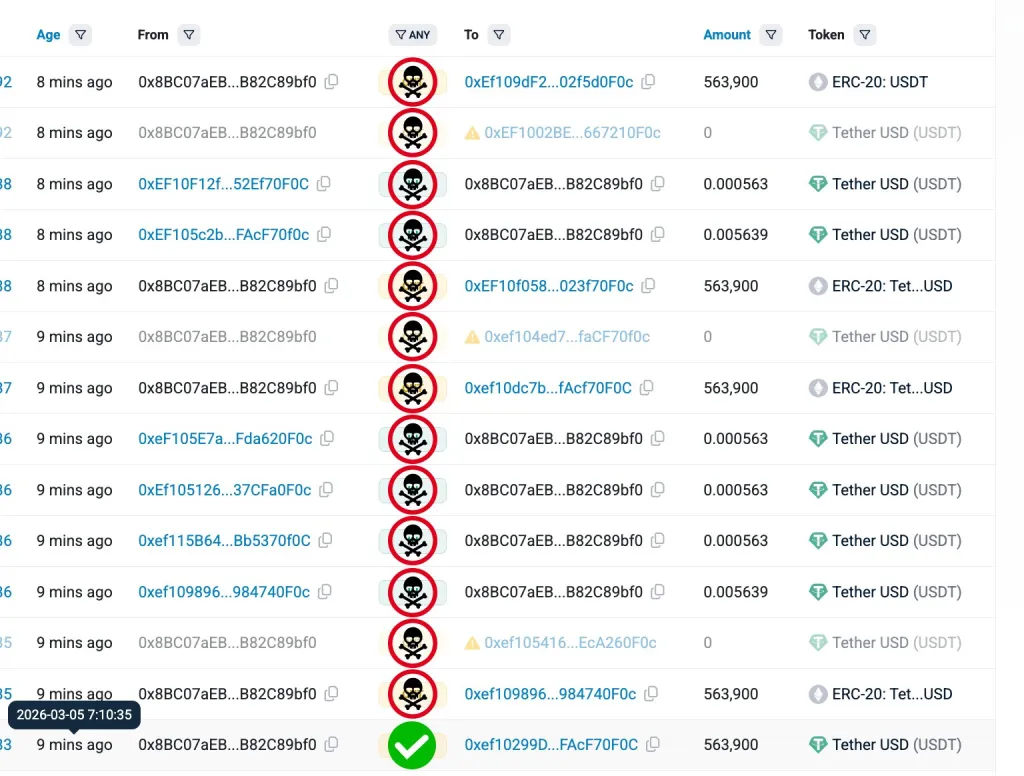
Competition among poisoning groups has become fierce. Etherscan screenshots show instances where up to 13 fraudulent transactions from different attackers appeared in a victim's history within just minutes of a legitimate USDT transfer.
A user named Nima shared his firsthand experience:
«Address poisoning attacks are getting out of hand. I just sent two stablecoin transactions and received +89 emails from my Etherscan address watch alert notifications. It took them <30 mins to create all of these on mainnet. So many will fall victim to this.» — Nima 👁️ (@0xNimaRa), original post
Two stablecoin transfers triggered over 89 alert notifications in under 30 minutes.
The Broader Damage
Address poisoning is far from a new phenomenon, but its scale continues to grow. Researchers at Blockchain Address Poisoning documented roughly 17 million spoofing attempts between July 2022 and June 2024. These attacks targeted approximately 1.3 million users, with cumulative losses exceeding $79 million.
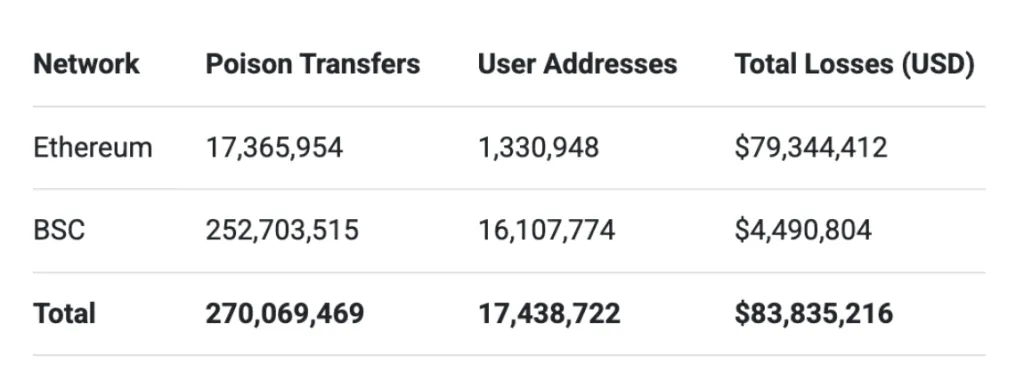
Low-fee blockchains face even greater exposure. On Binance Smart Chain, the volume of spoofed transfers is 1,355% higher than on Ethereum.
Only a tiny fraction of attempts succeed — roughly 0.01%. Yet the sheer volume makes the scheme highly profitable. Etherscan noted that these campaigns broadcast thousands or even millions of fake transfers, and even a minuscule success rate generates substantial returns at that scale.
In December 2025, a single investor lost nearly $50 million to an address poisoning attack. Binance founder Changpeng Zhao subsequently proposed additional security measures aimed at eradicating the practice.
Frequently Asked Questions
What is address poisoning in crypto?
Address poisoning is a scam technique where attackers send dust transactions from spoofed addresses that visually resemble a victim's real contacts. The goal is to trick users into copying a fake address from their transaction history and sending funds to it.
Why did address poisoning increase after Ethereum's Fusaka upgrade?
The Fusaka upgrade dramatically reduced Ethereum gas fees, making it nearly free for scammers to broadcast millions of dust transactions. USDT dust transfers surged 612% in the 90 days following the December 3, 2025 activation.
How much money has been lost to address poisoning attacks?
Between July 2022 and June 2024, researchers documented approximately 17 million spoofing attempts targeting around 1.3 million users, with cumulative losses exceeding $79 million. A single investor lost nearly $50 million in December 2025.
How can I protect myself from address poisoning?
Always verify the complete recipient address before sending funds, not just the first and last characters. Use your wallet's address book feature and avoid copying addresses from transaction history.
Which blockchains are most affected by address poisoning?
Low-fee blockchains are disproportionately affected. Binance Smart Chain has 1,355% more spoofed transfers than Ethereum, as cheaper transactions lower the cost barrier for attackers to execute mass poisoning campaigns.
Read also
AI Audit Uncovers Critical Liveness Bug in Ethereum's Nethermind Client
Octane Security's AI discovered a high-severity vulnerability in the Nethermind execution client that could have halted block production for 38% of Ethereum mainnet validators. The Ethereum Foundation awarded a maximum $50,000 bounty.
TON Wallet Introduces Yield Vaults for BTC, ETH, and USDT Directly in Telegram
TON Wallet has launched yield vaults for BTC, ETH, and USDT directly within Telegram, offering up to 18% APY on stablecoins through partnerships with Morpho, TAC, and Re7.
Bitcoin Down 2.5% Weekly: Jane Street Accusations & 7 Ethereum Forks
Bitcoin lost ~2.5% over the week amid macro shocks and geopolitical tensions. Jane Street faced market manipulation allegations while Ethereum unveiled an ambitious seven hard fork roadmap through 2029.
Bitcoin Hits $70,000 as Iran Ceasefire Talks Boost Risk Appetite
Bitcoin surged 4% to test the $70,000 level on April 6 amid reports of ceasefire negotiations between the US, Israel, and Iran. The derivatives market, however, sends mixed signals.
Bitcoin Rebounds to $70,000 as Leverage Drops and ETF Inflows Continue
BTC recovered above $70,000 on March 10, erasing weekend losses. Spot ETFs attracted $568M in weekly inflows while the estimated leverage ratio on Binance fell sharply from 0.198 to 0.152.
Stablecoin Transfer Volume Hits $10.5 Trillion in January — Highest Since April 2022
January stablecoin transaction volume surpassed $10.5 trillion, marking the highest monthly figure since April 2022. USDC led transfers while USDT maintained market cap dominance.