
Aave V4 Goes Live on Ethereum with New Hub and Spoke Architecture
Aave has launched its fourth protocol version on Ethereum mainnet, introducing a Hub and Spoke liquidity architecture with three specialized hubs and a new free interface called Aave Pro.
Aave Deploys Fourth Generation Protocol
The team behind DeFi lending protocol Aave has deployed version V4 on Ethereum mainnet. The upgrade introduces a fundamentally new liquidity management framework called Hub and Spoke.
"Aave V4 is now live on @ethereum." — Aave (@aave), original post
Why This Matters
Aave ranks among the largest decentralized lending protocols in DeFi. The migration to a new architectural model has implications across the Ethereum DeFi ecosystem — from liquidity providers and borrowers to developers building on top of the protocol. Hub and Spoke replaces isolated markets with a centralized hub system connected to specialized branches, each carrying its own collateral rules, risk parameters, and liquidation mechanisms. This represents a significant structural shift in how one of DeFi's foundational protocols organizes capital.
How Hub and Spoke Works
The core innovation in V4 is the separation of assets into central Liquidity Hubs and connected branches called Spokes. Assets are stored within the hubs, while Spokes connect to them with individual collateral rules, risk profiles, and liquidation mechanics.
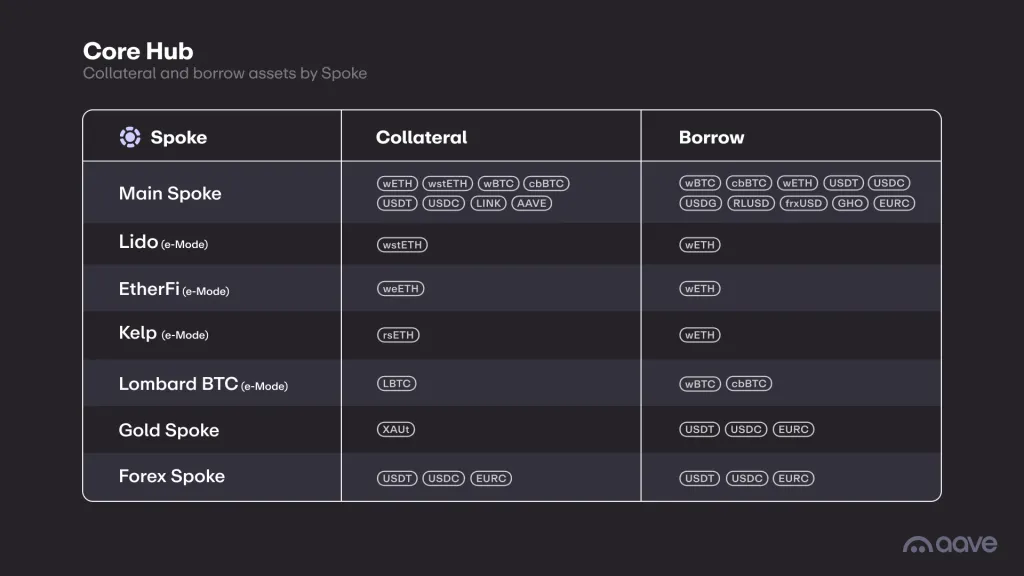
The flow works as follows: users deposit capital through Spokes, which then routes funds into Liquidity Hubs. Once there, the capital becomes available across all pools on the platform. This model consolidates liquidity while maintaining the flexibility of customized parameters for different strategies.
Three Hubs at Launch
To complement the upgraded protocol, the team released a free interface called Aave Pro. Three hubs are available from day one:
- Core Hub — the platform's primary market for standard lending and borrowing operations;
- Prime Hub — a pool designed for liquidity providers with stricter collateral requirements;
- Plus Hub — a venue tailored for stablecoin-based trading strategies.
Security Audits
The V4 codebase was reviewed by multiple auditing firms including Trail of Bits, Blackthorn, and ChainSecurity. Additional review was conducted by participants on the Sherlock platform. The protocol's architecture was developed with involvement from Certora.
Earlier in March 2026, Aave Labs co-founder Stani Kulechov addressed recent governance conflicts within the protocol and shared his perspective on the future of the DeFi sector.
Frequently Asked Questions
What is Aave V4 and when did it launch?
Aave V4 is the fourth version of the Aave DeFi lending protocol. It went live on Ethereum mainnet on March 30, 2026, introducing the Hub and Spoke liquidity architecture.
How does the Hub and Spoke architecture work in Aave V4?
Assets are stored in central Liquidity Hubs, with Spokes connecting to them carrying individual collateral rules, risk parameters, and liquidation mechanisms. Users deposit capital through Spokes, which routes funds to the hubs where they become available across all platform pools.
What liquidity hubs are available in Aave V4 at launch?
Three hubs launched on day one: Core Hub (the primary market), Prime Hub (a pool with stricter collateral requirements), and Plus Hub (designed for stablecoin trading strategies).
Who audited the Aave V4 code?
The codebase was audited by Trail of Bits, Blackthorn, and ChainSecurity. Additional review came from Sherlock platform participants, and the architecture was developed with involvement from Certora.
What is Aave Pro?
Aave Pro is a free interface released by the Aave team for interacting with the upgraded V4 protocol and its three liquidity hubs.
Read also
TON Wallet Introduces Yield Vaults for BTC, ETH, and USDT Directly in Telegram
TON Wallet has launched yield vaults for BTC, ETH, and USDT directly within Telegram, offering up to 18% APY on stablecoins through partnerships with Morpho, TAC, and Re7.
Weekly Recap: Aave Ecosystem Rescue Mobilizes 100,000 ETH and Quantum Computer Cracks 15-Bit ECC Key
Bitcoin held near $78,000, the DeFi community rallied over 100,000 ETH to help Aave recover from the Kelp hack, and a researcher cracked a 15-bit ECC key on a quantum computer.
Bitcoin Down 2.5% Weekly: Jane Street Accusations & 7 Ethereum Forks
Bitcoin lost ~2.5% over the week amid macro shocks and geopolitical tensions. Jane Street faced market manipulation allegations while Ethereum unveiled an ambitious seven hard fork roadmap through 2029.
AI Audit Uncovers Critical Liveness Bug in Ethereum's Nethermind Client
Octane Security's AI discovered a high-severity vulnerability in the Nethermind execution client that could have halted block production for 38% of Ethereum mainnet validators. The Ethereum Foundation awarded a maximum $50,000 bounty.
Bitcoin Hits $70,000 as Iran Ceasefire Talks Boost Risk Appetite
Bitcoin surged 4% to test the $70,000 level on April 6 amid reports of ceasefire negotiations between the US, Israel, and Iran. The derivatives market, however, sends mixed signals.
Bitcoin Rebounds to $70,000 as Leverage Drops and ETF Inflows Continue
BTC recovered above $70,000 on March 10, erasing weekend losses. Spot ETFs attracted $568M in weekly inflows while the estimated leverage ratio on Binance fell sharply from 0.198 to 0.152.