
Super Micro Co-founder Charged in $2.5B AI Chip Smuggling to China
The US Department of Justice charged Super Micro Computer co-founder Steve Liau with orchestrating a $2.5 billion scheme to illegally export AI chip-equipped servers to China through Southeast Asian intermediaries.
Major Export Control Violation Uncovered
US authorities have arrested Yi-Hsiang "Wally" Liau, co-founder of Super Micro Computer, charging him with orchestrating a massive $2.5 billion operation to smuggle AI chip-equipped servers into China. The indictment was announced by the Department of Justice in a press release.
Two additional defendants have been named: Jui-Tsang "Steven" Chang, the general manager of Super Micro's Taiwan office, who remains at large, and third-party broker Ting-Wei "Willy" Sun, who has also been apprehended.
Why This Matters
The case exposes the sheer scale of illicit high-tech component trafficking amid the deepening technological rivalry between Washington and Beijing. Jay Clayton, US Attorney for the Southern District of New York, stated that such schemes generate billions of dollars in illegal profits and pose a direct threat to US national security.
The smuggling of advanced semiconductors undermines the export control regime that the United States has constructed to limit China's access to critical artificial intelligence technologies. This prosecution signals an intensified enforcement posture from American authorities.
How the Smuggling Network Operated
According to prosecutors, the defendants built a multi-layered logistics chain using an intermediary company. Liau and Chang allegedly directed executives at a firm in Southeast Asia to place orders for servers from a US manufacturer.
The equipment was assembled in the United States, then shipped to facilities in Taiwan. From there, the servers were forwarded to the intermediary company's locations in other Southeast Asian countries. In the final step, the products were repackaged into unmarked boxes to conceal their contents before shipment to end destinations in China.
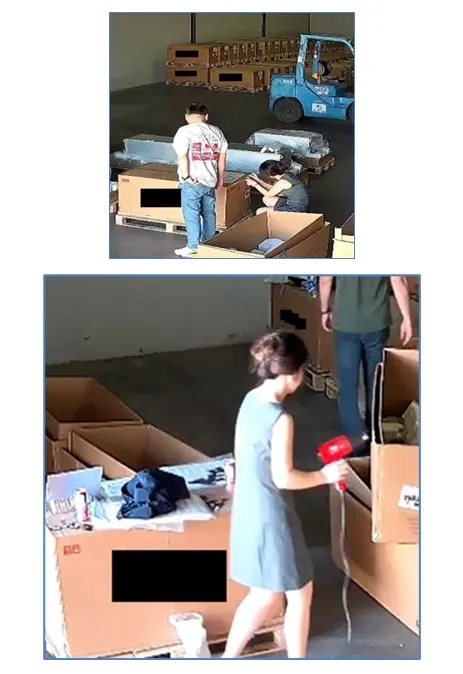
Between 2024 and 2025, equipment worth $2.5 billion flowed through this pipeline. To deceive American compliance auditors, the conspirators fabricated thousands of counterfeit servers. Surveillance footage captured Sun personally supervising the swapping of serial number labels — workers used a hair dryer to remove them.
Criminal Charges Filed
All three defendants face conspiracy charges on three counts:
- Violating the Export Control Reform Act — carrying a maximum sentence of 20 years in prison;
- Smuggling goods from the United States — up to 5 years;
- Defrauding the United States — up to 5 years.
Years of Smuggling Warnings
Reports of restricted chip smuggling into China have surfaced repeatedly in recent years. In December 2024, the US Commerce Department reportedly contacted Nvidia to determine how its products were reaching China. Nvidia then asked major distributors — including Super Micro and Dell Technologies — to scrutinize their customers in Southeast Asia. Five different participants in smuggling operations claimed at the time that they had evaded detection during Super Micro's compliance checks.
In July 2025, reports emerged that approximately $1 billion worth of chips had been smuggled into China within just three months of the Trump administration tightening export controls. According to the Financial Times, B200 processors became the most popular and accessible product on the black market.
By December 2025, Nvidia had developed proprietary technology to verify the physical location of its processors. The tool analyzes latency in data exchanges with Nvidia's servers, leveraging confidential computing capabilities built into its GPUs. It was offered to customers on an opt-in basis, and the company announced plans to open-source the software for independent review.
Also in December 2025, Trump authorized the sale of H200 AI chips to "approved customers" in China and other countries, provided that the United States receives 25% of the profits.
Frequently Asked Questions
Why was the Super Micro Computer co-founder arrested?
Yi-Hsiang 'Wally' Liau was charged with orchestrating a $2.5 billion smuggling operation that illegally exported AI chip-equipped servers to China. The scheme used transit shipments through Taiwan and Southeast Asia with an intermediary company and falsified documentation.
What penalties do the defendants face in the AI chip smuggling case?
The most serious charge — violating the Export Control Reform Act — carries a maximum sentence of 20 years in prison. Additional charges for smuggling goods from the US and defrauding the United States each carry up to 5 years.
How were AI chips smuggled into China?
Servers were assembled in the US, shipped to Taiwan, then forwarded to an intermediary company in Southeast Asia. There, the equipment was repackaged into unmarked boxes before being sent to final destinations in China.
How is Nvidia tracking its chips to prevent smuggling?
In December 2025, Nvidia developed technology to verify processor locations by analyzing latency in data exchanges with its servers. The company plans to open-source the software so independent researchers can review it.
How much were the smuggled AI chips worth?
The scheme uncovered by the DOJ involved $2.5 billion in equipment between 2024 and 2025. Separately, reports indicated that roughly $1 billion in chips were smuggled into China within three months of tightened export controls in 2025.
Read also
Nvidia Doubles Net Profit as AI Chip Demand Hits Record Highs
Nvidia reported Q4 revenue of $68.13 billion and net income of $43 billion, nearly double the prior year. CEO Jensen Huang also addressed the Anthropic-Pentagon dispute and fears of an AI-driven economic downturn.
US DOJ Seizes Over $580M in Crypto Linked to Chinese Criminal Organizations
The U.S. Department of Justice seized more than $580 million in cryptocurrency tied to Chinese criminal organizations, marking one of the largest crypto enforcement actions in history.
GPU Memory Attacks, $21B in Cybercrime Losses, and Chrome's Chip-Level Protection: Cybersecurity Roundup
The FBI reported record $21 billion in cybercrime losses for 2025, Google introduced hardware-bound session protection in Chrome, and researchers demonstrated three new attack methods targeting Nvidia GPU memory.
OpenAI Secures Record $110 Billion Round at $730 Billion Valuation
OpenAI closed the largest startup funding round in history at $110 billion, backed by Amazon, SoftBank, and Nvidia, with a $730 billion valuation.
Google Unveils Next-Gen AI Chips and Launches Agent Platform
Google announced new TPU 8t and TPU 8i processors, debuted the Gemini Enterprise Agent Platform with memory modules, and established a $750 million fund for AI agent adoption through consulting partners.
Nvidia Unveils Computing Platform for Space Data Centers at GTC 2026
Nvidia CEO Jensen Huang announced the Vera Rubin Space-1 module for orbital data centers, a $1 trillion order forecast, and new autonomous driving partnerships at GTC 2026.