
Nvidia Doubles Net Profit as AI Chip Demand Hits Record Highs
Nvidia reported Q4 revenue of $68.13 billion and net income of $43 billion, nearly double the prior year. CEO Jensen Huang also addressed the Anthropic-Pentagon dispute and fears of an AI-driven economic downturn.
Q4 Results Smash Wall Street Expectations
Nvidia released its fourth-quarter financial results, posting numbers that handily beat analyst forecasts. Earnings per share came in at $1.62 versus the expected $1.53, while total revenue reached $68.13 billion against the $66.21 billion consensus estimate.
Year-over-year revenue surged 73%, up from $39.3 billion in the same period a year ago. Net income nearly doubled to $43 billion from $22.1 billion in the prior reporting period.
The data center segment remains the overwhelming growth engine, accounting for more than 91% of total sales. Revenue from this division climbed 75% — it houses Nvidia's flagship AI processors.
Why This Matters
Nvidia's quarterly performance serves as a bellwether for the entire artificial intelligence industry. Earlier earnings reports from Alphabet, Amazon, Meta, and Microsoft led analysts to project combined annual capital expenditures approaching $700 billion as tech giants build out proprietary AI infrastructure.
Nvidia CFO Colette Kress confirmed that hyperscalers remain the company's largest customer group, contributing over 50% of data center revenue.
Forward guidance also exceeded expectations: Nvidia forecasts $78 billion in revenue for the first fiscal quarter, compared with the analyst consensus of $72.6 billion. Notably, the company excludes Chinese data center revenue from that outlook.
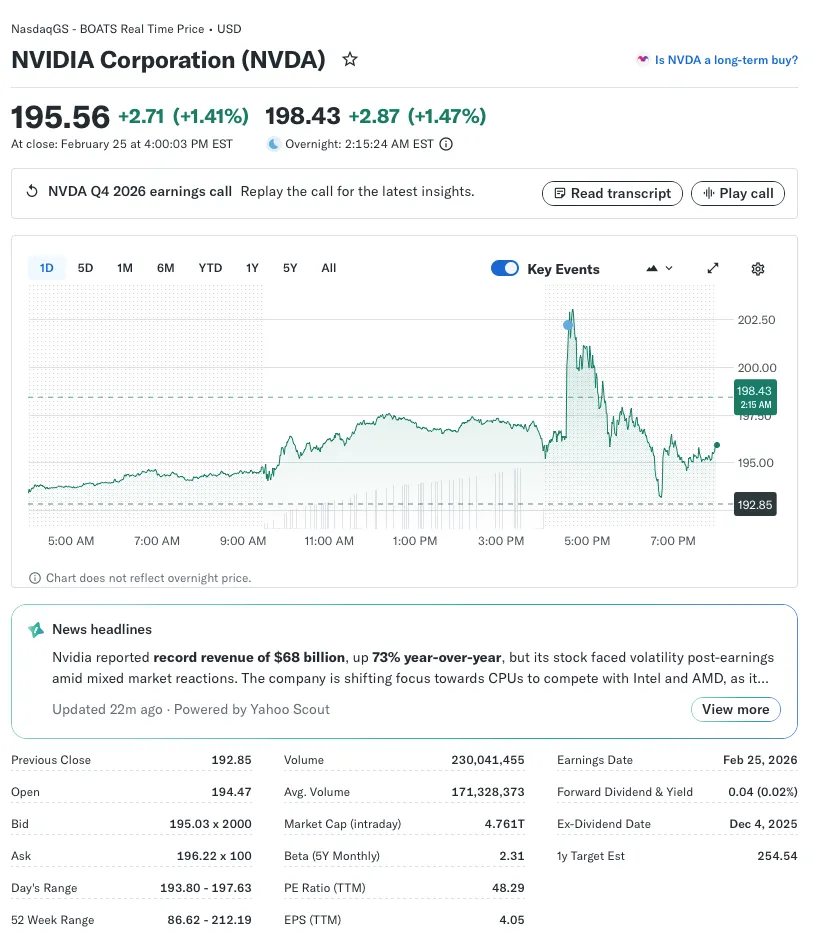
Nvidia shares have gained 5% year-to-date, outperforming the Nasdaq index, which has declined 0.4% over the same period.
Supply Constraints and Next-Gen Chips
Memory shortages remain the primary risk factor. Kress noted that supply limitations will weigh on the gaming business "in the first quarter of fiscal 2027 and beyond."
Meanwhile, demand is building for the next-generation Vera Rubin computing platform. Early samples have already been delivered to customers, with volume shipments expected in the second half of the year. The new chips are projected to deliver a 10x improvement in performance per watt — a crucial metric given the growing energy constraints facing data centers.
Nvidia is also diversifying its supply chain beyond Asia. Blackwell chips are manufactured at TSMC's Arizona facilities, and some systems are assembled at a major new Foxconn plant in Mexico.
Huang Weighs In on the Anthropic-Pentagon Dispute
Nvidia CEO Jensen Huang addressed the friction between the U.S. Department of Defense and Anthropic, describing the situation as far from dire. He said the Pentagon has every right to use technologies it has purchased, while Anthropic can set its own product usage policies.
Huang characterized both positions as reasonable and emphasized that even a breakdown in negotiations would not be catastrophic — Anthropic is not the only AI company in existence, and the Department of Defense is not the only customer.
Pushing Back on AI Economic Collapse Fears
Huang also responded to a Citrini Research report that outlined a scenario in which artificial intelligence triggers an economic collapse. The report partially fueled a sell-off in software developer and payment services stocks.
Huang said markets misread the situation. In his view, AI agents will not replace existing software but rather work alongside it. Platforms like Cadence, Synopsys, ServiceNow, and SAP exist for fundamentally sound reasons, and AI agents will function as "intelligent software" that leverages these tools on behalf of users to boost productivity.
In January, the Trump administration officially authorized exports of Nvidia's H200 AI chips — the second most powerful in the company's lineup — to China.
Frequently Asked Questions
How much did Nvidia earn in Q4 2024?
Nvidia posted Q4 revenue of $68.13 billion, a 73% year-over-year increase, with earnings per share of $1.62. Net income nearly doubled to $43 billion from $22.1 billion in the prior reporting period.
What is driving Nvidia's revenue growth?
The data center segment is Nvidia's overwhelming growth engine, accounting for more than 91% of total sales. Revenue from this division climbed 75%, powered by demand for Nvidia's flagship AI processors from hyperscalers like Alphabet, Amazon, Meta, and Microsoft.
What is Nvidia's revenue forecast for next quarter?
Nvidia forecasts $78 billion in revenue for the first fiscal quarter, exceeding the analyst consensus of $72.6 billion. Notably, this outlook excludes Chinese data center revenue.
When will Nvidia's next-gen Vera Rubin chips be available?
Early samples of the Vera Rubin computing platform have already been delivered to customers, with volume shipments expected in the second half of the year. The new chips are projected to deliver a 10x improvement in performance per watt.
What are the main risks facing Nvidia right now?
Memory shortages remain the primary risk factor. Nvidia CFO Colette Kress noted that supply limitations will weigh on the gaming business in the first quarter of fiscal 2027 and beyond.
Read also
OpenAI Secures Record $110 Billion Round at $730 Billion Valuation
OpenAI closed the largest startup funding round in history at $110 billion, backed by Amazon, SoftBank, and Nvidia, with a $730 billion valuation.
Alphabet Posts $94.7B Q1 Revenue Beating Estimates Amid AI-Driven Growth
Google's parent company Alphabet reported Q1 2026 revenue of $94.7 billion, surpassing Wall Street forecasts, with its cloud division and AI integration fueling a strong beat across all metrics.
Bitcoin Miners Dump Crypto Reserves to Fund AI Infrastructure Pivot
Major public Bitcoin mining companies are liquidating their BTC holdings to finance a transition toward AI data center infrastructure. MARA Holdings, the largest public miner by reserves, denied rumors of a massive sell-off of its 53,822 BTC.
AI Audit Uncovers Critical Liveness Bug in Ethereum's Nethermind Client
Octane Security's AI discovered a high-severity vulnerability in the Nethermind execution client that could have halted block production for 38% of Ethereum mainnet validators. The Ethereum Foundation awarded a maximum $50,000 bounty.
GPU Memory Attacks, $21B in Cybercrime Losses, and Chrome's Chip-Level Protection: Cybersecurity Roundup
The FBI reported record $21 billion in cybercrime losses for 2025, Google introduced hardware-bound session protection in Chrome, and researchers demonstrated three new attack methods targeting Nvidia GPU memory.
Trump Orders All Federal Agencies to Drop Anthropic Technologies Within Six Months
Federal agencies have 6 months to drop Anthropic's Claude AI amid ethics clashes. See how xAI and Pentagon deals reshape the landscape.