
US February CPI Meets Expectations at 2.4% as Bitcoin Rallies Toward $71,000
US Consumer Price Index held steady at 2.4% in February, matching consensus forecasts. Bitcoin surged 2.3% toward $71,000 following the data release.
February CPI: No Surprises on Inflation Front
The US Consumer Price Index (CPI) for February held steady at 2.4% year-over-year, matching analyst expectations precisely. Bitcoin responded with a 2.3% jump, reaching the $71,000 level.
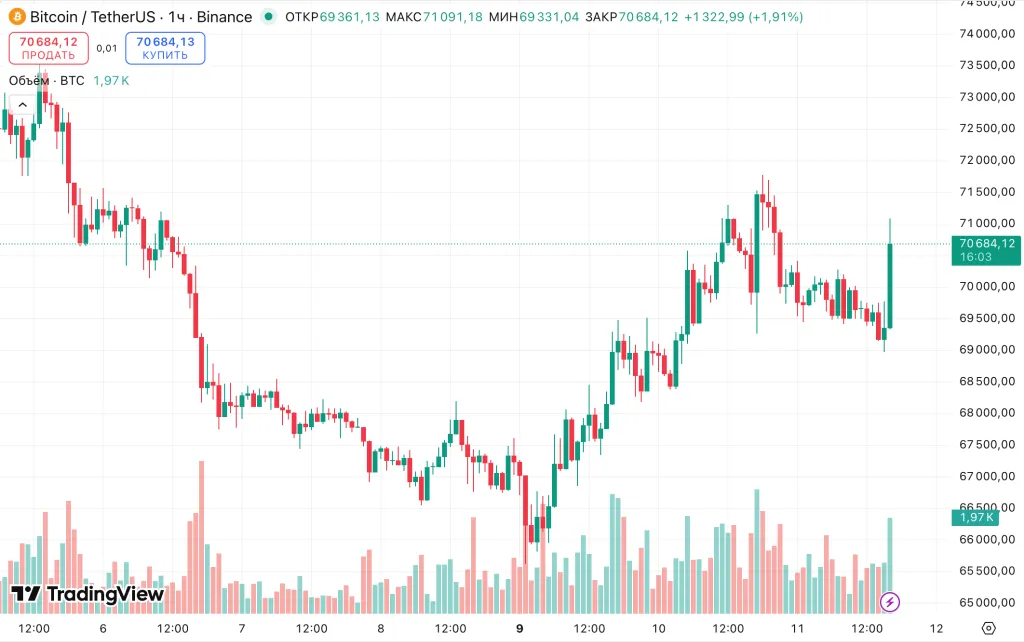
BTC/USDT hourly chart on Binance. Source: TradingView
Ethereum also posted gains, climbing 2.8% to approach the $2,100 mark.
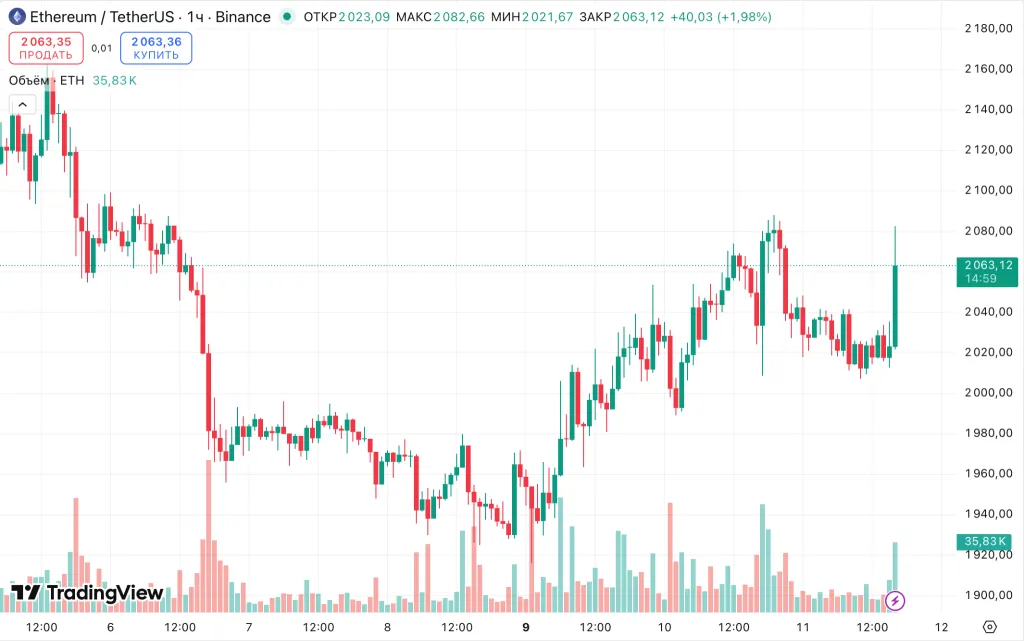
ETH/USDT hourly chart on Binance. Source: TradingView
Core CPI — which strips out volatile food and energy components — rose 0.2% month-over-month, slightly below January's 0.3%. On an annual basis, core inflation came in at 2.5%, matching both the consensus forecast and the previous month's reading.
Why This Matters
While the in-line CPI print reduces immediate market uncertainty, experts surveyed by Bloomberg caution that February's data does not yet reflect the impact of the war in Iran, which has already driven energy and fuel prices sharply higher.
Analysts flag concerning signals from the PCE index — another key inflation gauge favored by the Federal Reserve. Its core components for the prior month point to a minimum 0.4% increase, deviating from the Fed's 2% annual target even before accounting for Middle East conflict effects.
Expert Opinions and Scenarios
Bloomberg economists Anna Wong and Troy Duri suggested that rising energy costs could push the March CPI to approximately 3%.
Karen Manna, Chief Investment Officer at Federated Hermes, described the current statistics as "background noise," arguing that risk asset pricing is now being driven by the geopolitical situation around Iran rather than economic reports.
Christopher Hodge of Natixis identified the energy shock's economic impact as the central question, outlining two possible scenarios:
- Scenario 1: Higher energy costs act as a "consumption tax." Rising gasoline and heating expenses squeeze household budgets, demand falls, and inflation begins to decline.
- Scenario 2: Expensive energy entrenches inflation expectations. Consumers adapt to higher prices and begin demanding higher wages, embedding inflation for an extended period.
Hodge believes the Fed will bet on the first scenario but warned that time will tell whether the pass-through from temporary factors (oil prices) into core metrics and expectations accelerates this time around.
Fed Rate Outlook
Markets interpreted the CPI data as confirmation that the Fed's easing cycle remains on pause. The probability of holding rates at the March 18 meeting stands at 99%, while odds of an April cut dropped to just 11%.
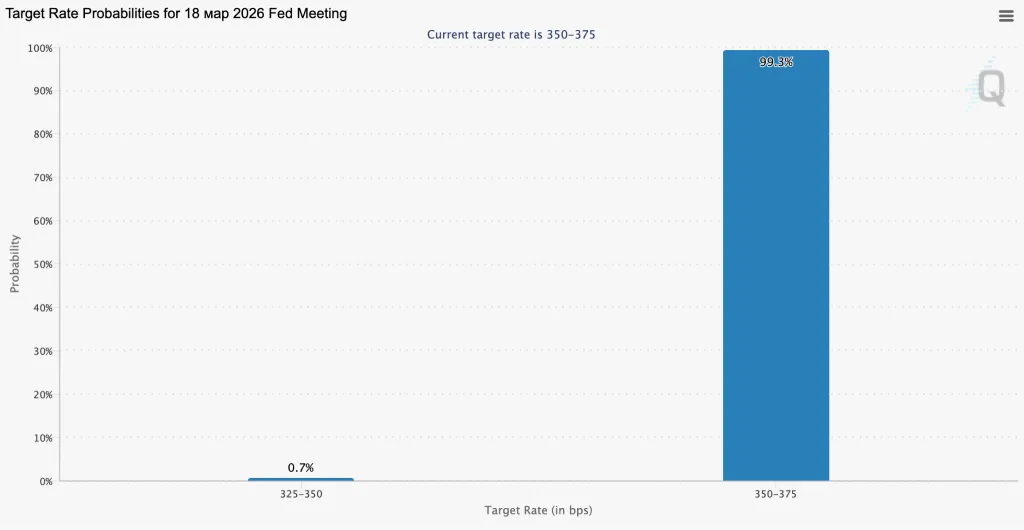
Fed rate change probabilities. Source: CME FedWatch
Wong and Duri expect moderate unemployment growth and slowing core inflation in the second half of the year, which would give the Fed room to maneuver. The economists project 100 basis points of rate cuts by year-end.
Broader Market Reaction
US stock index futures showed mixed results. Nasdaq dipped 0.04%, Dow Jones fell 0.07%, while the S&P 500 edged up 0.07%. The 10-year Treasury yield rose to 4.18%.
Oil markets continued their rally amid the Middle East conflict — crude prices have surged 80% over the past three weeks. WTI gained 2.2% in the last 24 hours, with Brent up 2.1%. Due to supply disruptions through the Strait of Hormuz, the International Energy Agency announced the release of 400 million barrels from strategic reserves to help stabilize the market.
Bitfinex analysts have previously identified oil prices as the primary driver of Bitcoin's price action in the current environment.
Frequently Asked Questions
What was the US CPI for February 2026?
The US Consumer Price Index for February came in at 2.4% year-over-year, matching analyst expectations. Core CPI, excluding food and energy, was 2.5% annually and 0.2% month-over-month, slightly below January's 0.3%.
Why did Bitcoin rally to $71,000?
Bitcoin surged 2.3% after the US CPI data matched market expectations, reducing uncertainty. The in-line inflation reading supported risk assets including cryptocurrencies.
Will the Fed cut rates in March 2026?
The probability of the Fed holding rates at the March 18 meeting is 99% according to CME FedWatch. April rate cut odds dropped to just 11%, though Bloomberg economists project 100 basis points of cuts by year-end.
How does the Iran conflict affect US inflation?
Bloomberg experts note that February CPI data does not yet capture the impact of the Iran war. Oil has surged 80% in three weeks, and analysts suggest March CPI could rise to approximately 3% due to energy cost pass-through.
How did Ethereum react to the CPI data?
Ethereum gained 2.8% following the CPI release, approaching the $2,100 level. The move mirrored Bitcoin's rally as markets reacted positively to inflation data matching consensus forecasts.
Read also
Bitcoin Down 2.5% Weekly: Jane Street Accusations & 7 Ethereum Forks
Bitcoin lost ~2.5% over the week amid macro shocks and geopolitical tensions. Jane Street faced market manipulation allegations while Ethereum unveiled an ambitious seven hard fork roadmap through 2029.
TON Wallet Introduces Yield Vaults for BTC, ETH, and USDT Directly in Telegram
TON Wallet has launched yield vaults for BTC, ETH, and USDT directly within Telegram, offering up to 18% APY on stablecoins through partnerships with Morpho, TAC, and Re7.
Bitcoin Hits $70,000 as Iran Ceasefire Talks Boost Risk Appetite
Bitcoin surged 4% to test the $70,000 level on April 6 amid reports of ceasefire negotiations between the US, Israel, and Iran. The derivatives market, however, sends mixed signals.
Bitcoin Rebounds to $70,000 as Leverage Drops and ETF Inflows Continue
BTC recovered above $70,000 on March 10, erasing weekend losses. Spot ETFs attracted $568M in weekly inflows while the estimated leverage ratio on Binance fell sharply from 0.198 to 0.152.
Bitcoin Drops Below $67,000 as Ethereum Foundation Unveils Quantum Defense Roadmap
Bitcoin lost 3% over the week amid Middle East tensions and ETF outflows, miner activity hit historic lows, and Ethereum Foundation outlined a four-hardfork plan for quantum resistance by 2029.
AI Audit Uncovers Critical Liveness Bug in Ethereum's Nethermind Client
Octane Security's AI discovered a high-severity vulnerability in the Nethermind execution client that could have halted block production for 38% of Ethereum mainnet validators. The Ethereum Foundation awarded a maximum $50,000 bounty.