
Standard Chartered: Stablecoin Velocity Has Doubled in Two Years
Standard Chartered's Geoffrey Kendrick found that stablecoin turnover velocity has doubled over the past two years, with tokens now changing hands roughly six times per month. USDC from Circle was the primary driver.
Stablecoins Now Change Hands Six Times a Month
Geoffrey Kendrick, head of digital asset research at Standard Chartered, has flagged a dramatic acceleration in stablecoin velocity — the rate at which fiat-pegged tokens change ownership. According to his analysis reported by The Block, the metric has doubled over the past two years, with tokens now switching hands approximately six times per month on average.
Kendrick acknowledged that this trend contradicts the bank's earlier assumption that velocity would remain stable. The primary catalyst behind the acceleration has been USDC, the stablecoin issued by Circle.
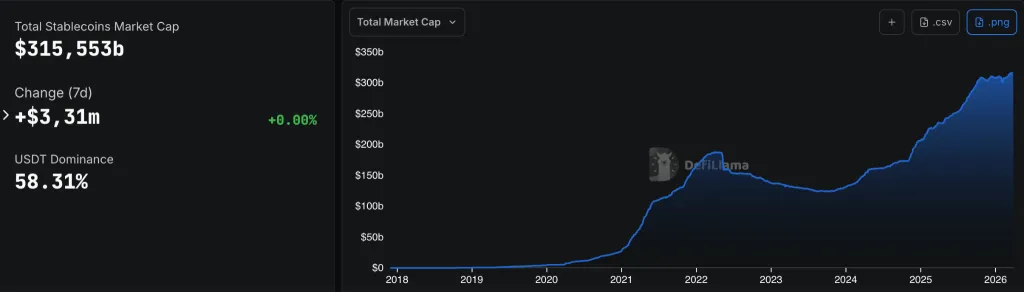
Total stablecoin supply stands at $315.5 billion at the time of publication. Source: DefiLlama
Why This Matters
Standard Chartered's projection that stablecoin supply would reach $2 trillion by 2028 was partly built on the assumption of constant velocity. A doubling of this metric means the existing pool of tokens can service a higher volume of transactions without requiring proportional new issuance. Even as transaction volumes continue growing, the demand for additional stablecoin minting could be lower than previously anticipated.
Kendrick outlined the dynamic clearly: if velocity holds steady, transaction growth will drive demand for more stablecoins. But if velocity keeps rising, that additional demand simply won't materialize — all else being equal.
New Use Cases Reshaping the Market
The analyst attributed the velocity surge to an evolution in how stablecoins are used. Dollar-pegged tokens have moved well beyond their original roles in crypto trading and savings. They increasingly serve as alternatives to traditional financial infrastructure, including emerging applications in AI-powered payments.
Standard Chartered emphasizes that the faster velocity reflects new, incremental demand rather than a wholesale shift in existing usage patterns. The savings segment in emerging markets — dominated by Tether's USDT and characterized by longer holding periods — has not shown a comparable acceleration.
The $2 Trillion Forecast Stands
Despite the shift in velocity dynamics, the bank has maintained its headline forecast: stablecoin supply is still expected to hit $2 trillion by 2028. Total stablecoin market capitalization stood at $315.5 billion at the time of reporting.
If that target is achieved, Standard Chartered estimates it would generate roughly $1 trillion in additional demand for U.S. Treasury bills. The bank's analysts have previously argued that stablecoins will transform global liquidity, trigger an outflow of $500 billion from bank deposits, and become the primary catalyst for mainstream crypto adoption.
However, the velocity factor introduces a new variable into these calculations. It may prove just as consequential as absolute supply when assessing stablecoins' real impact on the broader financial system.
The bullish thesis on stablecoins has found support from other prominent voices as well. In March, former hedge fund manager Stanley Druckenmiller called stablecoins the future of global payments, reinforcing the narrative that their role is expanding rapidly beyond the crypto-native ecosystem.
Frequently Asked Questions
What is stablecoin velocity?
Stablecoin velocity measures how frequently tokens change hands over a given period. According to Standard Chartered, stablecoins now change owners approximately six times per month on average — double the rate from two years ago.
Which stablecoin is driving the velocity increase?
USDC from Circle has been the primary driver of the acceleration in stablecoin turnover. Meanwhile, Tether's USDT, which dominates the savings use case in emerging markets, has not shown a similar velocity increase.
What is Standard Chartered's stablecoin forecast for 2028?
Standard Chartered maintains its projection that stablecoin supply will reach $2 trillion by 2028. At the time of reporting, total stablecoin market cap stood at $315.5 billion. The bank estimates this growth would create approximately $1 trillion in additional demand for U.S. Treasury bills.
How does higher velocity affect stablecoin supply demand?
Higher velocity means the existing pool of stablecoins can handle more transactions without requiring proportional new issuance. If velocity continues to rise, growth in transaction volumes may not translate into demand for additional stablecoin minting, all else being equal.
What new use cases are driving stablecoin adoption?
Stablecoins have expanded beyond crypto trading and savings into replacing traditional financial infrastructure. New applications include AI-powered payments and cross-border transactions, reflecting a fundamental shift in how fiat-pegged tokens are utilized.
Read also
Top 10 Dollar Stablecoins in 2026: From Dominant Players to Exit Candidates
The stablecoin market has surpassed $311 billion in total capitalization. Here's a breakdown of the ten largest USD-pegged stablecoins — from undisputed leaders Tether and Circle to ambitious newcomers.
Stablecoin Transfer Volume Hits $10.5 Trillion in January — Highest Since April 2022
January stablecoin transaction volume surpassed $10.5 trillion, marking the highest monthly figure since April 2022. USDC led transfers while USDT maintained market cap dominance.
TRON Energy Rental: How to Cut USDT Transfer Fees by Up to 60%
USDT issuance on TRON surpassed $85 billion in February 2026, but transfer fees remain steep at $1.83–$3.83 per transaction. Energy rental services like TronZap offer a way to cut costs by 50–60%.
Bitcoin Down 2.5% Weekly: Jane Street Accusations & 7 Ethereum Forks
Bitcoin lost ~2.5% over the week amid macro shocks and geopolitical tensions. Jane Street faced market manipulation allegations while Ethereum unveiled an ambitious seven hard fork roadmap through 2029.
TON Wallet Introduces Yield Vaults for BTC, ETH, and USDT Directly in Telegram
TON Wallet has launched yield vaults for BTC, ETH, and USDT directly within Telegram, offering up to 18% APY on stablecoins through partnerships with Morpho, TAC, and Re7.
Options Traders Bet on Bitcoin Rally to $80,000 by Summer
Bitcoin consolidates near $70,000 after a volatility spike. Options market participants are increasingly positioning for a rally to $80,000 by early summer, despite macroeconomic headwinds.