
Stablecoin Inflows Surge 414.5% as Retail Investors Fuel Growth Amid US Regulatory Battle
Net weekly stablecoin inflows jumped to $1.7 billion, with total market capitalization reaching $293.7 billion. Meanwhile, US banking lobbyists clash with crypto advocates over yield payments in a heated Senate debate.
Capital Floods Back Into Stablecoins
Net weekly inflows into stablecoins surged 414.5% to reach $1.7 billion, according to a fresh report from analytics firm Messari. The sector's total market capitalization climbed to $293.7 billion.
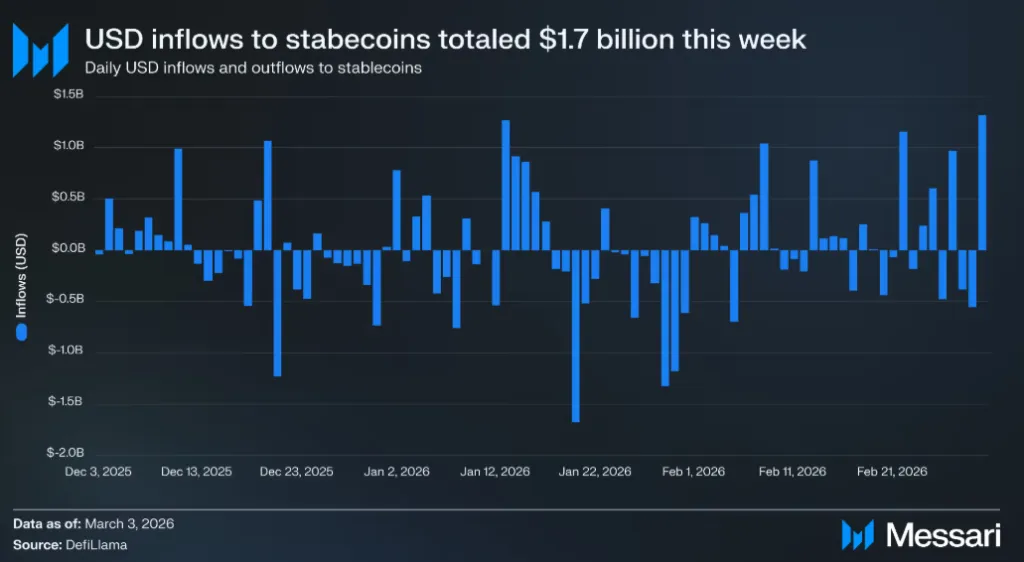
On-chain activity reinforced the bullish picture. Weekly transaction volume grew 6% to $312.5 billion, while daily transfer count rose nearly 10% to 30.9 million. Analysts noted a decline in average transaction size — a pattern consistent with retail users returning to stablecoins for everyday payments and transfers.
PYUSD, USDS, and USDC led the weekly gains. USDT maintained its dominant position with a 62.5% market share. USDe and USD1 were the only notable laggards, experiencing slight volume declines.
Why This Matters
The sharp increase in retail-driven stablecoin adoption signals that digital dollar equivalents are transitioning from a tool primarily used by large traders into a mainstream payment instrument. Smaller but far more frequent transactions reflect growing everyday utility. Major corporations are taking notice — Meta is reportedly exploring stablecoin payment integration across its platforms, with an estimated launch in the second half of 2026. Notably, the company plans to rely on third-party token providers rather than issuing its own stablecoin.
Banking Lobby vs. Crypto Yields: A Senate Standoff
This growth is unfolding against a backdrop of intense regulatory debate in the United States. The American banking lobby is pushing back hard against the concept of stablecoin yield payments, fearing a mass exodus of traditional deposits. These disagreements have led the Senate to indefinitely postpone consideration of the Clarity Act, a bill aimed at establishing a comprehensive crypto market framework.
President Donald Trump criticized traditional financial institutions on Truth Social, stating that banks are threatening the law and undermining it, vowing that his administration would not allow such behavior.
Eric Trump, co-founder of the World Liberty Financial platform and the president's son, went further in his condemnation:
"Let me make this very clear: Big Banks (think JPMorgan Chase, Bank of America, Wells Fargo, etc.) are lobbying overtime to block Americans from getting higher yields on their savings—while trying to block any rewards or perks from being given to customers." — Eric Trump (@EricTrump), original post
According to him, the American Bankers Association and other lobbying groups are spending millions to use the Clarity Act to ban 4–5% annual yields on stablecoins. He pointed out that traditional banks offer customers a meager 0.01–0.05% annual return while themselves earning 3.65% from the Federal Reserve. He characterized this approach as anti-consumer and anti-American.
JPMorgan's Stance and the White House Response
JPMorgan CEO Jamie Dimon called for a level playing field, arguing that any stablecoin issuer holding client balances and paying interest should be subject to traditional banking regulations.
Patrick Witt, executive director of the Presidential Council on Digital Assets, pushed backon Dimon's argument, calling it disingenuous. Witt explained that banking-level regulation is warranted when lending or rehypothecation of reserves occurs, but simply paying interest on balances does not trigger such requirements.
For additional context, a joint study by BVNK, Coinbase, and Artemis published earlier found that stablecoins have reduced remittance costs by 40%, with total stablecoin transfer volume reaching $10.5 trillion.
Frequently Asked Questions
How much did stablecoin inflows increase?
Net weekly stablecoin inflows surged 414.5% to $1.7 billion, according to Messari's report. The total stablecoin market capitalization reached $293.7 billion.
Which stablecoin has the largest market share?
USDT maintains its dominant position with a 62.5% market share. PYUSD, USDS, and USDC were the top weekly gainers in the sector.
Why was the US Clarity Act delayed?
The Senate indefinitely postponed the Clarity Act due to disagreements over stablecoin yield payments. The banking lobby opposes allowing stablecoin issuers to pay interest, fearing deposit outflows from traditional banks.
Is Meta planning to integrate stablecoin payments?
Meta is exploring stablecoin payment integration across its platforms, with an estimated launch in the second half of 2026. The company plans to use third-party providers rather than issuing its own token.
What yields do banks offer compared to stablecoins?
According to Eric Trump, traditional banks offer customers just 0.01–0.05% annually while earning 3.65% from the Federal Reserve. Stablecoin platforms can potentially offer 4–5% annual yields.
Read also
Stablecoin Transfer Volume Hits $10.5 Trillion in January — Highest Since April 2022
January stablecoin transaction volume surpassed $10.5 trillion, marking the highest monthly figure since April 2022. USDC led transfers while USDT maintained market cap dominance.
Top 10 Dollar Stablecoins in 2026: From Dominant Players to Exit Candidates
The stablecoin market has surpassed $311 billion in total capitalization. Here's a breakdown of the ten largest USD-pegged stablecoins — from undisputed leaders Tether and Circle to ambitious newcomers.
Weekly Recap: Bitcoin Tests $74K, Miners Dump Holdings, ChatGPT Boycott Grows
Bitcoin briefly touched $74,000 before retreating to $67,500. Public miners sold over 15,000 BTC in five months, traders flocked to Hyperliquid for oil and gold futures, and a ChatGPT boycott gained major traction.
TON Wallet Introduces Yield Vaults for BTC, ETH, and USDT Directly in Telegram
TON Wallet has launched yield vaults for BTC, ETH, and USDT directly within Telegram, offering up to 18% APY on stablecoins through partnerships with Morpho, TAC, and Re7.
Weekly Recap: Aave Ecosystem Rescue Mobilizes 100,000 ETH and Quantum Computer Cracks 15-Bit ECC Key
Bitcoin held near $78,000, the DeFi community rallied over 100,000 ETH to help Aave recover from the Kelp hack, and a researcher cracked a 15-bit ECC key on a quantum computer.
TRON Energy Rental: How to Cut USDT Transfer Fees by Up to 60%
USDT issuance on TRON surpassed $85 billion in February 2026, but transfer fees remain steep at $1.83–$3.83 per transaction. Energy rental services like TronZap offer a way to cut costs by 50–60%.