
Sonic Labs Launches USSD Stablecoin Backed by U.S. Treasury Bills
Sonic Labs has introduced US Sonic Dollar (USSD), a native stablecoin backed 1:1 by U.S. Treasury bills from BlackRock, Superstate, and WisdomTree, built on Frax Finance infrastructure.
The team behind Layer 1 blockchain Sonic has rolled out a native dollar-pegged stablecoin called US Sonic Dollar (USSD). The asset is collateralized 1:1 by U.S. Treasury bills issued through BlackRock, Superstate, and WisdomTree, and is built on Frax Finance's frxUSD infrastructure.
"Introducing USSD, the US Sonic Dollar. A network-native USD stablecoin built to be the stable liquidity layer across the Sonic ecosystem and a core piece of our vertical integration initiative. Built on @fraxfinance's infrastructure. Backed 1:1 by U.S. Treasury bills from…" — Sonic (@SonicLabs), original post
Why This Matters
The launch of USSD reflects a growing trend toward "institutional-grade" stablecoins anchored to real-world financial instruments. Collateralization through Treasury bills from major asset managers adds transparency and credibility. For the Sonic network itself, a native stablecoin represents a critical step toward building a self-sufficient financial infrastructure.
The developers emphasized that stablecoins serve as the "money layer" of onchain finance. In their view, for Sonic to become more than just a deployment platform for applications, it needs a reliable dollar primitive around which the entire network can coordinate.
How USSD Works
USSD is designed to serve as the foundational liquidity layer across the Sonic ecosystem. The token complies with the Genius Act and forms part of Sonic's broader vertical integration strategy.
Revenue generated from collateral assets is intended to fund liquidity support, buybacks, and other mechanisms as the network scales.
Minting occurs by depositing supported assets — including USDC, USDT, PYUSD, USDB, BUIDL, USTB, WTGXX, and others — at a 1:1 ratio through smart contracts on Sonic. There are no minting fees.
Redemption is handled via smart contracts on the user's chosen network, enabling:
- Cross-chain liquidity transfers;
- Settlement and treasury operations;
- Position rebalancing across ecosystems.
For networks supporting CCTP, direct conversion routes between USSD and major dollar stablecoins are available. In the future, qualified users will be able to redeem USSD directly for U.S. dollars, subject to KYC/AML compliance and issuer approval.
Current Market Metrics
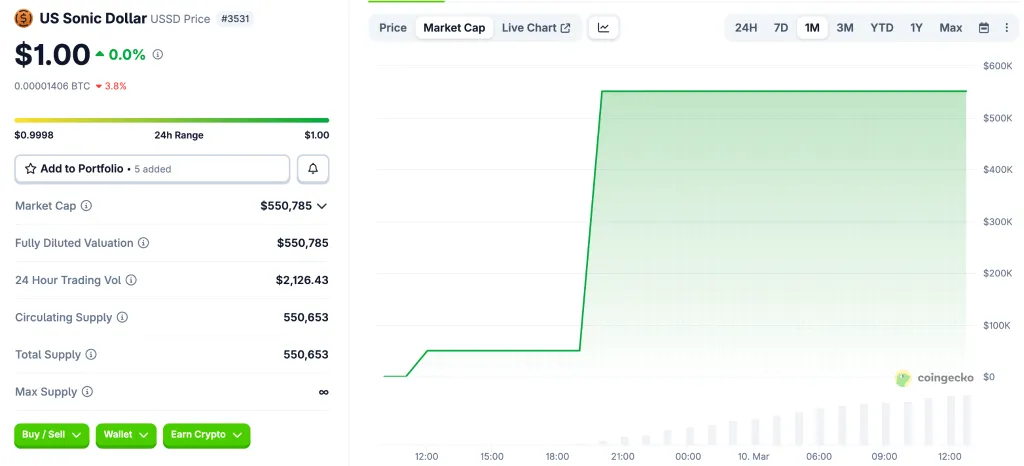
At the time of writing, USSD's market capitalization stands at $550,785 with 550,653 tokens in circulation. Trading volume has reached just $2,126. The total stablecoin sector is valued at $314 billion, with USDT commanding a 58.6% market share.
Stablecoin Liquidity Shows Signs of Recovery
Alongside the USSD launch, CryptoQuant analyst CryptoMe highlighted a broader recovery in stablecoin liquidity.
"Stablecoin Liquidity Is Rising Again! Is It Flowing Into Crypto Markets? Even though these data still show weakness for now, they are promising for a long-term investment view." — CryptoQuant.com (@cryptoquant_com), original post
In December, the Federal Reserve wound down its quantitative tightening (QT) program and shifted to purchasing Treasury bills. Over the following three and a half months, the Fed expanded its balance sheet in line with prior guidance. Starting in mid-February, the combined market capitalization of USDT and USDC began climbing again, recovering from the December decline.
Stablecoin issuers typically mint new tokens in response to genuine demand, making supply expansion a common proxy for capital inflows. However, there are exceptions — a company may mint stablecoins and hold them in its own reserves rather than releasing them into circulation.
To assess actual inflows, CryptoMe examined exchange-level data. The Exchange Netflow metric shows an overall downward trend, but inflows have begun increasing in recent weeks. Exchange Reserve figures for stablecoins also trend downward, though a modest uptick has emerged.
According to the analyst, the Fed is expanding the dollar supply, and stablecoin liquidity is growing in tandem. Some of these funds are reaching the market, but the inflow remains modest, leaving room for short-term volatility and pullbacks. Nevertheless, the current signals appear encouraging for long-term investors.
Earlier reports indicated that net stablecoin inflows surged 414.5% in early March, reaching $1.7 billion in a single week.
Frequently Asked Questions
What is the USSD stablecoin from Sonic Labs?
USSD (US Sonic Dollar) is a network-native dollar stablecoin on the Sonic blockchain, backed 1:1 by U.S. Treasury bills from BlackRock, Superstate, and WisdomTree. It is built on Frax Finance's frxUSD infrastructure.
How is USSD backed and minted?
USSD is collateralized by U.S. Treasury bills. Users can mint it by depositing supported assets like USDC, USDT, PYUSD, BUIDL, USTB, and others at a 1:1 ratio through smart contracts on Sonic, with no minting fees.
What is the current market cap of USSD?
At launch, USSD has a market capitalization of $550,785 with 550,653 tokens in circulation. Trading volume stands at just $2,126.
Can USSD be redeemed for US dollars?
In the future, qualified users will be able to redeem USSD directly for U.S. dollars, provided they complete KYC/AML procedures and receive issuer approval. Currently, redemption is available through smart contracts in supported networks.
Why is stablecoin liquidity increasing in 2026?
The Federal Reserve ended its quantitative tightening program in December and began purchasing Treasury bills. Over three and a half months, the Fed expanded its balance sheet, which contributed to growing USDT and USDC market capitalization starting mid-February.
Read also
Stablecoin Transfer Volume Hits $10.5 Trillion in January — Highest Since April 2022
January stablecoin transaction volume surpassed $10.5 trillion, marking the highest monthly figure since April 2022. USDC led transfers while USDT maintained market cap dominance.
Top 10 Dollar Stablecoins in 2026: From Dominant Players to Exit Candidates
The stablecoin market has surpassed $311 billion in total capitalization. Here's a breakdown of the ten largest USD-pegged stablecoins — from undisputed leaders Tether and Circle to ambitious newcomers.
Weekly Recap: Bitcoin Tests $74K, Miners Dump Holdings, ChatGPT Boycott Grows
Bitcoin briefly touched $74,000 before retreating to $67,500. Public miners sold over 15,000 BTC in five months, traders flocked to Hyperliquid for oil and gold futures, and a ChatGPT boycott gained major traction.
TON Wallet Introduces Yield Vaults for BTC, ETH, and USDT Directly in Telegram
TON Wallet has launched yield vaults for BTC, ETH, and USDT directly within Telegram, offering up to 18% APY on stablecoins through partnerships with Morpho, TAC, and Re7.
Weekly Recap: Aave Ecosystem Rescue Mobilizes 100,000 ETH and Quantum Computer Cracks 15-Bit ECC Key
Bitcoin held near $78,000, the DeFi community rallied over 100,000 ETH to help Aave recover from the Kelp hack, and a researcher cracked a 15-bit ECC key on a quantum computer.
TRON Energy Rental: How to Cut USDT Transfer Fees by Up to 60%
USDT issuance on TRON surpassed $85 billion in February 2026, but transfer fees remain steep at $1.83–$3.83 per transaction. Energy rental services like TronZap offer a way to cut costs by 50–60%.