SoftBank Shares Plunge 9.8% as Stargate Project with OpenAI Collapses
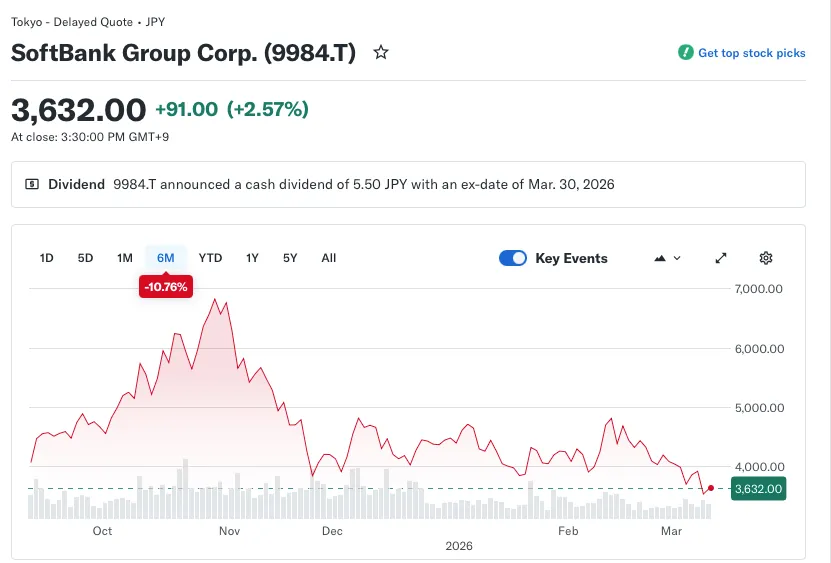
SoftBank stock dropped 9.8% on March 9 after OpenAI and Oracle abandoned plans to expand their joint Texas data center under the Stargate initiative. The company has lost nearly half its value in four months.
SoftBank shares tumbled 9.8% on March 9 — double the broader decline of the Japanese stock market. The selloff was triggered by OpenAI and Oracle scrapping plans to expand their joint data center in Texas under the Stargate initiative, according to the FT.
The $500 Billion Stargate Dream That Never Materialized
Over the past four months, the Japanese tech conglomerate's stock has lost nearly half its value. Growing investor skepticism about SoftBank's massive bet on the makers of ChatGPT is the driving force behind the decline.
In December 2025, the holding company closed a $41 billion investment in OpenAI, bringing its total commitment to $64.6 billion. That same month, media reports highlighted the failure of the high-profile Stargate initiative, which had a planned budget of $500 billion.
The joint venture never assembled a management team, never appointed leadership, and never broke ground on any data centers. For months, the partners failed to agree on fundamental questions:
- Who would build the facilities
- Who would own the completed campuses
- How financing would be allocated among participants
Between September and October 2025, OpenAI executives made multiple trips to Tokyo to negotiate with SoftBank CEO Masayoshi Son. The parties could not reach agreement on the flagship Texas campus. OpenAI explored building it independently, but lenders refused to provide funding.
Why This Matters
The Stargate collapse is more than a corporate setback. The project was positioned as one of the largest AI infrastructure initiatives ever conceived. Its failure raises questions about the AI industry's ability to execute mega-projects requiring coordination between multiple major players. Other companies closely tied to OpenAI are also feeling the pressure, with both Oracle and CoreWeave shares declining.
S&P Downgrades SoftBank's Rating Outlook
Rating agency S&P assigned a negative outlook to SoftBank's already low credit rating. The key concern: an excessive concentration of illiquid assets on the group's balance sheet, accounting for more than half of its $320 billion investment portfolio.
The S&P decision complicates the holding company's efforts to raise debt for further investments in OpenAI. To free up capital for the ChatGPT maker, SoftBank sold $5.8 billion worth of Nvidia shares and a $9.1 billion stake in telecom operator T-Mobile during 2025.
The FT notes that Masayoshi Son has a pattern of becoming overly fixated on a single sector and increasing leverage until he meets resistance from shareholders or creditors. Sometimes this approach pays off — as with the early bet on Alibaba. But there are also cautionary tales, most notably the WeWork debacle.
Beyond OpenAI: Robotics and Infrastructure
SoftBank's ambitions extend beyond OpenAI. The corporation recently spent over $9 billion on robotics and digital infrastructure. In February 2025, SoftBank and OpenAI also agreed to form a joint venture in Japan to deliver AI services to enterprise clients.
Frequently Asked Questions
Why did SoftBank stock crash on March 9?
SoftBank shares fell 9.8% after OpenAI and Oracle abandoned plans to expand their joint data center in Texas as part of the Stargate initiative. The decline was double the overall drop of the Japanese stock market.
What is the Stargate project and why did it fail?
Stargate was a planned $500 billion AI infrastructure initiative involving SoftBank, OpenAI, and Oracle. It failed because the partners could not agree on fundamental issues including who would build the facilities, who would own them, and how financing would be split.
How much has SoftBank invested in OpenAI?
SoftBank closed a $41 billion investment deal in December 2025, bringing its total investment in OpenAI to $64.6 billion. To fund these investments, the company sold $5.8 billion in Nvidia shares and a $9.1 billion stake in T-Mobile.
What did S&P do to SoftBank's credit rating?
S&P assigned a negative outlook to SoftBank's already low credit rating due to excessive illiquid assets on the company's balance sheet. These illiquid holdings account for more than half of its $320 billion investment portfolio.
Which other companies are affected by the Stargate collapse?
Oracle and CoreWeave, both closely tied to OpenAI, have also seen their share prices decline. The broader AI infrastructure sector is feeling pressure from investor skepticism about mega-scale AI projects.
Read also
OpenAI Secures Record $110 Billion Round at $730 Billion Valuation
OpenAI closed the largest startup funding round in history at $110 billion, backed by Amazon, SoftBank, and Nvidia, with a $730 billion valuation.
Oracle Lays Off Thousands as AI Infrastructure Spending Reshapes Tech Workforce
Oracle has begun mass layoffs affecting thousands of employees worldwide as the company redirects resources toward AI infrastructure. Meanwhile, Block CEO Jack Dorsey envisions AI replacing middle management entirely.
DeepSeek Launches V4-Pro: Open-Source Model Outperforms Claude Opus 4.6 and GPT-5.4
Chinese AI startup DeepSeek released a preview of its V4 model family, with the flagship V4-Pro boasting 1.6 trillion parameters and surpassing leading closed-source models in multiple benchmarks.
Elon Musk Delivers First Testimony in OpenAI Lawsuit Against Altman and Brockman
The trial over Elon Musk's lawsuit against OpenAI began in Oakland federal court. Musk claims the company's shift from nonprofit to for-profit betrayed its founding mission.
Anthropic Launches Claude Opus 4.7 as OpenAI Fires Back with Codex Overhaul and GPT-Rosalind
Anthropic released Claude Opus 4.7 with 10% gains in agentic coding and tripled image resolution. OpenAI responded the same day with a major Codex update featuring computer use on macOS and a new reasoning model GPT-Rosalind for drug discovery.
AI Audit Uncovers Critical Liveness Bug in Ethereum's Nethermind Client
Octane Security's AI discovered a high-severity vulnerability in the Nethermind execution client that could have halted block production for 38% of Ethereum mainnet validators. The Ethereum Foundation awarded a maximum $50,000 bounty.