
Record Bitcoin Outflow: 47,700 BTC Withdrawn from Exchanges in One Week
Crypto exchanges lost 47,700 BTC in a single week, with Bitfinex recording its largest outflow since June 2025. CryptoQuant analyst flags potential accumulation phase.
Cryptocurrency exchanges lost 47,700 BTC over the past week, a figure roughly matching the peak outflow levels seen in 2025. CryptoQuant analyst Axel Adler Jr. flagged the development as a significant market signal, suggesting that large-scale investors are actively moving their holdings off centralized platforms. The sheer volume of withdrawals — nearly 50,000 BTC in just seven days — underscores a notable shift in market behavior that could have meaningful implications for Bitcoin's price trajectory in the weeks ahead.
March 4 Peak: $2.26 Billion in a Single Day
The largest single-day outflow occurred on March 4, when trading platforms saw 31,900 BTC — worth approximately $2.26 billion — leave their wallets. To put this in perspective, that single day accounted for nearly two-thirds of the entire week's outflow, indicating a highly concentrated and potentially coordinated withdrawal event.
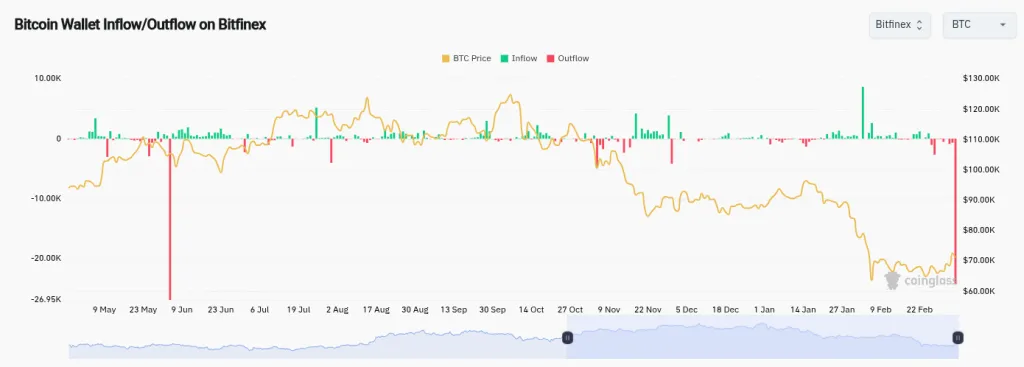
Bitfinex accounted for the lion's share, with 25,000 BTC withdrawn from the exchange. This marked Bitfinex's largest outflow since June 2025. The remaining 6,900 BTC were distributed across other major platforms, but none came close to matching Bitfinex's volume. Such a concentrated withdrawal from a single exchange often points to institutional or whale-level activity rather than retail investors gradually moving small amounts.
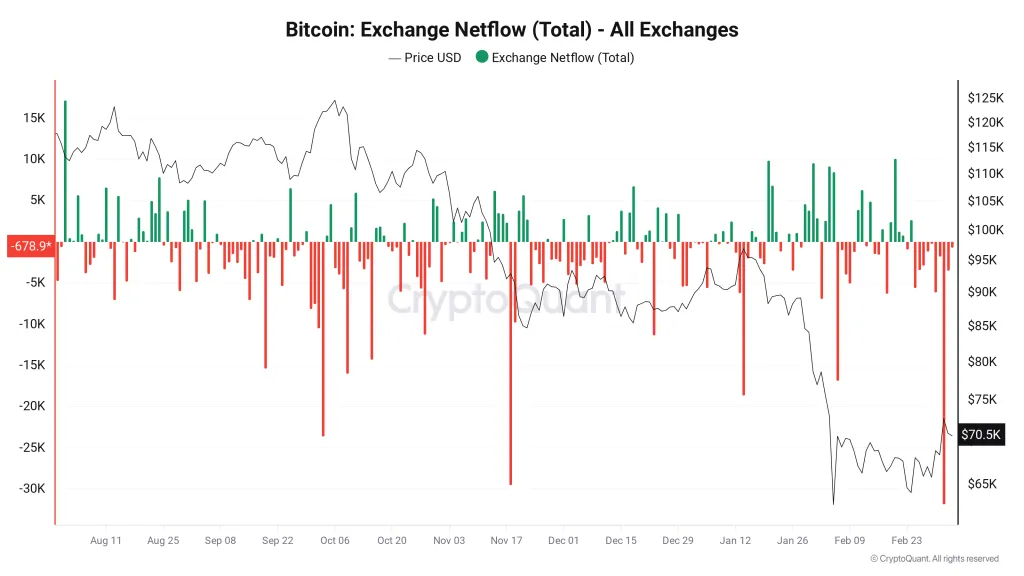
According to Adler Jr., withdrawals exceeded deposits every single day throughout the week, maintaining a consistently negative net balance across exchanges. This sustained pattern is particularly noteworthy because temporary spikes in outflows are common, but an unbroken streak of net-negative flows across multiple days signals a deeper structural trend.
Why Large-Scale BTC Outflows Matter
Heavy Bitcoin outflows from exchanges are a well-established indicator of reduced sell-side pressure. When investors move coins to cold storage, the available supply on the open market contracts, potentially supporting upward price movement. The logic is straightforward: coins held on exchanges are readily available for selling, while coins in cold wallets are effectively removed from the tradable supply.
This dynamic becomes especially relevant at a time when Bitcoin has been navigating a complex price environment. As covered in our analysis of Bitcoin's recent rebound to $70,000, the market has shown resilience despite broader uncertainties. A shrinking exchange supply adds another bullish data point to the current picture.
The analyst highlighted a telling sequence of events: exchanges received roughly $1.1 billion in stablecoins at the start of March, immediately followed by the massive BTC withdrawal wave. This pattern suggests a large-scale spot purchase. Adler Jr. estimated that investors bought Bitcoin at an average price of around $70,000 and then transferred the acquired assets to cold wallets.
This "stablecoins in, BTC out" pattern is a classic indicator of deliberate accumulation. Rather than buying and holding on-exchange for short-term trading, these investors appear to be securing their positions for the long term — a behavior typically associated with institutional players or high-conviction whales.
Accumulation Phase on the Horizon
Adler Jr. outlined a specific scenario going forward. If the current pattern — outflows without coins returning to exchanges — persists for another 3 to 5 days, the market will enter a sustained accumulation phase. Such a development would serve as a bullish signal for Bitcoin's price, according to the analyst.
An accumulation phase is generally characterized by the following key features:
- Persistent net outflows — more BTC leaving exchanges than arriving, over an extended period
- Decreasing exchange reserves — total BTC held on platforms trends downward, tightening available supply
- Stablecoin inflows — fresh capital entering exchanges, signaling buying intent ahead of further purchases
- Reduced selling pressure — fewer coins available for immediate liquidation on order books
If this scenario materializes, the supply squeeze could become a powerful catalyst for price appreciation. With fewer coins available to sell, even moderate increases in demand could drive outsized price moves.
Broader Market Context: A Growing Self-Custody Trend
The BTC outflow fits within a broader trend of assets leaving centralized platforms. In February, investors withdrew 31.6 million ETH from exchanges — the largest monthly volume since November 2025. Both developments point to a growing preference for self-custody among crypto holders.
This self-custody trend has been accelerating for several reasons. Concerns about exchange solvency, increased regulatory scrutiny, and the maturing of hardware wallet technology have all contributed to investors taking direct control of their digital assets. The recent introduction of new custody solutions — such as TON Wallet's yield vaults for BTC, ETH, and USDT — also demonstrates that the ecosystem is evolving to make self-custody more attractive and functional.
Meanwhile, the broader macroeconomic backdrop continues to influence Bitcoin's price action. As Wintermute recently noted, Bitcoin's price movements are increasingly tied to macroeconomic regime shifts, making it important to consider exchange flow data alongside broader economic indicators.
Institutional Signals and Short-Term Risks
The timing of these massive outflows is also worth examining in the context of institutional positioning. While the outflow data paints a bullish picture, the market is not without its counterforces. As reported, Strategy (formerly MicroStrategy) has become the most-shorted US stock with $6 billion in bets against it — a signal that some institutional players remain bearish or at least hedged on Bitcoin's near-term prospects.
Additionally, the market experienced a 2.5% weekly decline amid broader volatility, reminding investors that even strong on-chain signals like exchange outflows do not guarantee immediate price appreciation. Short-term price action can be influenced by a range of factors, including leverage liquidations, regulatory headlines, and macroeconomic data releases.
Key Takeaways
To summarize the significance of this record BTC exchange outflow event:
- 47,700 BTC left exchanges in one week, matching 2025's peak outflow levels and signaling significant investor conviction.
- March 4 saw 31,900 BTC ($2.26B) withdrawn, with Bitfinex alone accounting for 25,000 BTC — its largest single outflow since June 2025.
- $1.1 billion in stablecoins flowed into exchanges at the start of March, followed by the massive BTC withdrawals, pointing to deliberate spot accumulation around $70,000.
- Withdrawals exceeded deposits every day of the week, an unbroken streak that strengthens the bullish interpretation of the data.
- A confirmed accumulation phase could emerge within 3-5 days if the outflow pattern continues, potentially reducing sell-side pressure and supporting higher prices.
The convergence of declining exchange reserves, stablecoin inflows, and a broader self-custody trend paints a compelling picture of market participants positioning for long-term gains. However, as always in crypto markets, investors should weigh on-chain signals against broader macroeconomic and market structure factors before drawing conclusions.
Frequently Asked Questions
How much Bitcoin was withdrawn from exchanges in March 2026?
A total of 47,700 BTC was withdrawn from crypto exchanges over one week. The peak day was March 4, when 31,900 BTC worth $2.26 billion left trading platforms.
Which exchange had the largest Bitcoin outflow?
Bitfinex accounted for the largest share, with 25,000 BTC withdrawn on March 4 alone. This was the exchange's biggest outflow since June 2025.
Is Bitcoin leaving exchanges a bullish signal?
Declining exchange balances reduce sell-side pressure on the market. CryptoQuant analyst Axel Adler Jr. noted that if the outflow trend continues for 3–5 more days without coins returning, it would confirm a sustained accumulation phase and serve as a bullish signal.
What was the average BTC purchase price before the withdrawal?
According to Adler Jr., the average purchase price was approximately $70,000. About $1.1 billion in stablecoins flowed into exchanges at the start of March, just before the mass BTC withdrawal began.
Are other cryptocurrencies also being withdrawn from exchanges?
Yes, a similar trend is occurring with Ethereum. In February, investors withdrew 31.6 million ETH from centralized exchanges — the highest monthly volume since November 2025.
Read also
Bernstein Calls $60,000 a 'Clear Bottom' for Bitcoin, Expects Extended Bull Cycle
Analysts at Bernstein have identified $60,000 as a firm floor for Bitcoin, projecting a structurally longer bull cycle. On-chain data from Glassnode confirms a resurgence of buying activity.
Bitcoin Down 2.5% Weekly: Jane Street Accusations & 7 Ethereum Forks
Bitcoin lost ~2.5% over the week amid macro shocks and geopolitical tensions. Jane Street faced market manipulation allegations while Ethereum unveiled an ambitious seven hard fork roadmap through 2029.
TON Wallet Introduces Yield Vaults for BTC, ETH, and USDT Directly in Telegram
TON Wallet has launched yield vaults for BTC, ETH, and USDT directly within Telegram, offering up to 18% APY on stablecoins through partnerships with Morpho, TAC, and Re7.
Weekly Recap: Aave Ecosystem Rescue Mobilizes 100,000 ETH and Quantum Computer Cracks 15-Bit ECC Key
Bitcoin held near $78,000, the DeFi community rallied over 100,000 ETH to help Aave recover from the Kelp hack, and a researcher cracked a 15-bit ECC key on a quantum computer.
Strategy Becomes Most-Shorted US Stock With $6B in Bets
Strategy tops the list of most-shorted large-cap US stocks with $6 billion in short positions, representing 14% of its market cap, as Bitcoin's decline erodes confidence in the company's debt-fueled BTC accumulation model.
Institutional Investors Dump ETF Shares Worth 25,000 BTC During Market Crash
Institutional investors massively sold Bitcoin ETF positions in Q4 2025, offloading shares equivalent to 25,098 BTC during the crypto market correction.