
OpenAI Launches Ultra-Fast GPT-5.4 Mini and GPT-5.4 Nano Models
OpenAI released two compact AI models — GPT-5.4 mini and GPT-5.4 nano — optimized for minimal latency while maintaining strong performance across coding, multimodal tasks, and agent workflows.
Two New Speed-Optimized Models
OpenAI has released two new AI models — GPT-5.4 mini and GPT-5.4 nano — both engineered for scenarios where response latency is a critical factor.
«We're introducing GPT-5.4 mini and nano, our most capable small models yet. GPT-5.4 mini is more than 2x faster than GPT-5 mini. Optimized for coding, computer use, multimodal understanding, and subagents. For lighter-weight tasks, GPT-5.4 nano is our smallest and cheapest…» — OpenAI Developers (@OpenAIDevs), original post
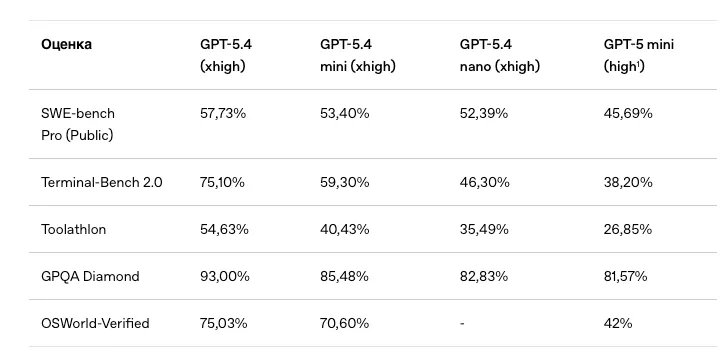
According to the company, GPT-5.4 mini substantially outperforms GPT-5 mini in code generation, logical reasoning, multimodal analysis, and tool integration. Processing speed has increased by more than 2x. On benchmarks such as SWE-Bench Pro and OSWorld-Verified, the model approaches the performance levels of the full GPT-5.4.
Why This Matters
The launch of GPT-5.4 mini and nano reflects an industry-wide push toward compact yet powerful models that operate in real time. For developers building AI-powered applications — from chatbots to automated agents — response latency directly determines user experience and product viability. Making these models available via API enables developers to build fast, responsive services without relying on expensive full-scale neural networks.
OpenAI highlighted key use cases where the new models excel:
- AI assistants with instant response times;
- Subagents that quickly handle auxiliary tasks;
- Interface management systems that capture and interpret screenshots;
- Multimodal applications for real-time image processing.
The company emphasized that for these scenarios, the best model is not necessarily the most powerful one — it's the one that responds instantly, reliably interacts with tools, and still handles complex professional tasks effectively.
GPT-5.4 nano is the smallest and fastest variant in the GPT-5.4 lineup. OpenAI recommends it for data classification and extraction, ranking, and subagents tasked with simple auxiliary operations.
Coding and Development
OpenAI specifically highlighted GPT-5.4 mini's effectiveness in software development workflows where rapid iteration speed is essential. The model handles targeted code edits, codebase navigation, frontend generation, and debugging cycles with minimal latency.
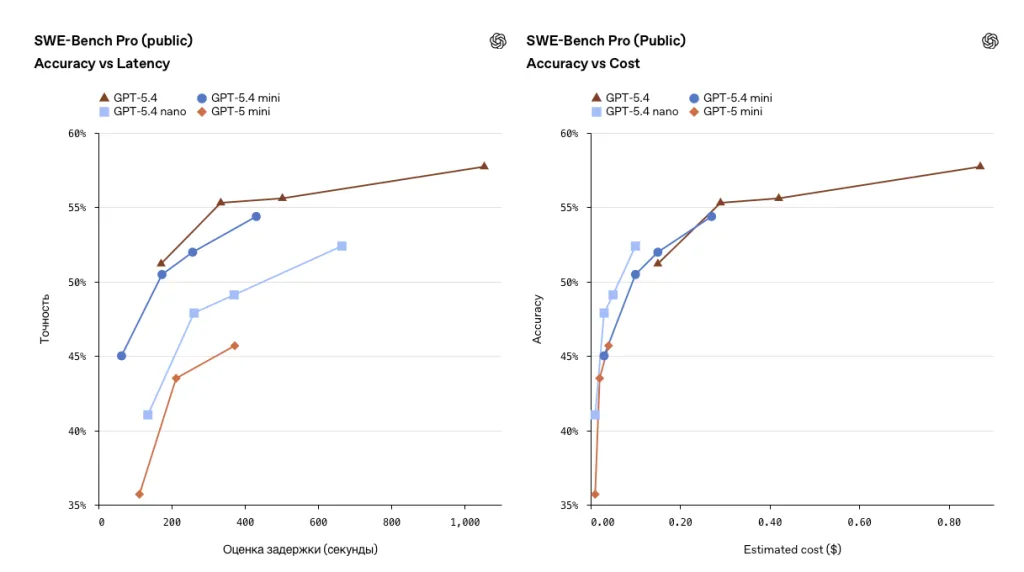
In benchmarks, GPT-5.4 mini outperforms GPT-5 mini at comparable response speeds, while operating significantly faster in several tests.
Computer Use
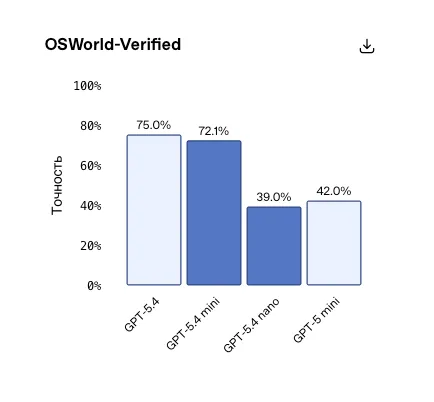
GPT-5.4 mini delivers strong results in multimodal tasks related to interface management. The model can instantly interpret screenshots of complex user dashboards and execute computer actions based on that analysis.
Availability and Pricing
GPT-5.4 mini is available through the API, Codex, and ChatGPT. Pricing is set at $0.75 per million input tokens and $4.5 per million output tokens.
GPT-5.4 nano is currently available exclusively through the API at lower rates: $0.2 per million input tokens and $1.25 per million output tokens.
Frequently Asked Questions
How much faster is GPT-5.4 mini compared to GPT-5 mini?
According to OpenAI, GPT-5.4 mini is more than 2x faster than GPT-5 mini. It also outperforms its predecessor in coding, reasoning, multimodal analysis, and tool integration while approaching GPT-5.4 performance on key benchmarks.
What is the pricing for GPT-5.4 mini and nano?
GPT-5.4 mini costs $0.75 per million input tokens and $4.5 per million output tokens. GPT-5.4 nano is cheaper at $0.2 per million input tokens and $1.25 per million output tokens.
Where can I access GPT-5.4 mini and GPT-5.4 nano?
GPT-5.4 mini is available through the API, Codex, and ChatGPT. GPT-5.4 nano is currently available exclusively through the API.
What is GPT-5.4 nano best used for?
OpenAI recommends GPT-5.4 nano for data classification and extraction, ranking tasks, and subagents that handle simple auxiliary operations. It is the smallest and most affordable model in the GPT-5.4 family.
What are the main use cases for GPT-5.4 mini?
OpenAI highlights AI assistants with instant response, subagents for auxiliary tasks, interface management systems that interpret screenshots, and real-time multimodal image processing applications as primary use cases.
Read also
OpenAI Secures Record $110 Billion Round at $730 Billion Valuation
OpenAI closed the largest startup funding round in history at $110 billion, backed by Amazon, SoftBank, and Nvidia, with a $730 billion valuation.
DeepSeek Launches V4-Pro: Open-Source Model Outperforms Claude Opus 4.6 and GPT-5.4
Chinese AI startup DeepSeek released a preview of its V4 model family, with the flagship V4-Pro boasting 1.6 trillion parameters and surpassing leading closed-source models in multiple benchmarks.
AI Audit Uncovers Critical Liveness Bug in Ethereum's Nethermind Client
Octane Security's AI discovered a high-severity vulnerability in the Nethermind execution client that could have halted block production for 38% of Ethereum mainnet validators. The Ethereum Foundation awarded a maximum $50,000 bounty.
Weekly Recap: Aave Ecosystem Rescue Mobilizes 100,000 ETH and Quantum Computer Cracks 15-Bit ECC Key
Bitcoin held near $78,000, the DeFi community rallied over 100,000 ETH to help Aave recover from the Kelp hack, and a researcher cracked a 15-bit ECC key on a quantum computer.
Weekly Recap: Bitcoin Tests $74K, Miners Dump Holdings, ChatGPT Boycott Grows
Bitcoin briefly touched $74,000 before retreating to $67,500. Public miners sold over 15,000 BTC in five months, traders flocked to Hyperliquid for oil and gold futures, and a ChatGPT boycott gained major traction.
Weekly Recap: Bitcoin Tests $78,000, Russia Introduces Criminal Penalties for Illegal Crypto Exchange
Bitcoin surged to $78,000 amid geopolitical developments, hackers drained hundreds of millions from Hyperbridge and Kelp, while Russia approved criminal liability for unlicensed crypto exchange operations.