
OP_NET Brings Native Smart Contracts to Bitcoin's Base Layer
The OP_NET protocol launched on Bitcoin mainnet on March 19, enabling DeFi tools without cross-chain bridges or wrapped tokens. All operations run through native BTC transactions.
Bitcoin Gets Native Smart Contract Functionality
On March 19, 2026, the OP_NET protocol went live on Bitcoin's mainnet, bringing smart contract capabilities and DeFi tooling directly to the base layer of the world's first cryptocurrency. The launch eliminates the need for cross-chain bridges and wrapped tokens — solutions that have historically been the only gateway for BTC holders looking to access decentralized finance.
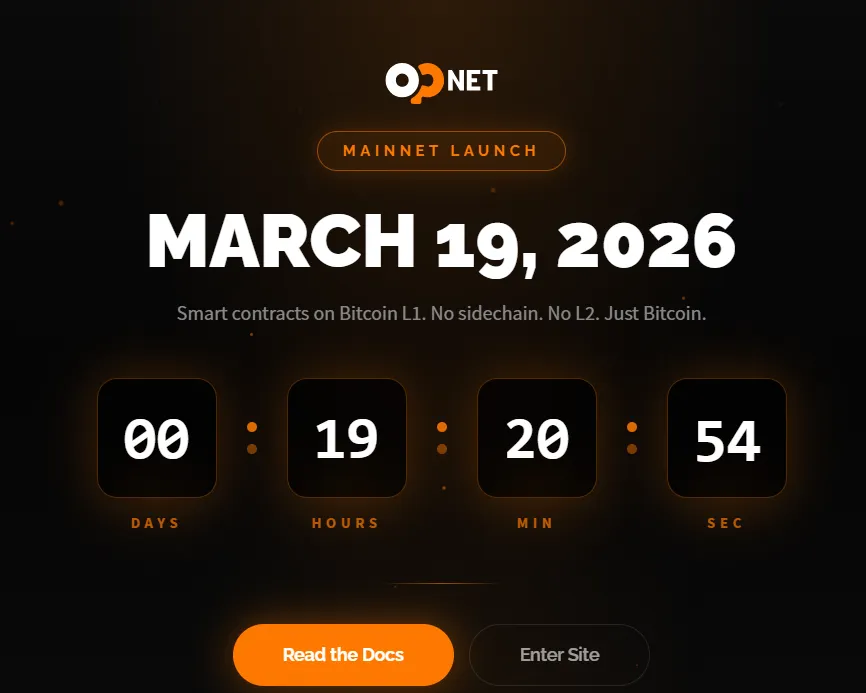
The core proposition of OP_NET is full native integration. Users simply connect a Bitcoin wallet to protocol applications. Every operation runs through standard BTC transactions, and fees are paid exclusively in bitcoin. Previously, BTC holders had to transfer funds to networks like Ethereum or rely on centralized services — both approaches carrying risks of hacks or asset freezes.
Why This Matters
Native smart contracts on Bitcoin reshape the BTCFi landscape. Until now, BTC holders participating in DeFi had to trust bridges and external blockchains — components that have repeatedly been exploited. OP_NET embeds smart contract code and execution parameters directly into transactions confirmed by Bitcoin miners. This offers a fundamentally different security model compared to cross-chain alternatives.
Launch Ecosystem: DEX, Token Standard, and Staking
Alongside the mainnet activation, the team unveiled a suite of tools designed to bootstrap a full DeFi ecosystem:
- OP-20 — a token standard for issuing assets on Bitcoin;
- MotoSwap — a decentralized exchange for swapping assets;
- Staking and farming instruments.
Stablecoin integration through an extended standard called OP-20S is planned for Q2 2026.
The SlowFi Thesis: Latency as a Feature
OP_NET co-founder Chad Master described the project's philosophy as SlowFi in an interview with CoinDesk. The team views Bitcoin's roughly 10-minute block time not as a limitation but as a structural advantage. The inherent friction in withdrawing capital, they argue, keeps liquidity locked inside protocols and reduces the risk of panic-driven farm-and-dump cycles common on faster blockchains.
Master drew a comparison to Ethereum's "DeFi Summer of 2020," while emphasizing that Bitcoin provides a more robust environment for such activity.
Broader Context: BTCFi Momentum Builds
The OP_NET launch fits into an accelerating trend of DeFi development on Bitcoin. In December 2025, the team behind BTCFi project Babylon announced BTC-collateralized lending on Aave V4. The arrival of fully native smart contracts on Bitcoin could accelerate this trajectory by offering an alternative to solutions dependent on external chains.
The nearest litmus test will be the stablecoin integration slated for Q2 — mass liquidity inflows into the new ecosystem hinge largely on that milestone.
Frequently Asked Questions
What is OP_NET and how does it work on Bitcoin?
OP_NET is a protocol that embeds smart contract code directly into Bitcoin transactions confirmed by miners. It enables DeFi functionality without cross-chain bridges or wrapped tokens, with all fees paid in native BTC.
When did OP_NET launch on Bitcoin mainnet?
OP_NET was activated on Bitcoin mainnet on March 19, 2026. The launch included the OP-20 token standard, decentralized exchange MotoSwap, and staking and farming tools.
What is the SlowFi concept?
SlowFi is a term coined by OP_NET co-founder Chad Master. It frames Bitcoin's approximately 10-minute block time as an advantage — the structural friction in withdrawing capital helps retain liquidity in protocols and reduces farm-and-dump panic selling.
Will OP_NET support stablecoins?
Yes, stablecoin integration is planned for Q2 2026 through an extended token standard called OP-20S. This is expected to be a key driver for attracting broader liquidity to the ecosystem.
How is OP_NET different from Ethereum DeFi?
Unlike Ethereum-based DeFi, OP_NET operates directly on Bitcoin's base layer. All transactions are native BTC transactions, eliminating the need for bridges or wrapped tokens and the security risks associated with them.
Read also
TON Wallet Introduces Yield Vaults for BTC, ETH, and USDT Directly in Telegram
TON Wallet has launched yield vaults for BTC, ETH, and USDT directly within Telegram, offering up to 18% APY on stablecoins through partnerships with Morpho, TAC, and Re7.
Weekly Recap: Aave Ecosystem Rescue Mobilizes 100,000 ETH and Quantum Computer Cracks 15-Bit ECC Key
Bitcoin held near $78,000, the DeFi community rallied over 100,000 ETH to help Aave recover from the Kelp hack, and a researcher cracked a 15-bit ECC key on a quantum computer.
Bitcoin Down 2.5% Weekly: Jane Street Accusations & 7 Ethereum Forks
Bitcoin lost ~2.5% over the week amid macro shocks and geopolitical tensions. Jane Street faced market manipulation allegations while Ethereum unveiled an ambitious seven hard fork roadmap through 2029.
Strategy Becomes Most-Shorted US Stock With $6B in Bets
Strategy tops the list of most-shorted large-cap US stocks with $6 billion in short positions, representing 14% of its market cap, as Bitcoin's decline erodes confidence in the company's debt-fueled BTC accumulation model.
Institutional Investors Dump ETF Shares Worth 25,000 BTC During Market Crash
Institutional investors massively sold Bitcoin ETF positions in Q4 2025, offloading shares equivalent to 25,098 BTC during the crypto market correction.
Bitcoin Hits $70,000 as Iran Ceasefire Talks Boost Risk Appetite
Bitcoin surged 4% to test the $70,000 level on April 6 amid reports of ceasefire negotiations between the US, Israel, and Iran. The derivatives market, however, sends mixed signals.