OP Labs Cuts 20% of Staff as Base Moves to Its Own Architecture
Optimism developer OP Labs laid off 20 employees to streamline operations. The move follows Base's departure from OP Stack and a 36.7% drop in the OP token over the past month.
OP Labs Reduces Workforce by 20%
OP Labs, the development company behind the Optimism Layer 2 network, has laid off 20 employees. CEO Jing Wang announced the decision, framing it as a move to sharpen the company's focus and reduce coordination overhead.
«Today we shared difficult news with the OP Labs team. Our priority was to communicate with the impacted people & give the team time to process the news before sharing publicly. This decision reflects a narrowing of our focus, not our runway.» — Optimist Prime (@jinglejamOP), original post
A screenshot of the company's internal chat showed 102 remaining members, putting the reduction at approximately 19.6% of the total staff. Wang emphasized that the decision was not driven by financial constraints — OP Labs is well-capitalized with years of runway remaining. Instead, the goal is to do fewer things but do them well, make decisions faster, and cut coordination costs.
Wang did not specify which roles were affected but encouraged recruiters to consider the departing team members, describing them as talented engineers, operations staff, and developers who helped build Optimism into what it is today.
Why This Matters
Optimism is one of the most prominent Layer 2 scaling solutions for Ethereum. At the time of writing, its TVL exceeds $1.5 billion, and the project has reached Stage 1 decentralization.

The OP Stack serves as an open-source framework for building customizable blockchains. Coinbase's L2 network Base was built on this technology. However, in mid-February, Base developers announced a transition to their own independent architecture, creating additional pressure on the Optimism ecosystem.
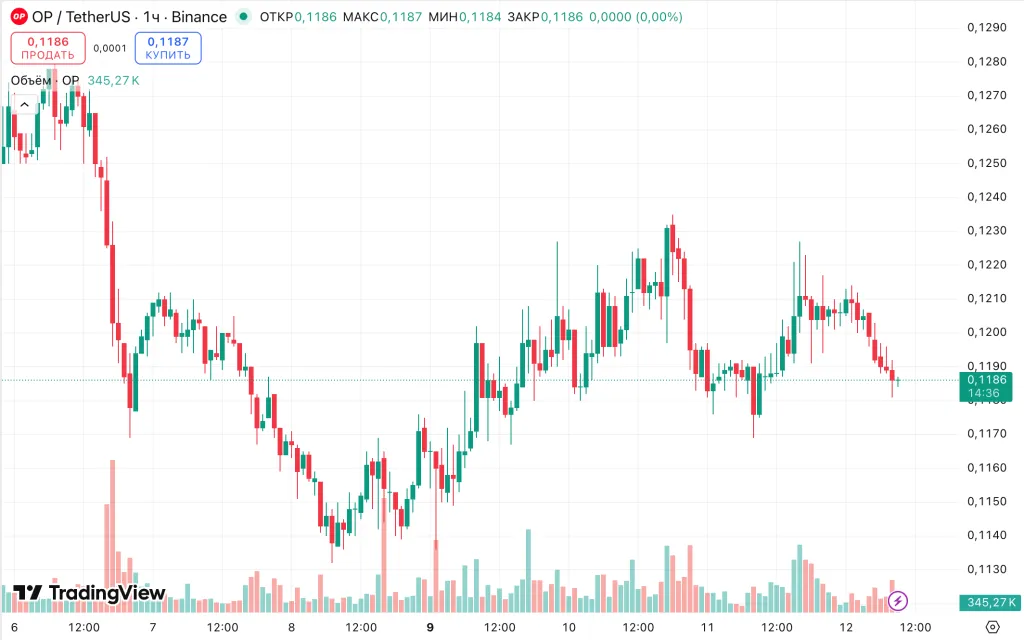
The native OP token has fallen 36.7% over the past month and was trading near $0.11 at the time of publication.
The Broader L2 Narrative Shift
The layoffs at OP Labs coincide with a broader debate about the future relevance of Layer 2 solutions. Ethereum co-founder Vitalik Buterin has argued that as the mainnet scales, the case for L2s diminishes. He noted that rollups are decentralizing more slowly than expected and advised their developers to seek unique niches: privacy, highly specialized applications, non-financial use cases, and ultra-high speed.
As a technical foundation, Buterin proposed the concept of a "native rollup precompile" — a mechanism embedded directly into the Ethereum protocol for verifying ZK proofs. Meanwhile, players like Offchain Labs maintain that Ethereum's mainnet still cannot match L2 throughput.
Optimism's 2026 Roadmap
Despite the headcount reduction and market headwinds, Optimism has laid out a clear development roadmap for 2026. A central priority is accelerating block formation times.
«What Optimism is shipping in 2026: → Even faster blocks → More economic parameters → Continuous upgrades → Native interoperability → Custom compliance controls → Actions SDK → ZK proof systems» — Optimism (@Optimism), original post
Additional planned upgrades include:
- Native cross-chain interoperability;
- Compliance control mechanisms tailored to different jurisdictions;
- ZK proof systems compatible with Ethereum's quantum-resistant roadmap.
Separately, in March the Ethrex team, in collaboration with the Ethereum Foundation and L2BEAT, released code and documentation for a production-ready native rollup environment — a development that could shape the trajectory of the entire L2 landscape going forward.
Frequently Asked Questions
Why did OP Labs lay off employees?
CEO Jing Wang stated the layoffs were not about finances — OP Labs has years of runway. The decision was made to narrow focus, speed up decision-making, and reduce coordination overhead across the organization.
How did Base leaving OP Stack affect Optimism?
Base announced in mid-February that it would move to its own independent architecture, departing from OP Stack. This added pressure to the Optimism ecosystem, and the OP token dropped 36.7% over the past month to around $0.11.
What is Optimism's current TVL?
Optimism's total value locked exceeds $1.5 billion at the time of writing. The project has also achieved Stage 1 decentralization according to L2BEAT's classification.
What is Optimism building in 2026?
The roadmap includes faster block times, native cross-chain interoperability, jurisdiction-specific compliance controls, and ZK proof systems compatible with Ethereum's quantum-resistant roadmap.
What did Vitalik Buterin say about L2 relevance?
Buterin argued that L2 relevance diminishes as the Ethereum mainnet scales. He noted that rollups are decentralizing slower than expected and recommended developers pursue unique niches like privacy, specialized apps, and non-financial use cases.
Read also
Bitcoin Down 2.5% Weekly: Jane Street Accusations & 7 Ethereum Forks
Bitcoin lost ~2.5% over the week amid macro shocks and geopolitical tensions. Jane Street faced market manipulation allegations while Ethereum unveiled an ambitious seven hard fork roadmap through 2029.
AI Audit Uncovers Critical Liveness Bug in Ethereum's Nethermind Client
Octane Security's AI discovered a high-severity vulnerability in the Nethermind execution client that could have halted block production for 38% of Ethereum mainnet validators. The Ethereum Foundation awarded a maximum $50,000 bounty.
TON Wallet Introduces Yield Vaults for BTC, ETH, and USDT Directly in Telegram
TON Wallet has launched yield vaults for BTC, ETH, and USDT directly within Telegram, offering up to 18% APY on stablecoins through partnerships with Morpho, TAC, and Re7.
Bitcoin Hits $70,000 as Iran Ceasefire Talks Boost Risk Appetite
Bitcoin surged 4% to test the $70,000 level on April 6 amid reports of ceasefire negotiations between the US, Israel, and Iran. The derivatives market, however, sends mixed signals.
Bitcoin Rebounds to $70,000 as Leverage Drops and ETF Inflows Continue
BTC recovered above $70,000 on March 10, erasing weekend losses. Spot ETFs attracted $568M in weekly inflows while the estimated leverage ratio on Binance fell sharply from 0.198 to 0.152.
Stablecoin Transfer Volume Hits $10.5 Trillion in January — Highest Since April 2022
January stablecoin transaction volume surpassed $10.5 trillion, marking the highest monthly figure since April 2022. USDC led transfers while USDT maintained market cap dominance.