
NYT Journalist Identifies Adam Back as Bitcoin Creator After 18-Month Investigation
Pulitzer Prize-winning journalist John Carreyrou published an extensive investigation claiming British cryptographer Adam Back is Satoshi Nakamoto. Back has denied the allegations.
Pulitzer Prize-winning journalist John Carreyrou of The New York Times has published the results of an 18-month investigation concluding that British cryptographer Adam Back is Satoshi Nakamoto — the pseudonymous creator of Bitcoin. Back has firmly denied the claim.
«The mystery of Satoshi Nakamoto, the pseudonymous inventor of Bitcoin, has remained unsolved for 17 years. Not anymore. Read my 18-month investigation to find out who Satoshi really is.» — John Carreyrou (@JohnCarreyrou), original post
Why This Matters
The identity of Bitcoin's creator has been one of the technology world's greatest mysteries for 17 years. While numerous attempts have been made to unmask Satoshi Nakamoto, this marks the first time a journalist of Carreyrou's stature — known for exposing the Theranos fraud — has taken on the case. Publication in the NYT lends particular weight to the theory, even though the evidence remains circumstantial. Confirmation of Satoshi's identity could have profound implications for market sentiment and the very concept of decentralization underpinning Bitcoin.
Cypherpunk Archives and Linguistic Forensics
Carreyrou's starting point was the 2024 documentary Money Electric: The Bitcoin Mystery. In one scene, Back visibly tensed up on a park bench in Riga when the filmmaker suggested he might be Bitcoin's inventor. Carreyrou, who claims an ability to detect deception, found Back's behavior suspicious.
The journalist dove into cypherpunk mailing list archives, where Back had been active since 1995. From 134,308 messages by 620 participants, he built a database and used linguistic analysis — hyphenation errors, spelling variations — to narrow the field down to a single individual.
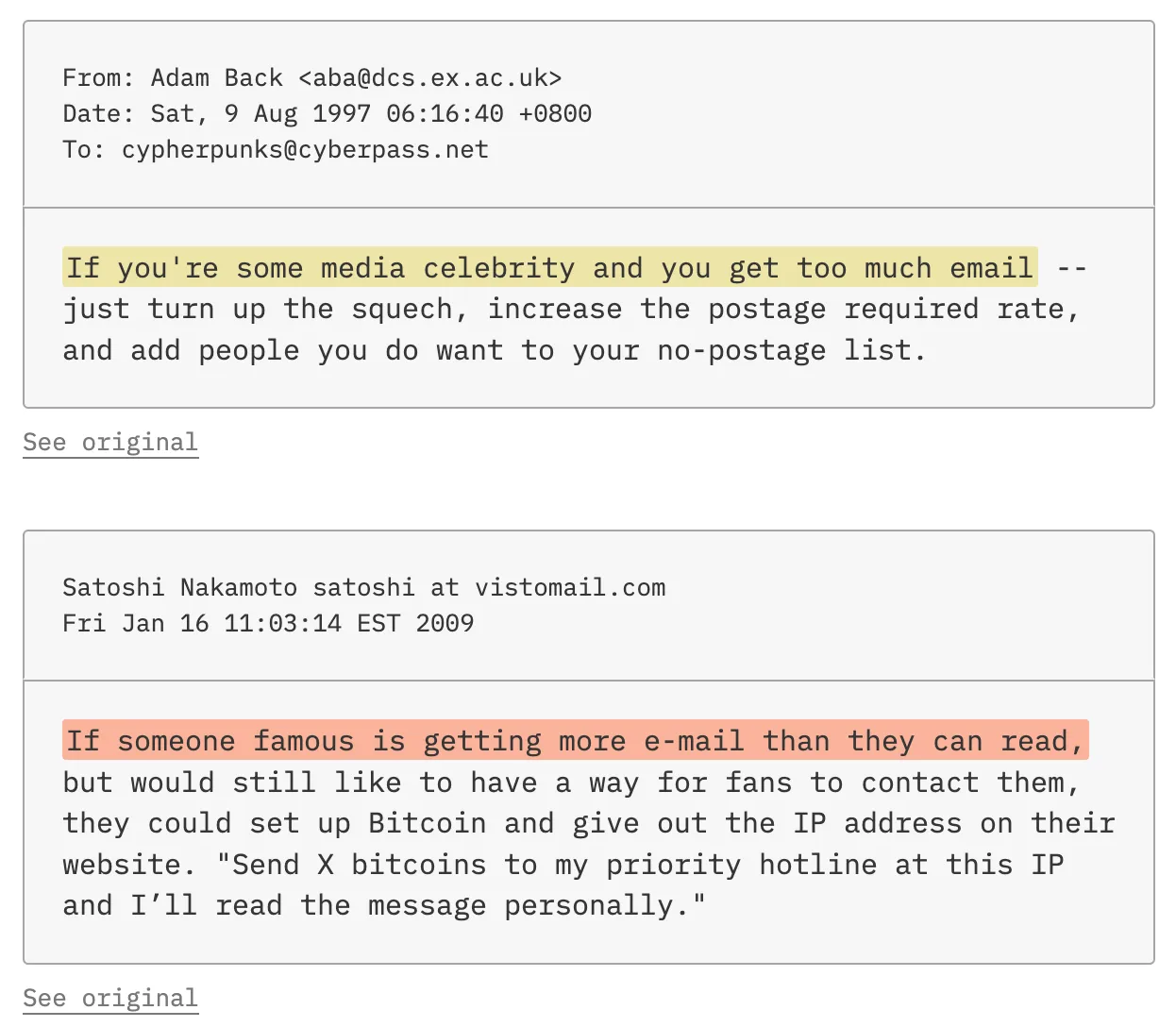
The critical discovery came from Back's 1997 posts, where the cryptographer described all five core features of what would become Bitcoin: an electronic cash system completely independent from banks, preserving privacy for both sender and recipient, operating across a distributed network, incorporating built-in scarcity, and requiring no trust in any centralized entity. The Bitcoin white paper wouldn't appear for another decade.
Carreyrou also noted that Back anticipated a solution to the Byzantine Generals' Problem, described nodes that could "come and go" without harming the network, and proposed using his Hashcash system to mint coins for Wei Dai's b-money. Satoshi later referenced both technologies in the white paper.
Hyphens, Spelling, and Rare Expressions
The linguistic component of the investigation examined vocabulary, punctuation, and spelling habits. Across all measured traits, Back emerged as the closest match to Satoshi's writing. Both authors placed two spaces between sentences — a typographic habit associated with an older generation. Both used the interjection bloody, characteristic of British English. Back later denied using the word, but Carreyrou found a 1998 post containing the same expression.
The central linguistic argument involved inconsistent hyphenation — not an isolated mistake but a persistent pattern shared by both writers:
- e-mail / email
- built-in / built in
- off-line / offline
- pre-compiled / precompiled
Both also mixed British and American spellings (cheque / check) and wrote technical terms as single words (backup, bugfix). According to Carreyrou, such habits are harder to fake than word choice.
Before Satoshi, only eight people in the mailing lists used the term Proof-of-Work as a hyphenated compound noun. After applying an additional rare filter — mentions of WebMoney — only one name remained: Adam Back. The phrase burning the money to describe destroying electronic currency was used by Back alone before Satoshi adopted it. The expression partial pre-image appeared in posts by two people — Hal Finney and Back — but only Back hyphenated it the same way Satoshi did.
Suspicious Silence and Timing
Carreyrou flagged a curious chronological pattern: a person who had spent years discussing electronic cash, privacy, and distributed networks virtually disappeared from public discourse precisely when Satoshi emerged. After Nakamoto's departure, Back returned to active participation in the Bitcoin community.
In 2013, the cryptographer appeared at a Bitcointalk conference right when an analysis of Satoshi's wallet holdings was published. Two years later, his position in the block size debate echoed Nakamoto's arguments almost verbatim. The journalist also questioned the authenticity of the email correspondence between Satoshi and Back — Back never provided metadata that could verify the exchange.
Adam Back's Response
Following publication, Back publicly rejected Carreyrou's conclusions, reiterating that he is not Satoshi.
«i'm not satoshi, but I was early in laser focus on the positive societal implications of cryptography, online privacy and electronic cash, hence my ~1992 onwards active interest in applied research on ecash, privacy tech on cypherpunks list which led to hashcash and other ideas.» — Adam Back (@adam3us), original post
The cryptographer attributed the similarities to "a combination of coincidences and recurring phrases among people with similar backgrounds and interests." Back also pointed to a potential confirmation bias, noting that he wrote roughly 20 times more than other participants in the mailing list, which statistically increases the chance of random overlaps. He says he suggested Carreyrou correct for this as a possible confirmation bias.
This is not the first attempt to identify Satoshi. In February 2025, deBanked editor Sean Murray proposed that Block co-founder Jack Dorsey was Bitcoin's creator, presenting an extensive compilation of facts, dates, and coincidences to support the theory.
Frequently Asked Questions
Why does NYT think Adam Back is Satoshi Nakamoto?
Journalist John Carreyrou conducted an 18-month investigation analyzing 134,308 cypherpunk mailing list messages. He found unique linguistic matches between Back and Satoshi, including identical hyphenation patterns, double spacing between sentences, and rare phrases. Back also described all five key Bitcoin features in 1997 posts — a decade before the white paper.
Has Adam Back denied being Satoshi Nakamoto?
Yes. After the NYT investigation was published, Back publicly stated he is not Satoshi. He attributed the linguistic similarities to coincidences among people with similar backgrounds and pointed to potential confirmation bias, noting he wrote roughly 20 times more messages than other mailing list participants.
What evidence links Adam Back to Bitcoin's creator?
The evidence is circumstantial and includes linguistic analysis of writing patterns, the timing of Back's public silence during Satoshi's active period, his 1997 description of Bitcoin-like features, and his refusal to provide metadata for alleged email exchanges with Satoshi. Rare phrases like 'burning the money' and hyphenated 'Proof-of-Work' were used by Back before Satoshi.
What documentary started the Adam Back Satoshi investigation?
The 2024 documentary Money Electric: The Bitcoin Mystery featured a scene where Back visibly tensed up when the filmmaker suggested he might be Bitcoin's creator. This moment prompted Carreyrou to launch his 18-month investigation.
Who else has been accused of being Satoshi Nakamoto?
Multiple people have been named as potential Satoshi candidates over the years. In February 2025, deBanked editor Sean Murray claimed Block co-founder Jack Dorsey was Bitcoin's creator. Other past suspects include Hal Finney, Nick Szabo, and Craig Wright.
Read also
Bitcoin Down 2.5% Weekly: Jane Street Accusations & 7 Ethereum Forks
Bitcoin lost ~2.5% over the week amid macro shocks and geopolitical tensions. Jane Street faced market manipulation allegations while Ethereum unveiled an ambitious seven hard fork roadmap through 2029.
TON Wallet Introduces Yield Vaults for BTC, ETH, and USDT Directly in Telegram
TON Wallet has launched yield vaults for BTC, ETH, and USDT directly within Telegram, offering up to 18% APY on stablecoins through partnerships with Morpho, TAC, and Re7.
Weekly Recap: Aave Ecosystem Rescue Mobilizes 100,000 ETH and Quantum Computer Cracks 15-Bit ECC Key
Bitcoin held near $78,000, the DeFi community rallied over 100,000 ETH to help Aave recover from the Kelp hack, and a researcher cracked a 15-bit ECC key on a quantum computer.
Strategy Becomes Most-Shorted US Stock With $6B in Bets
Strategy tops the list of most-shorted large-cap US stocks with $6 billion in short positions, representing 14% of its market cap, as Bitcoin's decline erodes confidence in the company's debt-fueled BTC accumulation model.
Institutional Investors Dump ETF Shares Worth 25,000 BTC During Market Crash
Institutional investors massively sold Bitcoin ETF positions in Q4 2025, offloading shares equivalent to 25,098 BTC during the crypto market correction.
Bitcoin Hits $70,000 as Iran Ceasefire Talks Boost Risk Appetite
Bitcoin surged 4% to test the $70,000 level on April 6 amid reports of ceasefire negotiations between the US, Israel, and Iran. The derivatives market, however, sends mixed signals.