
Nvidia CEO Jensen Huang Pushes Back on AI Job Loss Fears, Unveils 'Five-Layer Cake' Vision
Nvidia's Jensen Huang published an essay comparing AI's expansion to the age of electrification, arguing it will create millions of skilled trade jobs rather than destroy employment.
Nvidia CEO Jensen Huang has published an extensive essay rejecting the widespread narrative that artificial intelligence will be a mass job killer. Instead, he framed AI as a "new industry at the scale of electrification" that will generate enormous demand for electricians, welders, and construction workers.
"These are skilled, well-paying jobs, and there aren't enough of them. You don't need a computer science degree to be part of this transformation," Huang wrote.
Why This Matters
Huang's essay landed amid mounting market anxiety over AI's impact on employment. Since the start of 2026, the tech sector has faced a rough stretch — falling stock prices, mass layoffs at fintech firm Block, and unsettling statements from Anthropic's leadership about neural networks potentially replacing human workers. Coming from the head of the world's dominant AI chip maker, this isn't just an opinion piece — it's an attempt to shape the narrative for an entire industry.
To support his argument, Huang pointed to radiology: AI now assists in analyzing medical images, yet demand for radiologists continues to grow. Productivity gains, in his view, unlock new opportunities that fuel further economic expansion. "This is not a paradox," he emphasized.
The 'Five-Layer Cake' of AI Architecture
Huang also laid out a framework describing AI's architecture as a five-layer stack. At the base sits energy, followed by chips, physical infrastructure, models, and applications.
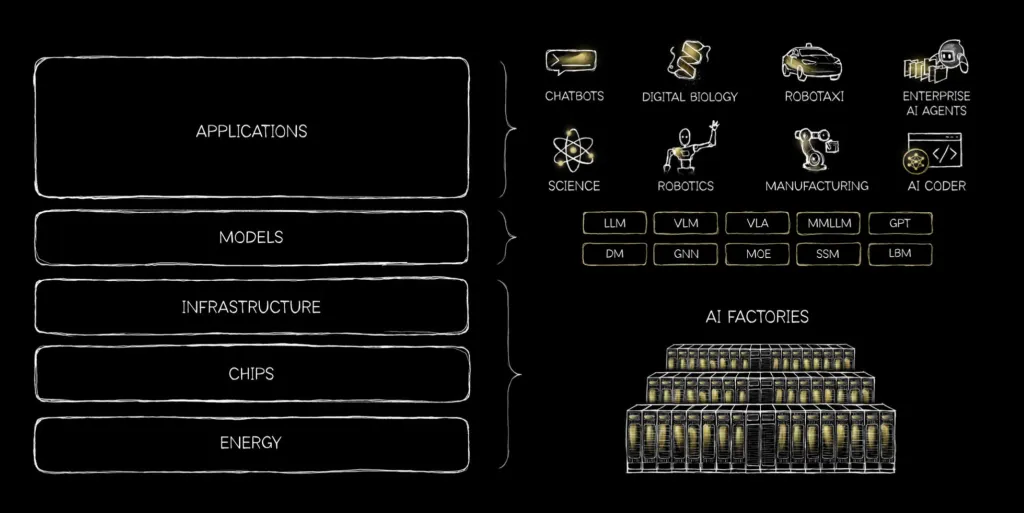
The "five-layer cake" concept of AI architecture. Source: Nvidia blog
According to Huang, the AI industry has evolved beyond experimentation into full-scale industrial production, demanding trillions in investment and a massive workforce. The fundamental difference between neural networks and traditional software lies in how they process information. Conventional programs search for and execute pre-written instructions, while neural networks generate responses in real time by "reasoning" based on context.
This is precisely why legacy data centers cannot adequately support AI workloads, Huang argued. The technology requires purpose-built infrastructure constructed from the ground up, starting with the energy layer.
"Intelligence generated in real time requires energy produced in real time. Energy is the first principle of AI infrastructure and the limiter of how much intelligence a system can produce," he explained.
This paradigm extends well beyond Nvidia's own supply chain. If energy becomes the critical resource, any disruption in its generation — such as a Middle East conflict — directly impedes the scaling of AI technologies.
Huang acknowledged that building specialized AI infrastructure is still in its early stages. Hundreds of billions of dollars have already been invested, but trillions more lie ahead. Purpose-built "AI factories" are being constructed worldwide at an unprecedented pace.
The Nvidia chief also addressed open-source models. He cited DeepSeek-R1 as an example of how accessible powerful neural networks accelerate adoption and increase demand for training, infrastructure, chips, and energy. Open source, in his assessment, is not a threat to Nvidia's business — it's fuel for it.
NemoClaw: An Open Platform for AI Agents
Beyond public messaging, Nvidia is working on a tangible product. According to WIRED, the company is in discussions with Salesforce, Cisco, Google, and Adobe to launch an open platform for AI agents under the working name NemoClaw. The platform would enable businesses to integrate autonomous assistants into their workflows, with access not tied to Nvidia hardware.
As of publication, no formal agreements had been signed, and Nvidia did not respond to requests for comment.
Nvidia's push into AI agents coincides with surging interest in open-source AI tools that run locally on devices and perform tasks with minimal human involvement. A notable example is the OpenClaw project (also known as Clawdbot and Moltbot), which sparked a wave of enthusiasm in China in March.
At the end of 2025, Nvidia doubled its net profit on the back of record demand for AI chips. Now Huang is making the case that the industry's explosive growth is only beginning — and that it will benefit not just tech giants but skilled tradespeople around the globe.
Frequently Asked Questions
What did Jensen Huang say about AI replacing jobs?
Nvidia's CEO argued that AI will create numerous skilled trade jobs for electricians, welders, and construction workers rather than destroy employment. He emphasized that a computer science degree is not required to participate in the AI transformation.
What is Nvidia's five-layer cake AI architecture?
It's Jensen Huang's framework describing five levels of AI infrastructure: energy at the base, followed by chips, physical infrastructure, models, and applications. Energy is identified as the primary constraint on scaling AI capabilities.
What is NemoClaw by Nvidia?
NemoClaw is the working name for an open AI agent platform Nvidia is reportedly developing with Salesforce, Cisco, Google, and Adobe. The platform would let businesses integrate autonomous assistants without being locked into Nvidia hardware.
How does Nvidia view open-source AI models like DeepSeek-R1?
Jensen Huang described open-source models as fuel for Nvidia's business, not a threat. He argued that accessible powerful neural networks accelerate adoption and increase demand for training, chips, infrastructure, and energy.
How much investment does AI infrastructure require according to Nvidia?
Huang stated that hundreds of billions of dollars have already been invested in AI infrastructure, but trillions more are needed. Specialized 'AI factories' are being built worldwide at an unprecedented pace.
Read also
OpenAI Secures Record $110 Billion Round at $730 Billion Valuation
OpenAI closed the largest startup funding round in history at $110 billion, backed by Amazon, SoftBank, and Nvidia, with a $730 billion valuation.
DeepSeek Launches V4-Pro: Open-Source Model Outperforms Claude Opus 4.6 and GPT-5.4
Chinese AI startup DeepSeek released a preview of its V4 model family, with the flagship V4-Pro boasting 1.6 trillion parameters and surpassing leading closed-source models in multiple benchmarks.
Oracle Lays Off Thousands as AI Infrastructure Spending Reshapes Tech Workforce
Oracle has begun mass layoffs affecting thousands of employees worldwide as the company redirects resources toward AI infrastructure. Meanwhile, Block CEO Jack Dorsey envisions AI replacing middle management entirely.
AI Audit Uncovers Critical Liveness Bug in Ethereum's Nethermind Client
Octane Security's AI discovered a high-severity vulnerability in the Nethermind execution client that could have halted block production for 38% of Ethereum mainnet validators. The Ethereum Foundation awarded a maximum $50,000 bounty.
How ERC-8004 and x402 Standards Are Turning AI Agents Into Market Participants
Blockchain standards ERC-8004 and x402 are building the infrastructure for autonomous machine payments, challenging Big Tech's closed ecosystems and the attention economy model.
AI Agent Transaction Volume Is 15x Lower Than Bloomberg's Estimates, Says a16z Partner
a16z partner Noah Levine challenged Bloomberg's AI agent payment data, showing actual on-chain volume at $1.6–3M versus the reported $24M.