New Yorker Investigation: Sam Altman Systematically Misled OpenAI's Board of Directors
 AnthropicSTARTUP
A year-and-a-half-long New Yorker investigation found that Sam Altman repeatedly lied to OpenAI's board of directors and abandoned the company's original mission.
18-Month Investigation Uncovers Pattern of Deception at OpenAI
New Yorker investigative journalist Ronan Farrow and staff writer Andrew Marantz have completed an extensive 18-month probe into Sam Altman's leadership at OpenAI. Their conclusion: the CEO repeatedly lied to the company's board of directors. The investigation drew on previously unpublished internal memos, over 200 pages of documents, and interviews with more than 100 individuals.
The central question driving the investigation was why Altman was ousted by OpenAI's board members in November 2023.
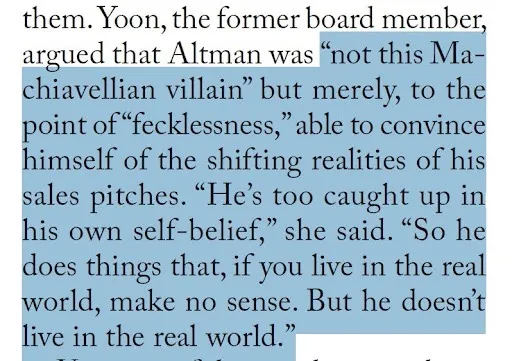
As Farrow framed it, OpenAI was founded on the premise that artificial intelligence could become the most dangerous invention in human history, making it essential for the CEO to be a person of extraordinary honesty. The board concluded that Altman lacked these qualities — and the investigation examines whether they were right not to trust him.
Why This Matters
OpenAI is one of the most influential AI companies in the world, with products used by hundreds of millions of people. Questions about the integrity of leadership at an organization developing potentially transformative technology go to the heart of AI safety and corporate governance. The findings cast doubt on OpenAI's commitment to the responsible development principles it has publicly championed.
Internal Documents Paint a Damning Picture
According to the investigation, in the fall of 2023, OpenAI's chief scientist Ilya Sutskever compiled approximately 70 pages of internal memos concerning Altman and his deputy Greg Brockman. One memo opens with the statement that Sam demonstrates a "consistent pattern of lying."
Dario Amodei, who had left the company, kept his own personal notes. In one document, he characterized Altman's statements as "bullshit." Those who facilitated Altman's removal accused him of deception.
The documents also noted a recurring behavior: Altman would create structures that on paper were meant to constrain his authority in the future, only to dismantle those mechanisms when the time came.
Specific Instances of Misleading the Board
The investigation details several concrete episodes. In late 2022, Altman assured the board that features of an upcoming AI model had been approved by the safety committee. Board member Helen Toner requested supporting documentation and discovered that the most contentious decisions had, in fact, not been approved.
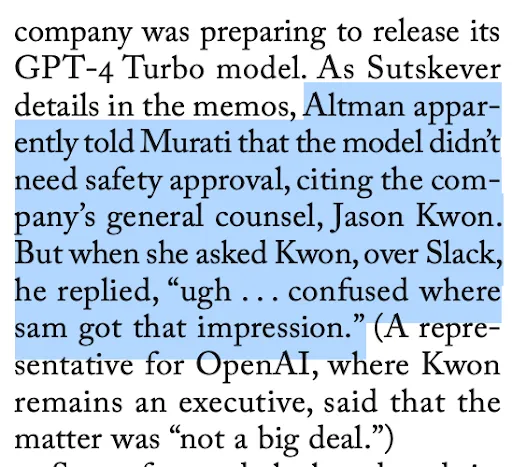
Another incident occurred in 2023 during preparations for the GPT-4 Turbo launch. Altman told CTO Mira Murati that the model did not require sign-off from the safety team, citing chief legal officer Jason Kwon as the source. However, Kwon said he had no idea where Altman got that notion.
The Nonprofit Question and the Safety Retreat
The investigation also addresses OpenAI's nonprofit status. The company accepted charitable donations, and some employees joined specifically because of its stated mission, accepting lower salaries as a result. Yet internal documents show that as early as 2017, the founders harbored doubts about the nonprofit structure. Brockman wrote in his diary that he could not say they were committed to the nonprofit model, adding that if they became a B-Corp within three months, it would mean they had been lying.
In October 2025, OpenAI completed a restructuring that split the organization into a for-profit corporation and a nonprofit foundation.
The article also reveals that OpenAI's leadership explored profiting by playing world powers — including China and Russia — against each other. The plan was dropped after several employees threatened to resign.
Former OpenAI researchers told the New Yorker that the company had abandoned its original safety-first mission and accelerated an industry-wide "race to the bottom." The piece documents numerous public and internal safety commitments that were ultimately discarded, with several dedicated safety teams disbanded. In May 2025, OpenAI disregarded expert testers' concerns during a ChatGPT update, making the model excessively "sycophantic."
Frequently Asked Questions
What did the New Yorker investigation reveal about Sam Altman?
The 18-month investigation by Ronan Farrow and Andrew Marantz found that Altman systematically lied to OpenAI's board of directors. Journalists reviewed over 200 pages of documents and conducted more than 100 interviews.
Why was Sam Altman fired from OpenAI in 2023?
Board members concluded that Altman lacked the integrity required to lead a company developing potentially dangerous technology. Internal memos documented his 'consistent pattern of lying.'
What specific lies did Sam Altman tell at OpenAI?
In late 2022, Altman falsely told the board that safety committees had approved features of an upcoming AI model. In 2023, he incorrectly told the CTO that GPT-4 Turbo didn't need safety team approval, misattributing the claim to the chief legal officer.
When did OpenAI stop being a nonprofit?
OpenAI completed its restructuring in October 2025, splitting into a for-profit corporation and a nonprofit foundation. Internal documents show the founders had doubts about the nonprofit model as early as 2017.
What did Ilya Sutskever document about Altman?
In fall 2023, OpenAI's chief scientist Ilya Sutskever compiled approximately 70 pages of internal memos about Altman. One memo explicitly cited a 'consistent pattern of lying' on the CEO's part.
Read also
Elon Musk Delivers First Testimony in OpenAI Lawsuit Against Altman and Brockman
The trial over Elon Musk's lawsuit against OpenAI began in Oakland federal court. Musk claims the company's shift from nonprofit to for-profit betrayed its founding mission.
OpenAI Secures Record $110 Billion Round at $730 Billion Valuation
OpenAI closed the largest startup funding round in history at $110 billion, backed by Amazon, SoftBank, and Nvidia, with a $730 billion valuation.
DeepSeek Launches V4-Pro: Open-Source Model Outperforms Claude Opus 4.6 and GPT-5.4
Chinese AI startup DeepSeek released a preview of its V4 model family, with the flagship V4-Pro boasting 1.6 trillion parameters and surpassing leading closed-source models in multiple benchmarks.
AI Audit Uncovers Critical Liveness Bug in Ethereum's Nethermind Client
Octane Security's AI discovered a high-severity vulnerability in the Nethermind execution client that could have halted block production for 38% of Ethereum mainnet validators. The Ethereum Foundation awarded a maximum $50,000 bounty.
Anthropic Weakens AI Safety Commitments Amid Pentagon Ultimatum Over Military Use
Anthropic dropped its core AI safety pledge as the Pentagon set a Feb 27 deadline for unrestricted Claude access. What this means for the industry.
Weekly Recap: Bitcoin Tests $78,000, Russia Introduces Criminal Penalties for Illegal Crypto Exchange
Bitcoin surged to $78,000 amid geopolitical developments, hackers drained hundreds of millions from Hyperbridge and Kelp, while Russia approved criminal liability for unlicensed crypto exchange operations.