
Bitcoin Sees Month-Long Exchange Outflows as Investors Shift to Accumulation Mode
 BinanceEXCHANGE
BTC net outflows from exchanges have dominated for nearly a month, signaling genuine accumulation. However, CryptoQuant analysts warn that short-term bounces could be "bull traps" due to insufficient liquidity.
Bitcoin Outflows Dominate Exchanges for Nearly a Month
Throughout March, Bitcoin withdrawals from cryptocurrency exchanges have significantly outpaced deposits. Analyst Darkfost highlighted that Netflow has remained negative for almost an entire month — even as the market continues through what he described as a "liquidation phase."
"📊 It has been one month that BTC outflows from exchanges have largely dominated flows. While BTC continues its liquidation phase, Netflow has remained negative for almost an entire month. This persistent outflow suggests genuine accumulation by investors, who continue to buy…" — Darkfost (@Darkfost_Coc), original post
The only exception was a brief spike in exchange deposits shortly before March 17, when the BTC price hit a six-week high of $76,000. According to Darkfost, the persistent withdrawal of coins from platforms indicates real accumulation — investors are buying Bitcoin and moving it to their own wallets.
Exchange inflows are traditionally viewed as a bearish signal, suggesting preparation to sell for stablecoins. Outflows, conversely, often signal potential buying pressure. Darkfost noted, however, that current demand remains insufficient to trigger a full-blown rally, though this dynamic is a key factor shaping the price range BTC has traded in for recent months.
Why This Matters
Prolonged Bitcoin outflows from centralized exchanges represent one of the most closely watched on-chain indicators for gauging market sentiment shifts. When coins move to cold storage, the available supply for selling shrinks — a setup that could fuel upward price pressure if demand increases.
Nick Ruck, Director at LVRG Research, confirmed that the capital outflow points to long-term investor intent rather than speculative interest. The migration away from centralized platforms reflects confidence in Bitcoin's fundamentals — holders are not looking to sell for risk hedging purposes.
Jeff Mei, COO of BTSE exchange, pointed out that since the recent escalation in geopolitical tensions, cryptocurrencies have outperformed both equities and gold. Mei noted the market had been oversold in prior weeks and months, which cushioned it from falling as sharply as stocks. He suggested this could signal Bitcoin's emergence as a hedge against traditional equities and growing institutional ownership.
In a separate report, Glassnode analysts noted a slight decline in unrealized losses across the broader market. They cautioned, however, that investor sentiment remains under pressure despite what they called "tentative signs of stabilization."
Bull Trap Warnings and Liquidity Concerns
CryptoQuant analyst Mignolet warned that current market conditions resemble the situation seen in the $80,000–$90,000 range, and that any short-term rally could prove deceptive.
"Various data points suggest that the conditions for a potential bottom are forming. However, the level of liquidity required to actually drive a trend reversal still appears insufficient." — Mignolet via CryptoQuant (@cryptoquant_com), original post
According to Mignolet, the supply-demand imbalance that emerged in mid-March has only deepened, and negative market momentum has accelerated. The current situation differs from previous correction phases, when tension eased gradually. The market is now repeating the pattern observed at the $80,000–$90,000 price level. While on-chain indicators point to potential bottom formation, available liquidity falls short of what's needed for a genuine trend reversal. Mignolet acknowledged the possibility of short-term price bounces that may restore optimism — but warned these moves would most likely turn out to be "bull traps."
Geopolitics and Current BTC Price
Bitcoin recovered above $71,000, gaining 0.6% over 24 hours. Markets were responding to reports of a "15-point peace plan" for resolving the Middle East conflict. Details of the document were not disclosed, though it reportedly includes a section prohibiting Iran from developing nuclear weapons.
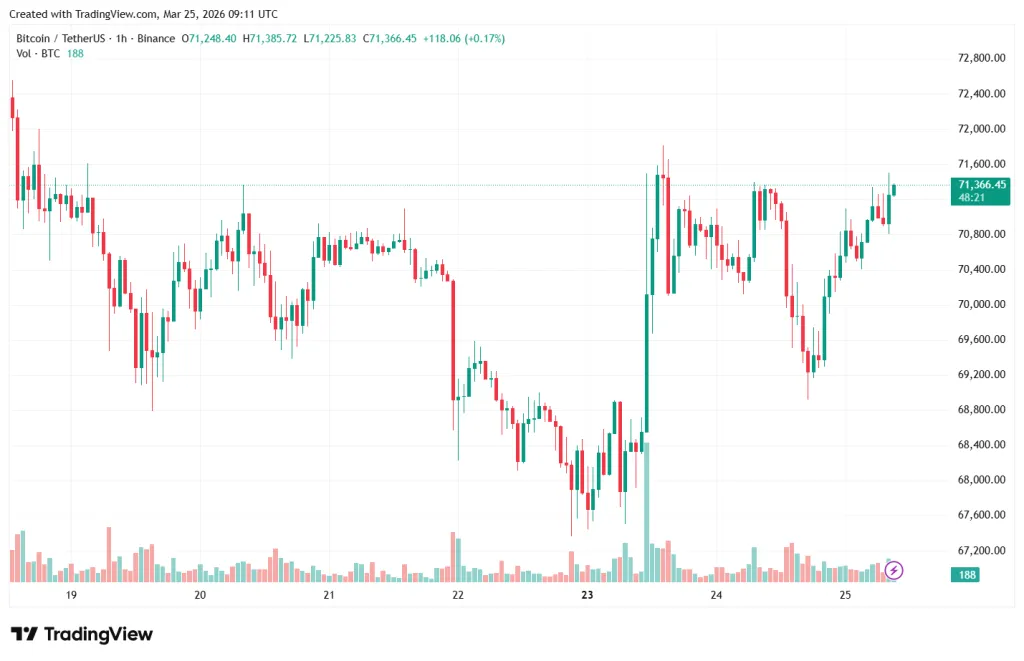
On a weekly basis, Bitcoin still shows a 3.5% decline, but has held above the $70,000 level for a third consecutive day. Alex Kuptsikevich, Senior Analyst at FxPro, noted stabilizing sentiment in a CoinDesk comment — while the leading cryptocurrency hasn't shifted to sharp growth, its ability to hold current elevated levels indicates buyer confidence.
In commodity markets, Brent crude fell 5.24% to $94.98, dropping below $100 for the first time since mid-March.
Frequently Asked Questions
Why is Bitcoin leaving exchanges?
Investors are withdrawing BTC from centralized platforms to personal wallets, signaling a long-term accumulation strategy. This outflow pattern has persisted for nearly a month, even during the ongoing market liquidation phase.
What is a bull trap in crypto?
A bull trap is a short-term price bounce that creates an illusion of an uptrend beginning, only to reverse back into decline. CryptoQuant analyst Mignolet warned that current BTC bounces likely represent bull traps due to insufficient market liquidity for a genuine trend reversal.
What is Bitcoin's price in March 2026?
Bitcoin recovered above $71,000, gaining 0.6% in 24 hours. On a weekly basis it still shows a 3.5% decline, but has held above the $70,000 level for three consecutive days.
Is Bitcoin becoming a hedge against stocks?
BTSE COO Jeff Mei noted that cryptocurrencies outperformed equities and gold during recent geopolitical tensions. He attributed this to the crypto market being oversold in prior weeks and suggested it may signal Bitcoin's emergence as a hedge against traditional stocks alongside growing institutional ownership.
What does negative Bitcoin Netflow mean?
Negative Netflow means more BTC is being withdrawn from exchanges than deposited. This is generally considered a bullish indicator as it reduces available selling supply and suggests investors are moving to accumulation rather than preparing to sell.
Read also
Bernstein Calls $60,000 a 'Clear Bottom' for Bitcoin, Expects Extended Bull Cycle
Analysts at Bernstein have identified $60,000 as a firm floor for Bitcoin, projecting a structurally longer bull cycle. On-chain data from Glassnode confirms a resurgence of buying activity.
Bitcoin Down 2.5% Weekly: Jane Street Accusations & 7 Ethereum Forks
Bitcoin lost ~2.5% over the week amid macro shocks and geopolitical tensions. Jane Street faced market manipulation allegations while Ethereum unveiled an ambitious seven hard fork roadmap through 2029.
TON Wallet Introduces Yield Vaults for BTC, ETH, and USDT Directly in Telegram
TON Wallet has launched yield vaults for BTC, ETH, and USDT directly within Telegram, offering up to 18% APY on stablecoins through partnerships with Morpho, TAC, and Re7.
Weekly Recap: Aave Ecosystem Rescue Mobilizes 100,000 ETH and Quantum Computer Cracks 15-Bit ECC Key
Bitcoin held near $78,000, the DeFi community rallied over 100,000 ETH to help Aave recover from the Kelp hack, and a researcher cracked a 15-bit ECC key on a quantum computer.
Strategy Becomes Most-Shorted US Stock With $6B in Bets
Strategy tops the list of most-shorted large-cap US stocks with $6 billion in short positions, representing 14% of its market cap, as Bitcoin's decline erodes confidence in the company's debt-fueled BTC accumulation model.
Institutional Investors Dump ETF Shares Worth 25,000 BTC During Market Crash
Institutional investors massively sold Bitcoin ETF positions in Q4 2025, offloading shares equivalent to 25,098 BTC during the crypto market correction.