
Litecoin Undergoes 13-Block Reorg After Zero-Day Vulnerability Exploit
 BinanceEXCHANGE
Attackers exploited a zero-day vulnerability on April 25 to launch a DoS attack on Litecoin mining pools, enabling invalid MWEB transactions that required a 13-block chain reorganization to reverse.
What Happened on the Litecoin Network
The Litecoin network experienced a significant security incident on April 25 when attackers exploited a zero-day vulnerability, triggering a deep blockchain reorganization. The attack began with a denial-of-service assault that knocked major mining pools offline, then leveraged nodes running outdated software to validate fraudulent transactions.
The Litecoin team addressed the situation publicly:
«Litecoin update: • A zero-day bug caused a DoS attack that disrupted major mining pools. • Non-updated mining nodes allowed an invalid MWEB transaction allowing them to peg out coins to third party DEX's • A 13-block reorg reversed those invalid transactions — they will not…» — Litecoin (@litecoin), original post
Why This Matters
A 13-block reorganization is an exceptionally rare event for a major proof-of-work blockchain. This incident raises questions about the resilience of the network against coordinated attacks and the security of the MimbleWimble Extension Block (MWEB) privacy feature. The fact that attackers were able to execute double-spend attacks against multiple cross-chain protocols during the reorg window highlights the cascading risks that blockchain reorganizations pose to the broader DeFi ecosystem.
Attack Breakdown and Developer Response
According to the incident report, the attack unfolded in stages. First, the attackers launched a DoS attack that disrupted major mining pools. With those pools hampered, nodes that had not been updated to the latest software version began confirming invalid MWEB-layer transactions. This allowed the attackers to interact with illegitimate coins and send them to third-party decentralized exchanges.
To counter the exploit, developers executed a 13-block reorganization that reversed all invalid transactions and removed them from the canonical chain. Litecoin representatives stated that all legitimate transactions during the affected period were preserved, the bug has been fully patched, and the network is operating normally.
Alex Shevchenko Calls It a "Coordinated Attack"
Aurora Labs CEO Alex Shevchenko described the incident as a "coordinated attack." According to his analysis, the reorganization affected blocks #3,095,930 through #3,095,943 and took over three hours to resolve. During that window, the attackers carried out double-spend attacks against several cross-chain protocols.
Litecoin representatives confirmed: «All valid operations during this period remained unchanged. The bug has been fully fixed, and the network continues to operate normally.»
Minimal Impact on LTC Price
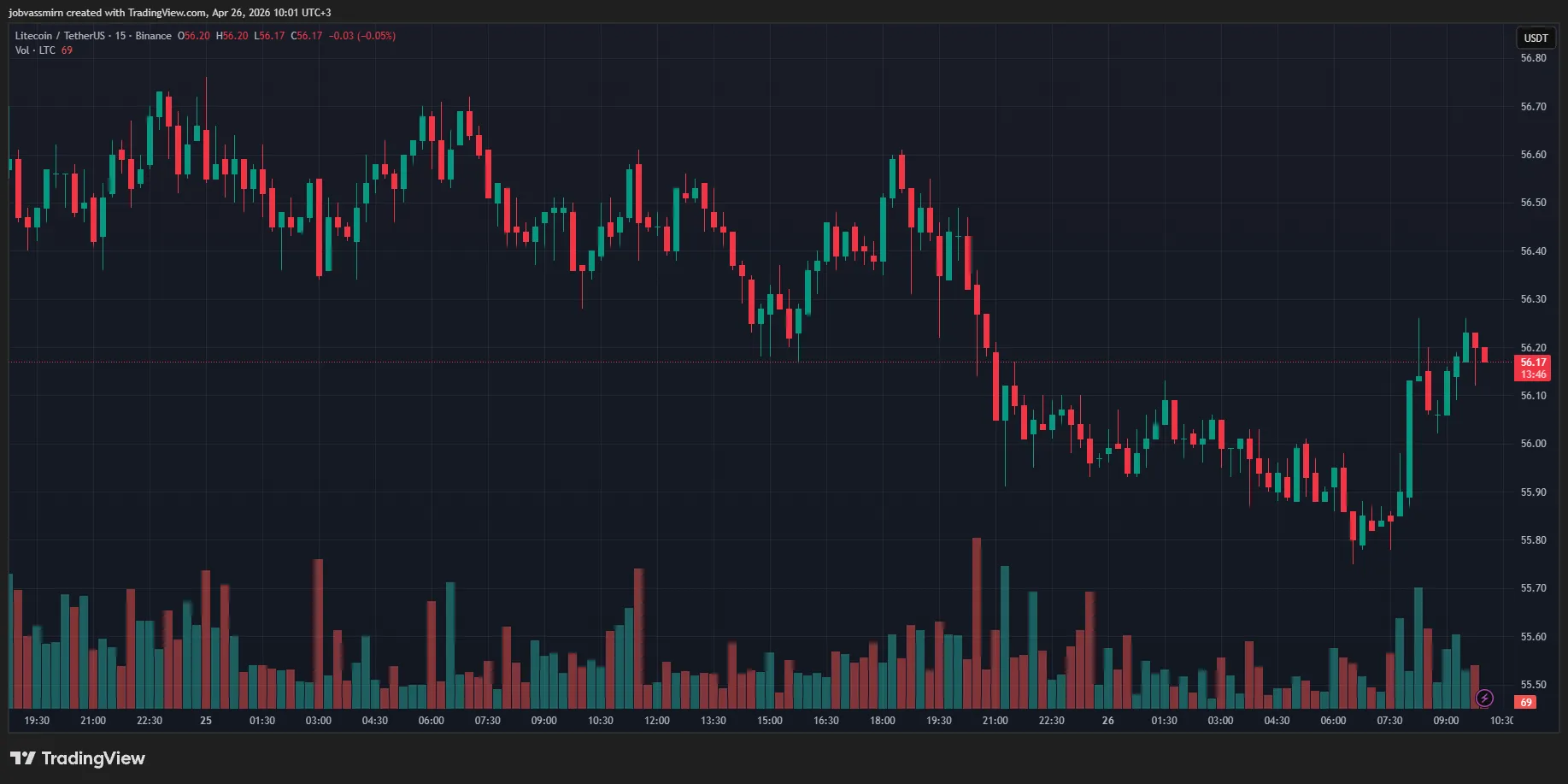
Despite the severity of the incident, market reaction was muted. At the time of reporting, LTC was trading around $56, down just 0.5% over 24 hours.
For context, a similar event occurred in September 2025 when Monero experienced its largest blockchain reorganization in 12 years — an 18-block rollback that invalidated 117 transactions.
Frequently Asked Questions
What happened to Litecoin on April 25 2026?
Attackers exploited a zero-day vulnerability to launch a DoS attack on major Litecoin mining pools. They then used non-updated nodes to push invalid MWEB transactions, prompting developers to execute a 13-block reorganization to reverse the fraudulent activity.
How many blocks were reorganized in the Litecoin reorg?
The reorganization affected 13 blocks, from block #3,095,930 to #3,095,943. According to Aurora Labs CEO Alex Shevchenko, the entire process took over three hours to complete.
Did the Litecoin reorg affect LTC price?
The market impact was minimal. LTC was trading around $56 at the time of the report, down only 0.5% over 24 hours despite the severity of the incident.
What is MWEB in Litecoin?
MWEB stands for MimbleWimble Extension Block, a privacy feature in the Litecoin network. The zero-day vulnerability exploited by attackers was at the MWEB transaction layer, allowing them to create invalid transactions and send illegitimate coins to DEXs.
Were legitimate Litecoin transactions lost during the reorg?
According to Litecoin representatives, all valid transactions during the affected period were preserved. Only the invalid transactions created by the attackers were reversed and excluded from the new chain.
Read also
Bitcoin Miner Position Index Hits Record Low Amid Rare Blockchain Reorganization
The Bitcoin Miner Position Index (MPI) has dropped to -1.04, its third-lowest reading ever, while the network experienced an unusual two-block reorganization involving Foundry USA, AntPool, and ViaBTC.
Weekly Recap: Bitcoin Tests $76K, SEC Greenlights Tokenized Stocks on Nasdaq
Bitcoin briefly touched $76,000 before retreating to $68,800. The SEC approved tokenized stock trading on Nasdaq, while mining difficulty dropped 7.76% amid growing miner losses.
Weekly Recap: Bitcoin Tests $74K, Miners Dump Holdings, ChatGPT Boycott Grows
Bitcoin briefly touched $74,000 before retreating to $67,500. Public miners sold over 15,000 BTC in five months, traders flocked to Hyperliquid for oil and gold futures, and a ChatGPT boycott gained major traction.
Litecoin Leads All Proof-of-Work Networks in Active Address Usage
Litecoin blockchain achieved the highest percentage of daily active addresses among Proof-of-Work networks, surpassing Bitcoin in network utilization metrics.
Bitdeer Launches SEALMINER DL1 Air ASIC Miner for Litecoin and Dogecoin
Bitdeer has unveiled the SEALMINER DL1 Air, a Scrypt-algorithm ASIC miner delivering 25 GH/s hashrate with air cooling, designed for industrial-scale LTC and DOGE mining.
Tether Proposes Merging XXI, Strike and Elektron Into Major Bitcoin Conglomerate
Tether Investments has proposed a three-way merger of Twenty-One Capital, Strike, and Elektron Energy to build a leading public bitcoin company combining treasury reserves, mining operations, and financial services.