Bitcoin Miner Position Index Hits Record Low Amid Rare Blockchain Reorganization
The Bitcoin Miner Position Index (MPI) has dropped to -1.04, its third-lowest reading ever, while the network experienced an unusual two-block reorganization involving Foundry USA, AntPool, and ViaBTC.
Miners pull back from selling as MPI nears all-time low
The Bitcoin Miner Position Index (MPI) has plunged to -1.04 — the third-lowest reading in the metric's entire history. CryptoQuant analyst Ignacio Moreno de Vicente flagged the development, calling it a bullish signal for the market.
«Extreme Miner Inactivity: A Hidden Strength or Silent Warning? Historically, the signal becomes more actionable when MPI begins to rise from these lows, indicating re-engagement alongside improving market conditions.» — CryptoQuant.com (@cryptoquant_com), original post
An MPI reading this low indicates that miners are sending far fewer coins to exchanges relative to their annual average. Sell-side pressure from this cohort is structurally subdued.
Why it matters
According to Moreno de Vicente, an extremely low MPI signals a contraction in supply from some of the most consistent natural sellers in the Bitcoin market. In past cycles, comparable readings appeared during miner stress periods or post-capitulation phases — often against a backdrop of macroeconomic uncertainty and shrinking profit margins.
However, the analyst cautions that reduced selling pressure alone does not reliably mark an absolute price bottom. MPI captures relative seller behavior but does not reveal who is absorbing the supply. Without clear demand expansion — via spot inflows, ETF inflows, or derivatives positioning — a low MPI on its own cannot sustain an upward price move.
The signal becomes more actionable when MPI starts climbing from its lows, suggesting miners are re-engaging as market conditions improve.
At the time of writing, BTC was trading near $71,000, up 3.9% over the preceding 24 hours.
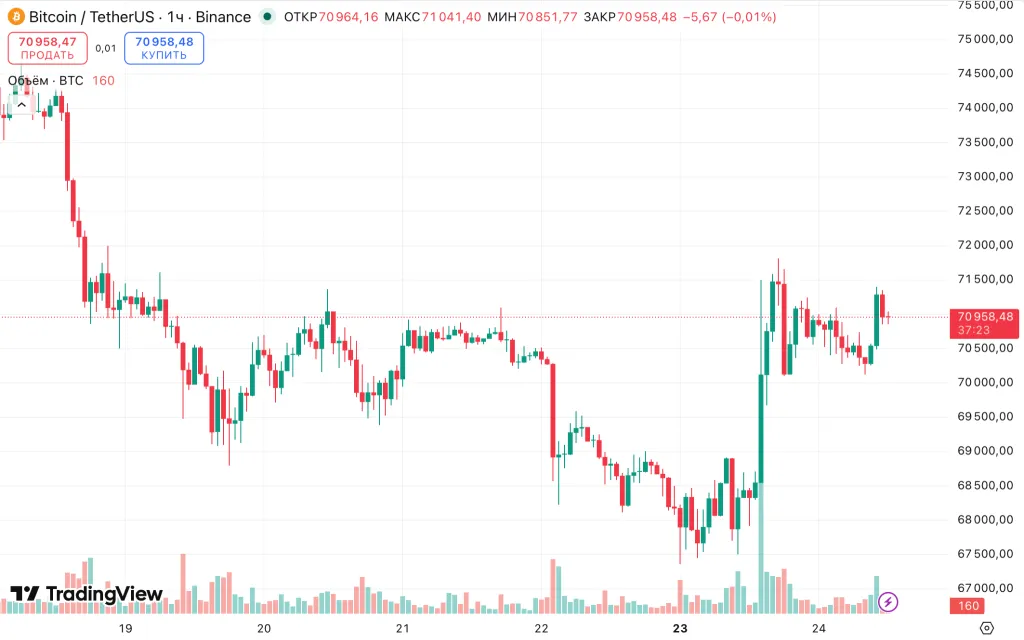
Hourly BTC/USDT chart on Binance. Source: TradingView
Rare two-block reorganization hits the Bitcoin network
Alongside the MPI drop, the Bitcoin blockchain experienced an uncommon event — a two-block reorganization. The incident centered on Foundry USA, currently the largest mining pool.
«We just had a rare-ish two block fork/reorg between Foundry and AntPool+ViaBTC. Foundry mined six blocks in a row.» — b10c (@0xB10C), original post
On March 23, Foundry and AntPool discovered valid blocks at height 941,881 just 12 seconds apart (15:49:35 and 15:49:47 UTC). The chain temporarily split, with some nodes accepting one block and some the other.
At the next height, ViaBTC extended AntPool's branch while Foundry continued building on its own. This created two competing chains, each two blocks deep. Foundry then secured heights 941,883 and 941,886, giving its version a decisive proof-of-work advantage. The blocks produced by AntPool and ViaBTC were orphaned — dropped from the canonical chain — and those miners forfeited the associated block rewards.
Transactions from the orphaned blocks returned to the mempool and were subsequently included in later blocks. Network security was not compromised; Bitcoin operated as designed, selecting the longest chain and restoring consensus within minutes.
Hashrate concentration amplifies reorganization risk
The reorg episode underscored the risks tied to mining centralization. As fewer pools control a greater share of the hashrate, the probability that a single pool mines several consecutive blocks increases — and with it, the chance of competing forks when large players find blocks simultaneously.
Mining economics are compounding the problem. On March 21, mining difficulty fell 7.76% — the second-largest negative adjustment of 2026. The network hashrate retreated from a record 1 ZH/s to roughly 920 EH/s. With BTC priced around $70,000 and estimated production cost at $88,000, mining has turned unprofitable for many participants. Smaller and mid-sized operators are exiting, further concentrating the remaining hashrate among fewer large pools.
For context, on March 9 the volume of yet-to-be-mined Bitcoin reached the 1 million BTC mark. The remaining coins will not be fully mined until approximately 2140.
Frequently Asked Questions
What is the Bitcoin Miner Position Index (MPI)?
MPI is a metric that tracks the volume of coins miners send to exchanges compared to their yearly average. A deeply negative MPI indicates miners are selling significantly less than usual, reducing supply-side pressure on Bitcoin's price.
Why did Bitcoin's MPI drop to a record low in March 2026?
The MPI fell to -1.04 as miners drastically reduced their exchange outflows. The pullback coincides with challenging mining economics — with BTC near $70,000 and estimated production costs at $88,000, many miners are operating at a loss and opting to hold rather than sell.
What happened during the Bitcoin blockchain reorg on March 23?
Foundry USA and AntPool found valid blocks at height 941,881 within 12 seconds of each other, causing a temporary chain split. Foundry subsequently mined more blocks, making its branch the canonical chain. AntPool and ViaBTC's competing blocks were orphaned.
Is a two-block Bitcoin reorg a security threat?
A two-block reorganization does not compromise Bitcoin's security. The network functioned as designed, selecting the chain with the most accumulated proof-of-work and restoring consensus within minutes. Transactions from orphaned blocks returned to the mempool for reprocessing.
What is the current Bitcoin mining cost in 2026?
The estimated cost to mine one Bitcoin is approximately $88,000 as of late March 2026. With BTC trading around $70,000, mining is unprofitable for many operators. This has driven smaller miners out, contributing to a 7.76% difficulty drop and hashrate decline from 1 ZH/s to roughly 920 EH/s.
Read also
Bitcoin Down 2.5% Weekly: Jane Street Accusations & 7 Ethereum Forks
Bitcoin lost ~2.5% over the week amid macro shocks and geopolitical tensions. Jane Street faced market manipulation allegations while Ethereum unveiled an ambitious seven hard fork roadmap through 2029.
TON Wallet Introduces Yield Vaults for BTC, ETH, and USDT Directly in Telegram
TON Wallet has launched yield vaults for BTC, ETH, and USDT directly within Telegram, offering up to 18% APY on stablecoins through partnerships with Morpho, TAC, and Re7.
Weekly Recap: Aave Ecosystem Rescue Mobilizes 100,000 ETH and Quantum Computer Cracks 15-Bit ECC Key
Bitcoin held near $78,000, the DeFi community rallied over 100,000 ETH to help Aave recover from the Kelp hack, and a researcher cracked a 15-bit ECC key on a quantum computer.
Strategy Becomes Most-Shorted US Stock With $6B in Bets
Strategy tops the list of most-shorted large-cap US stocks with $6 billion in short positions, representing 14% of its market cap, as Bitcoin's decline erodes confidence in the company's debt-fueled BTC accumulation model.
Institutional Investors Dump ETF Shares Worth 25,000 BTC During Market Crash
Institutional investors massively sold Bitcoin ETF positions in Q4 2025, offloading shares equivalent to 25,098 BTC during the crypto market correction.
Bitcoin Hits $70,000 as Iran Ceasefire Talks Boost Risk Appetite
Bitcoin surged 4% to test the $70,000 level on April 6 amid reports of ceasefire negotiations between the US, Israel, and Iran. The derivatives market, however, sends mixed signals.